.svg&w=384&q=75 "GoalGist logo")
Morocco Dominates Canada 3-0 in World Cup Knockout Clash
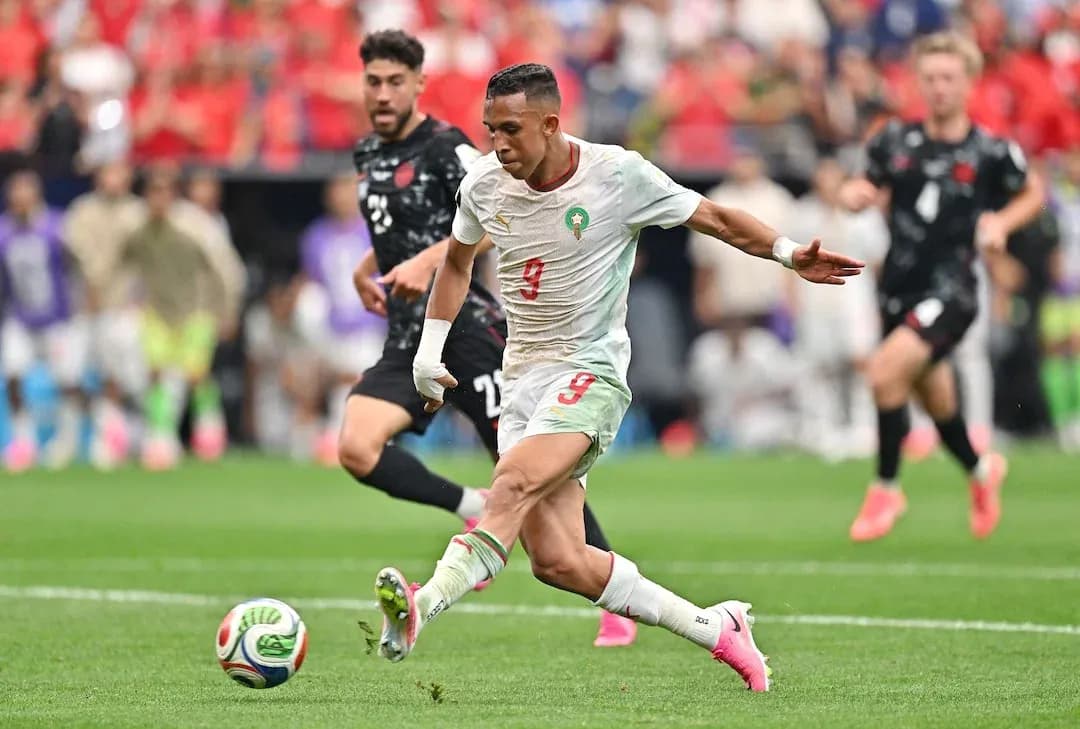
Under the closed roof of NRG Stadium in Houston, a Round of 16 tie that promised balance became a ruthless demonstration of Moroccan control. By full time, the scoreboard read Canada 0–3 Morocco, a line that distilled the wider story of this World Cup campaign: Morocco’s defensive steel and structured attacking patterns overwhelming a Canadian side still learning the nuances of knockout football.
Coming into the knockouts, both teams had travelled different paths through the group stage. Canada, ranked 2nd in Group B with 4 points and a goal difference of 5 after three matches, had built a surprisingly expansive identity. Overall this campaign they had scored 9 goals and conceded 6 across 5 fixtures, with an attacking profile at home of 2.3 goals for and 1.3 against on average. Morocco, also 2nd in their group with 7 points and a goal difference of 3, arrived in Houston as a side that knew how to manage tournaments: 11 goals for and only 4 against overall, conceding just 0.8 goals per game while scoring 2.2.
The team sheets underlined those identities. Jesse Marsch stayed loyal to his 4-4-2 that has featured in all 5 of Canada’s World Cup fixtures, with M. Crepeau behind a back four of A. Johnston, M. Bombito, L. De Fougerolles and R. Laryea. The midfield band of four – T. Buchanan, N. Sigur, S. Eustaquio and A. Ahmed – was tasked with feeding a front two of J. David and T. Oluwaseyi.
Across from them, Mohamed Ouahbi’s Morocco lined up in their now-familiar 4-2-3-1, a shape they have used in all 5 matches. Bono anchored a back line of A. Hakimi, I. Diop, R. Halhal and N. Mazraoui. The double pivot of A. Bouaddi and N. El Aynaoui provided the platform for a high-technical line of three – B. Diaz, A. Ounahi and B. El Khannouss – operating behind lone forward I. Saibari.
If there was an early tactical void for Canada, it lay in the absence of I. Koné, ruled out with a lower-leg fracture. His ability to carry the ball through pressure would have been invaluable against Morocco’s compact midfield. Without him, the creative burden fell even more heavily on Eustaquio and the wide players, with N. Saliba – one of the tournament’s more efficient Canadian creators with 2 assists and 1 goal in just 182 minutes – starting on the bench as a potential second-phase solution rather than an initial one.
Disciplinary trends hinted at where the contest might fray. Canada’s campaign yellow-card distribution showed a steady aggression across the first hour: 18.18% of their cautions arriving in the opening 15 minutes, then 27.27% between 31–45 and another 27.27% from 46–60. This is a side that tackles on the front foot, and figures like L. De Fougerolles and C. Larin embody that edge. De Fougerolles, already with 2 yellows overall, is a proactive defender who has committed 8 fouls and drawn 8; Larin, with 2 yellows as well, brings physicality in the press. Morocco, by contrast, tend to cluster their yellows between 16–60 minutes, with 33.33% of their cautions in each of the 16–30, 31–45 and 46–60 windows, reflecting a team that tightens the screw once the rhythm of the game is set rather than flying into early chaos.
In the “Hunter vs Shield” duel, the numbers framed a compelling pre-match clash. Canada’s attack had been productive: overall 1.8 goals per game, with J. David at the sharp end. David arrived in this tie with 3 goals, 12 shots and 8 on target, plus a willingness to work without the ball – 4 tackles, 1 blocked shot and 3 interceptions. Across the halfway line stood Morocco’s defensive unit that had conceded only 4 goals overall, with I. Diop emblematic of their resilience. Diop had already blocked 4 shots and made 5 interceptions, using his 194 cm frame to dominate aerially and on the ground, winning 11 of 18 duels.
The second key layer was the “Engine Room” confrontation. For Morocco, B. Diaz has been one of the tournament’s premier creators: 4 assists, 8 key passes and 11 dribble attempts with 5 successful, all at a 90% pass accuracy. He operates between the lines, dragging markers out and feeding runners. On the Canadian side, the closest analogue has been N. Saliba, whose 2 assists, 4 key passes and 83% pass accuracy in limited minutes made him an ideal candidate to change the tempo from the bench. Yet from the start, the load fell more on Eustaquio to circulate and on Ahmed to break lines with his movement.
Out wide, A. Hakimi’s presence tilted the tactical map. As both creator and outlet, Hakimi came into this match with 1 goal, 2 assists, 15 key passes and 11 tackles, plus 1 blocked shot and 5 interceptions. His duel with Buchanan and Laryea was always likely to decide which flank controlled territory. If Canada’s right side could pin him back, they could isolate Morocco’s full-backs; if not, Hakimi’s surges would repeatedly force De Fougerolles and Bombito to shuffle across, stretching the 4-4-2 into uncomfortable shapes.
Up front, I. Saibari’s all-round profile made him the perfect spearhead for Morocco’s approach. With 3 goals from 6 shots, 4 successful dribbles and 36 total duels (15 won), he thrives in contact, happy to receive to feet, spin into channels or act as a wall for underlapping midfielders. His movement across the Canadian centre-backs created constant decision points: step out and risk the ball slipped into Ounahi or El Khannouss, or sit and allow Saibari to turn.
Morocco’s penalty record added another layer to their threat profile. Overall this campaign they had been awarded 5 penalties, scoring 3 and missing 2 – a 60.00% conversion that is far from flawless but speaks to their ability to generate high-value chances in the box. Canada, by contrast, had not taken a penalty at this World Cup and could not rely on spot-kicks to redress any territorial imbalance.
In the end, the statistical prognosis that favoured Morocco’s blend of control and incision played out brutally on the pitch. A side conceding just 0.8 goals per game overall, with 2 clean sheets and no defeats, met a Canadian team that, for all its attacking verve, still conceded 1.2 goals on average and had failed to score once already this campaign. The 3–0 scoreline in Houston was not merely a snapshot of 90 minutes; it was the logical intersection of a well-drilled 4-2-3-1, led by the creative craft of B. Diaz, the two-way dynamism of Hakimi and the cutting edge of Saibari, against a brave but still-maturing Canadian collective that, on the night, discovered the harshest lessons of knockout football.