.svg&w=384&q=75 "GoalGist logo")
Mexico's Tactical Mastery in 2-0 Win Against South Africa
Mexico’s 2-0 win over South Africa at Estadio Azteca was built on structural control, ball circulation and superior spacing rather than sheer volume of chances. Javier Aguirre’s 4-1-4-1 used possession as a defensive tool, while Hugo Broos’ 5-3-2 tried to compress central zones but ultimately collapsed under numerical inferiority and territorial pressure.
Mexico’s shape was very clear from the opening minutes. Erik Lira sat as the single pivot in front of a back four of Israel Reyes, César Montes, Johan Vásquez and Jesús Gallardo, giving the side a stable 3+1 or 2+1 build-up depending on full-back height. With 61% possession and 520 passes (467 accurate, 90%), Mexico constantly recycled the ball through Lira and the two centre-backs, forcing South Africa’s front two, Iqraam Rayners and Lyle Foster, to defend large horizontal distances.
Ahead of Lira, the four-man line of Roberto Alvarado, Brian Gutiérrez, Álvaro Fidalgo and Julián Quiñones provided the key to territorial dominance. Fidalgo and Gutiérrez operated as dual interiors, often staggering their positions between South Africa’s midfield and defensive lines. Quiñones, nominally a midfielder on the left, repeatedly moved inside to become a second striker alongside Raúl Jiménez, pinning the back five and opening the wide lane for Gallardo’s overlaps. On the right, Alvarado held width more consistently, stretching Aubrey Modiba and limiting his ability to join transitions.
South Africa’s 5-3-2 out of possession was initially compact but passive. With only 3 total shots (1 inside the box) and an xG of 0.07, their offensive threat was almost non-existent. The midfield trio of Teboho Mokoena, Siphephelo Sithole and Jayden Adams were forced deep, forming almost a 5-3-0 at times. The line of confrontation was low, allowing Mexico to progress with short passes rather than being forced into long, risky balls. That suited Mexico’s technical profile and explains their high pass completion compared to South Africa’s 335 passes (272 accurate, 81%).
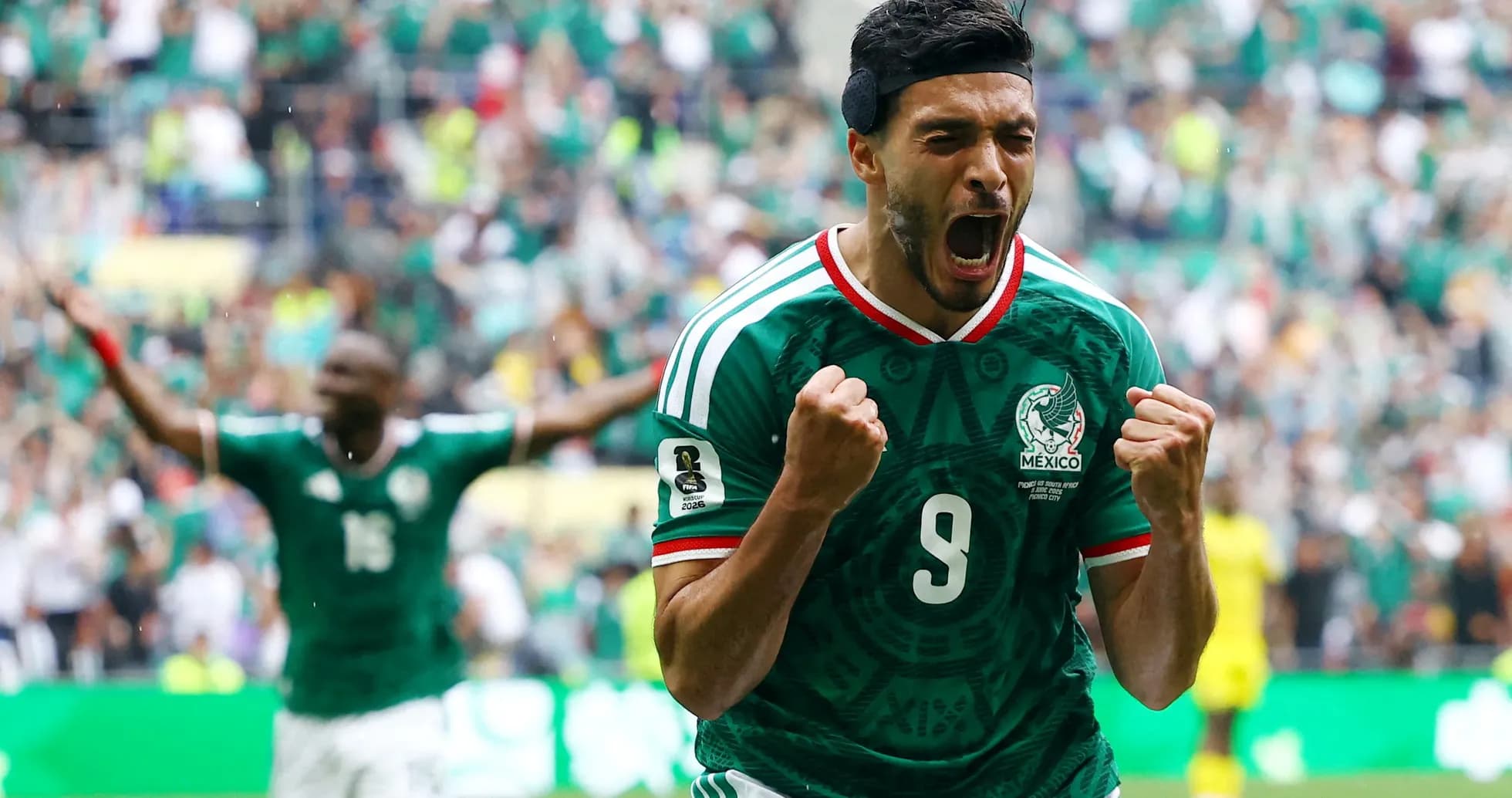
The first goal on 9 minutes captured Mexico’s structural superiority. Quiñones’ opener, assisted by Lira, reflected the value of the single pivot. Lira, positioned between South Africa’s lines, could receive, turn and play forward because the visitors’ front two could not cut both the passing lane to him and the routes to the full-backs. Once Lira found space, South Africa’s back five had to react late to the vertical pass, leaving gaps for Quiñones to attack. The early goal forced South Africa even deeper, further skewing the territorial balance.
Defensively, Mexico’s rest defence was generally secure. With only 2 shots on goal faced, Raúl Rangel (Mexico) had a relatively quiet evening, making 2 saves and operating mainly as a sweeper behind a high line. The centre-backs, Montes and Vásquez, were aggressive stepping into midfield when South Africa tried to play into Foster’s feet. Lira’s screening in front of them reduced the need for emergency defending; Mexico conceded only 3 total shots and no blocked shots were required from South Africa’s perspective.
South Africa’s best hope was transition, but their structure undermined them. The wing-backs, Modiba and Khuliso Mudau, were pinned so deep by Mexico’s wide players that counter-attacks often started with long clearances rather than controlled outlets. With just 1 corner and 11 fouls, South Africa rarely sustained attacks high enough to create set-piece pressure.
The match’s key tactical hinge came after the interval with discipline. In the 49th minute, Siphephelo Sithole’s red card for “Professional foul last man” left South Africa with ten men and further tilted the field. Already struggling to get out, they now had one fewer midfielder to cover horizontal spaces against Mexico’s four-man line. Broos responded with substitutions on 56 and 61 minutes: Thalente Mbatha (IN) came on for Lyle Foster (OUT), and Themba Zwane (IN) came on for Jayden Adams (OUT). The intent was to stabilise midfield and keep a front presence with Rayners and Zwane’s technical quality, but the numerical deficit meant South Africa increasingly formed a 5-3-1 block with very limited counter-punch.
Aguirre’s in-game management was proactive and aimed at maintaining intensity between the lines. On 66 minutes, Gilberto Mora (IN) came on for Álvaro Fidalgo (OUT), and Luis Chávez (IN) came on for Brian Gutiérrez (OUT). This refreshed the interior roles without changing the 4-1-4-1 structure. Mora and Chávez, both comfortable on the ball, kept Mexico’s passing rhythm high and ensured that the extra man in midfield was constantly exploited through quick combinations rather than sterile circulation.
The second goal on 67 minutes, scored by Raúl Jiménez and assisted by Alvarado, underlined this. With South Africa a man down and retreating, Mexico could overload the right half-space. Alvarado’s assist came from exploiting the gap between Modiba and the left centre-back as South Africa’s line was dragged across. Jiménez’s movement between centre-backs was decisive, but the platform was collective: sustained possession, quick switches and fresh legs in midfield.
Substitutions later in the half shifted Mexico into game-management mode. At 76 minutes, Armando González (IN) came on for Jiménez (OUT) and Edson Álvarez (IN) replaced Lira (OUT). Álvarez’s introduction effectively turned the pivot role into a more defensive anchor, helping to control any late South African transitions. At 79 minutes, Alexis Vega (IN) came on for Quiñones (OUT), adding fresh running to press South Africa’s build-up and threaten in behind.
South Africa’s late changes were more about damage limitation and legs than tactical reinvention. At 77 minutes, Oswin Appollis (IN) replaced Modiba (OUT), and Evidence Makgopa (IN) came on for Rayners (OUT). With two forwards again, South Africa tried to offer a direct outlet, but the lack of midfield control and the second red card at 84 minutes to Themba Zwane for “Violent conduct” reduced any realistic chance of a comeback. By then, Mexico were also down to ten after César Montes’ red card at 90+2’ for “Professional foul last man”, but the timing meant it had minimal tactical impact on the result, serving mainly to disrupt Mexico’s defensive index and discipline profile.
From a statistical verdict, the 2-0 scoreline closely matches the underlying numbers. Mexico’s xG of 1.41 against South Africa’s 0.07 reflects clear attacking superiority, even if Mexico’s 16 total shots translated into only 4 on goal. The 5 blocked shots show South Africa’s back line often defending deep in their own box, absorbing pressure rather than contesting higher up. Ronwen Williams (South Africa) made 2 saves, mirroring Rangel’s tally, but the key difference lay in volume and quality of threat: South Africa’s 2 shots on goal were isolated, low-probability efforts.
Discipline heavily shaped the game state. Mexico finished with 1 yellow and 1 red; South Africa accumulated 2 yellows and 2 reds. The early South African dismissal turned a difficult defensive assignment into a near-impossible one, and the later upgrade and red for Zwane via VAR intervention at 82–84 minutes killed any remaining hope of late pressure. Overall, Mexico’s superior structure, ball circulation and in-game management translated their statistical edge into a controlled, tactically coherent World Cup group-stage victory.