.svg&w=384&q=75 "GoalGist logo")
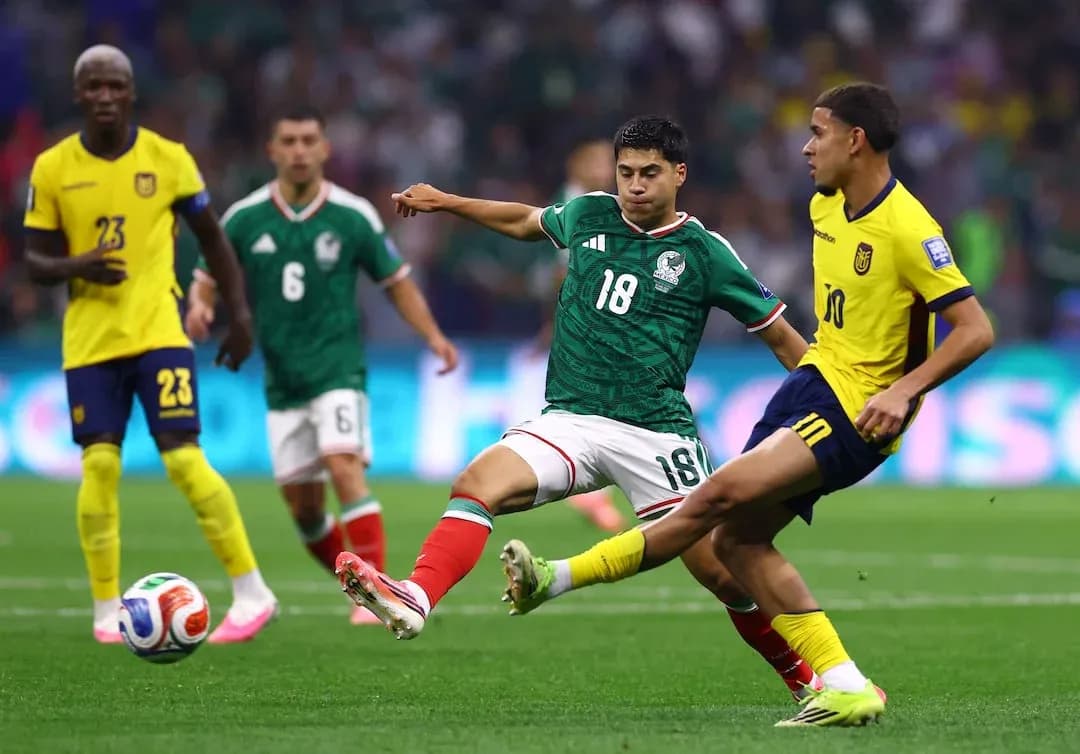
Mexico Dominates Ecuador 2–0 in Round of 32
Under the lights of Estadio Banorte in Mexico City, the Round of 32 became the stage where Mexico’s growing tournament authority met Ecuador’s stubborn resistance. By the final whistle, a 2–0 scoreline in regular time under referee S. Vincic felt like the natural extension of what both sides had been hinting at all tournament: Mexico as a relentless, structured machine; Ecuador as a side caught between defensive grit and attacking inhibition.
I. The Big Picture – Mexico’s Perfect March, Ecuador’s Ceiling
Following this result, Mexico’s season arc in the World Cup remains immaculate. Overall this campaign, they have played 4 matches, winning all 4, with no draws or defeats. At home they have played 3, winning all 3; on their travels they have played 1 and also won it. Their attacking numbers are quietly ruthless: in total this campaign they have scored 8 goals, with 5 at home and 3 away. The scoring rhythm is controlled rather than chaotic, reflected in an overall average of 2.0 goals per game, split into 1.7 at home and 3.0 away.
More striking is the defensive wall. In total this campaign Mexico have not conceded a single goal – 0 at home, 0 away, 0 overall. Their goal difference in the group phase was 6 (6 scored, 0 conceded), and that defensive DNA has clearly carried into the knockouts. Four matches, four clean sheets; 3 clean sheets at home, 1 away. This is not a side simply riding momentum; it is one structurally built to deny chances.
Ecuador arrived with a more fragile profile. Overall this campaign they have played 4 matches, with 1 win, 1 draw and 2 defeats. At home they have played 2, winning 1 and drawing 1; away they have played 2 and lost both. Their attacking return is modest: in total this campaign they have scored just 2 goals, both at home, with 0 on their travels. That leaves them at an overall scoring average of 0.5 goals per match, split into 1.0 at home and 0.0 away.
Defensively, Ecuador’s numbers underline the strain. Overall they have conceded 4 goals, 1 at home and 3 away, for an overall average of 1.0 goals against per match (0.5 at home, 1.5 away). Their goal difference in the group was exactly balanced at 0 (2 scored, 2 conceded), a statistical portrait of a team that can hang in games but struggles to tilt them decisively in their favour.
II. Tactical Voids and Discipline – A Clean Sheet Culture vs. Edgy Defenders
There were no listed absences to reshape the tactical plans, so both coaches could lean into their preferred identities. Mexico, under Javier Aguirre, again trusted the 4‑3‑3 that has been their primary shape (3 uses this campaign), with a back four of J. Sanchez, C. Montes, J. Vasquez and J. Gallardo shielding goalkeeper R. Rangel. Ahead of them, the midfield trio of G. Mora, E. Lira and L. Romo formed a compact, hard-working engine, allowing a front line of R. Alvarado, R. Jimenez and J. Quiñones to stretch the pitch.
Ecuador, guided by Sebastian Beccacece, leaned on their most-used 4‑4‑2 (3 uses this campaign). H. Galindez stood behind a back line of A. Franco, J. Ordonez, W. Pacho and P. Hincapié. The midfield quartet of J. Yeboah, M. Caicedo, P. Vite and N. Angulo supported a front two of G. Plata and E. Valencia.
Discipline has been a quiet pillar of Mexico’s success. Across the tournament, their yellow cards cluster in two windows: 50.00% between 16–30 minutes and 50.00% between 61–75 minutes. They have also seen a red card in the 91–105 minute band, with C. Montes carrying that burden in the statistics. Yet those moments have not derailed their defensive structure; they remain perfect in terms of goals conceded.
Ecuador, by contrast, arrive with a more combustible defensive profile. Their yellow cards are spread across 31–45 minutes (25.00%), 46–60 (25.00%), 61–75 (12.50%), 76–90 (12.50%) and a heavy 25.00% in 91–105 minutes. They have also had a red card in the 91–105 band, with P. Hincapié the standout in both yellow and red card charts. A. Franco, another key defender, tops the yellow card list with 2 bookings, 7 fouls committed and 1 successful block. This disciplinary edge hints at a back line that often has to defend on the limit, especially late in games.
III. Key Matchups – Hunter vs Shield, Engine vs Enforcer
The most compelling duel in this tie was always going to be Mexico’s “hunter” against Ecuador’s “shield.” J. Quiñones, listed as a midfielder but deployed high on the left of the front three, has been one of the tournament’s most incisive attackers. Heading into this game he had 3 goals and 1 assist in 4 appearances, with 9 shots (5 on target), 7 key passes and 6 successful dribbles from 8 attempts. His duel volume – 40 contested, 19 won – underlines his willingness to engage physically as well as technically.
Against him stood an Ecuadorian back line that, in total this campaign, had conceded 4 goals and managed just 1 clean sheet. P. Hincapié, with 12 tackles, 2 successful blocks and 4 interceptions, is the most active defender in that unit, but his disciplinary record (1 yellow, 1 red, 5 fouls committed) makes him vulnerable when isolated. A. Franco adds 8 tackles, 1 block and 4 interceptions, with 7 fouls committed and 2 yellow cards. Together, they form a combative but high-risk shield.
On the opposite flank, Mexico’s creative “engine” R. Alvarado has been one of the World Cup’s top providers. Heading into this match he had 3 assists, 10 key passes and 140 total passes at 82% accuracy, along with 7 tackles and 1 interception. He is not just a winger; he is the conduit through which Mexico turn possession into penetration.
Ecuador’s midfield enforcers, particularly M. Caicedo and the wide players J. Yeboah and N. Angulo, were tasked with disrupting those passing lanes. But structurally, Ecuador’s 4‑4‑2 can be stretched horizontally by Mexico’s 4‑3‑3, especially when L. Romo and G. Mora step into half-spaces to create overloads. That dynamic forced Ecuador’s wide midfielders deeper, leaving E. Valencia and G. Plata increasingly isolated against a Mexico back four that, in total this campaign, has not been breached.
IV. Statistical Prognosis – Why 2–0 Felt Inevitable
Even without explicit xG values, the statistical patterns make the 2–0 outcome feel almost pre-written. Mexico entered the Round of 32 with an overall scoring average of 2.0 goals per match and an overall goals against average of 0.0. Ecuador arrived scoring 0.5 per match and conceding 1.0, with a particular vulnerability away from home where they concede 1.5 per game and fail to score at all.
Mexico’s clean sheet culture – 4 in 4, with no goals conceded at home or away – collides directly with Ecuador’s attacking drought on their travels, where they have failed to score in both away fixtures and in 3 of 4 matches overall. On the other side of the ball, Mexico’s varied attacking cast, led by the finishing of J. Quiñones and the supply of R. Alvarado, was always likely to find cracks in a defence anchored by defenders who tackle and block well but live on a disciplinary knife-edge.
In narrative terms, this Round of 32 clash was less about a single moment and more about the weight of accumulated evidence. Mexico’s structure, balance and defensive perfection met an Ecuador side still searching for a reliable attacking identity. The 2–0 scoreline at Estadio Banorte did not just send Mexico into the next round; it confirmed that their statistical profile – ruthless, controlled, and unbreached – has translated seamlessly from group stage promise to knockout reality.