.svg&w=384&q=75 "GoalGist logo")
Mexico's Tactical Mastery Secures 2-0 Win Over Ecuador
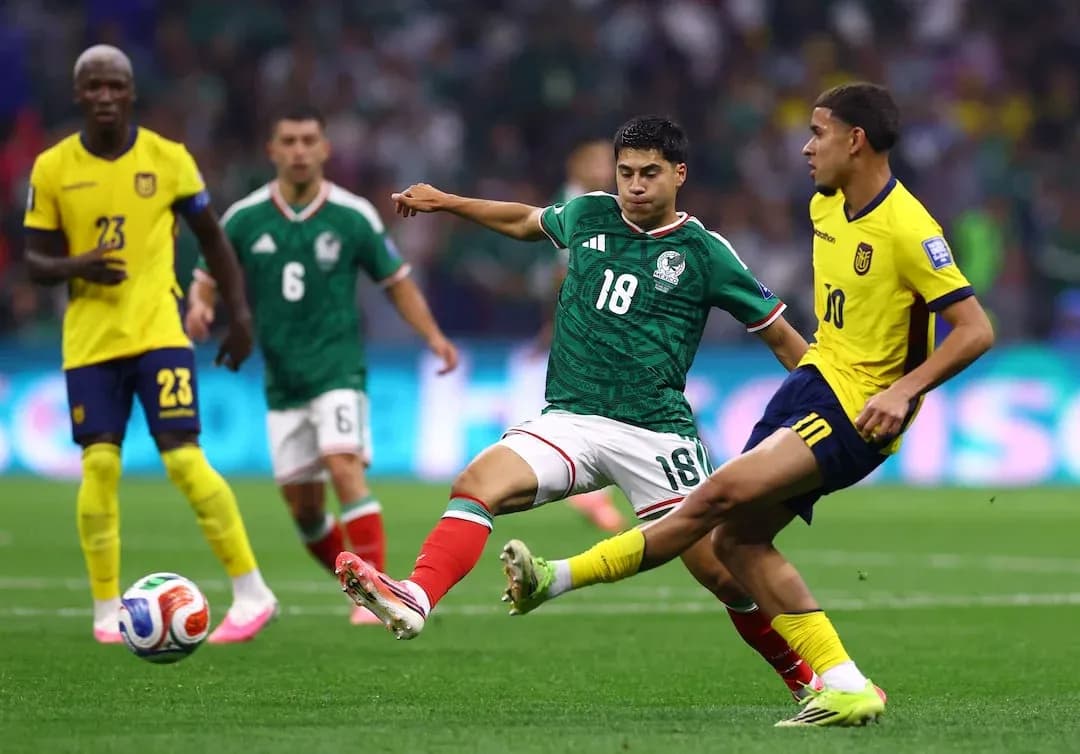
Mexico’s 2-0 win over Ecuador at Estadio Banorte in this World Cup Round of 32 tie was a clinic in game-state control rather than territorial dominance. Javier Aguirre’s side accepted a 43% share of the ball, but used their 4-3-3 structure to create the better chances (1.02 xG to 0.73) and then managed the match efficiently once two first-half goals had been secured.
Mexico’s 4-3-3 was clearly designed to attack Ecuador’s full-backs and half-spaces. With Julián Quiñones off the left and Roberto Alvarado off the right, Raúl Jiménez operated as a classic reference point between centre-backs. The midfield trio of Gilberto Mora, Erik Lira and Luis Romo staggered their positions: Lira held in front of the back four, Mora stepped higher to connect with the right side, and Romo drifted to support the left. This gave Mexico three clear lanes of progression and a stable rest-defense against Ecuador’s counter-attacking threats.
The opening goal on 22 minutes, scored by Quiñones and assisted by Alvarado, encapsulated the plan. Mexico used short combinations on the right to draw Ecuador’s midfield across, then switched quickly into the left half-space where Quiñones could attack an isolated defender. The second goal on 31 minutes reversed the pattern: Quiñones now combined centrally and slipped Jiménez through, exploiting the gap between Ecuador’s centre-backs. Both goals came from structured occupation of the front line and timely midfield support, rather than chaotic transitions.
Out of possession, Mexico’s 4-3-3 became a compact 4-1-4-1. Lira screened passes into Enner Valencia and Gonzalo Plata, forcing Ecuador wide. The back four of Jorge Sánchez, César Montes, Johan Vásquez and Jesús Gallardo held a relatively deep line, prioritizing control of depth over aggressive pressing. That conservative height explains why Ecuador enjoyed 57% possession and 407 passes, but were limited to just one shot on goal and seven shots in total, with only five inside the box. Mexico’s block allowed circulation in harmless zones, then collapsed around the ball when it entered the final third.
With the ball, Mexico were more direct and vertical. Their 319 passes (249 accurate, 78%) were used to progress quickly once they broke Ecuador’s first line. The full-backs played a measured role: Sánchez and Gallardo advanced selectively, ensuring that in rest-defense Mexico often had at least three plus Lira behind the ball. That structure was vital in denying Ecuador counter-attacks, especially once the South Americans began chasing the game in the second half.
In goal, Raúl Rangel (Mexico) had a quiet but controlled evening, officially required for 1 save as Ecuador’s attacks rarely penetrated into truly dangerous zones. The goals prevented figure of -0.57 indicates that Ecuador’s single shot on target was of modest quality and that Rangel’s involvement did not significantly swing the expected outcome. At the other end, Hernán Galíndez (Ecuador) also registered 1 save, but the two goals conceded aligned closely with Mexico’s xG of 1.02, suggesting Mexico finished at roughly the level of their chance quality rather than overperforming.
Sebastian Beccacece’s Ecuador lined up in a 4-4-2 with John Yeboah and Nilson Angulo nominally wide, and Moisés Caicedo and Pedro Vite in central midfield. On paper, this shape should have allowed Ecuador to outnumber Mexico’s double pivot zones and control the ball, which they did. However, their possession lacked vertical incision. The front two, Valencia and Plata, were often disconnected, receiving with backs to goal and little support between the lines. Mexico’s single pivot plus narrow wide midfielders effectively crowded the central channels.
Beccacece’s adjustments at half-time — Alan Franco (OUT) replaced by Yaimar Medina (IN), and Joel Ordóñez (OUT) replaced by Ángelo Preciado (IN) — signalled a desire for more thrust down the right and slightly different build-up angles from the back. Later, Kevin Rodriguez (IN) for Enner Valencia (OUT) at 59' and the double change of Jordy Caicedo (IN) for Yeboah (OUT) and Kendry Páez (IN) for Angulo (OUT) at 79' were all geared towards adding fresh legs and more direct running in the final third. Yet Mexico’s compact shape and game-state advantage meant these changes produced more possession and crosses, but not clear chances.
Aguirre’s substitutions were primarily about energy and control. Brian Gutiérrez (IN) for Mora (OUT) at 58' and Obed Vargas (IN) for Romo (OUT) at 73' refreshed the midfield legs protecting the back four. Santiago Giménez (IN) for Jiménez (OUT) at 74' maintained a central reference to contest clearances and relieve pressure. The late double change at 80', with Orbelín Pineda (IN) for Quiñones (OUT) and Israel Reyes (IN) for Alvarado (OUT), subtly shifted Mexico towards a more conservative posture, with Reyes offering extra defensive security on the flank and Pineda capable of holding the ball under pressure.
Discipline played a clear tactical role in the closing stages. Ecuador finished with three yellow cards and one red card, all in the second half and all while chasing the game. The dismissal of Piero Hincapié for “Unsportsmanlike conduct” at 90+5' effectively ended any realistic hope of a late comeback and forced Ecuador into a 10-man structure against a Mexico side already content to manage the clock. Earlier cautions to Alan Franco at 45+1' and later to Kendry Páez at 90+3' and Moisés Caicedo at 90+9' for “Tripping” reflected growing frustration as Mexico repeatedly disrupted Ecuador’s rhythm.
Statistically, the match underlined Mexico’s efficiency. Despite having fewer shots (15 to 7) and only 3 on goal, they converted two of those into goals and generated the higher xG. Ecuador’s 8 corners to Mexico’s 3 highlight their territorial advantage, but Mexico’s 3 blocked shots and disciplined foul count (10 fouls to Ecuador’s 14) show a side defending assertively without losing control. The negative goals prevented value for both sides (-0.57 each) indicates that finishing broadly matched chance quality, reinforcing the idea that the tactical structure — not goalkeeping heroics or freak finishing — decided the tie.
In sum, Mexico’s 4-3-3 delivered a controlled, game-state oriented performance: early, well-constructed goals, a compact mid-block, and measured use of possession to secure a 2-0 victory and safe passage from the Round of 32. Ecuador’s higher possession and passing accuracy could not compensate for their lack of vertical threat and the late disciplinary collapse that sealed their exit.