.svg&w=384&q=75 "GoalGist logo")
Manchester City vs Aston Villa: Tactical Battle Analysis
Manchester City’s 4-2-2-2 at the Etihad Stadium was designed to dominate territory and possession, and the raw numbers show they largely achieved that structural aim but lost the tactical battle in both boxes to Aston Villa’s 4-2-3-1. City finished with 52% possession, 458 passes and an 88% completion rate, out-passing Villa’s 436 at 90%. Yet Villa carried the sharper attacking threat, producing higher xG (1.58 to City’s 1.25), more shots on goal (5 to 3) and ultimately turning that efficiency into a 2-1 away win.
Out of possession, Villa’s 4-2-3-1 behaved like a compact 4-4-1-1, with Douglas Luiz and L. Bogarde screening central zones and O. Watkins ready to spring transitions. City’s double pivot of Nico and Bernardo Silva was supposed to dictate tempo and connect the back four to the advanced midfield line of A. Semenyo and Savinho, but Villa’s structure forced much of City’s circulation into safer areas. City still generated 16 total shots, yet only 3 were on target, with 6 blocked – a sign that Villa’s back line and midfield block were well-positioned to get bodies in the way rather than be stretched into last-ditch defending.
First Half
The first half reflected City’s plan working in broad strokes. J. Trafford (Manchester City) had relatively little to do in terms of shot-stopping, making 3 saves overall across the 90 minutes. In front of him, the back four of Rico Lewis, J. Stones, R. Dias and N. Ake were positioned high, compressing the pitch and allowing City to sustain pressure. The 9 corner kicks they forced (against Villa’s 4) underline that territorial control. Semenyo’s 23rd-minute goal came as a natural product of this pressure, with City’s advanced midfield box finding space between Villa’s lines and exploiting the half-spaces.
Second Half
Unai Emery’s adjustment at half-time was decisive. The substitution of A. Garcia (OUT) for M. Cash (IN) at 46' immediately gave Villa more vertical thrust down the right and a more aggressive outlet on transitions. Within a minute, Watkins equalised, and the pattern of the second half shifted from City’s measured control to a more open, transition-heavy contest that suited Villa’s front four of L. Bailey, R. Barkley, E. Buendia and Watkins.
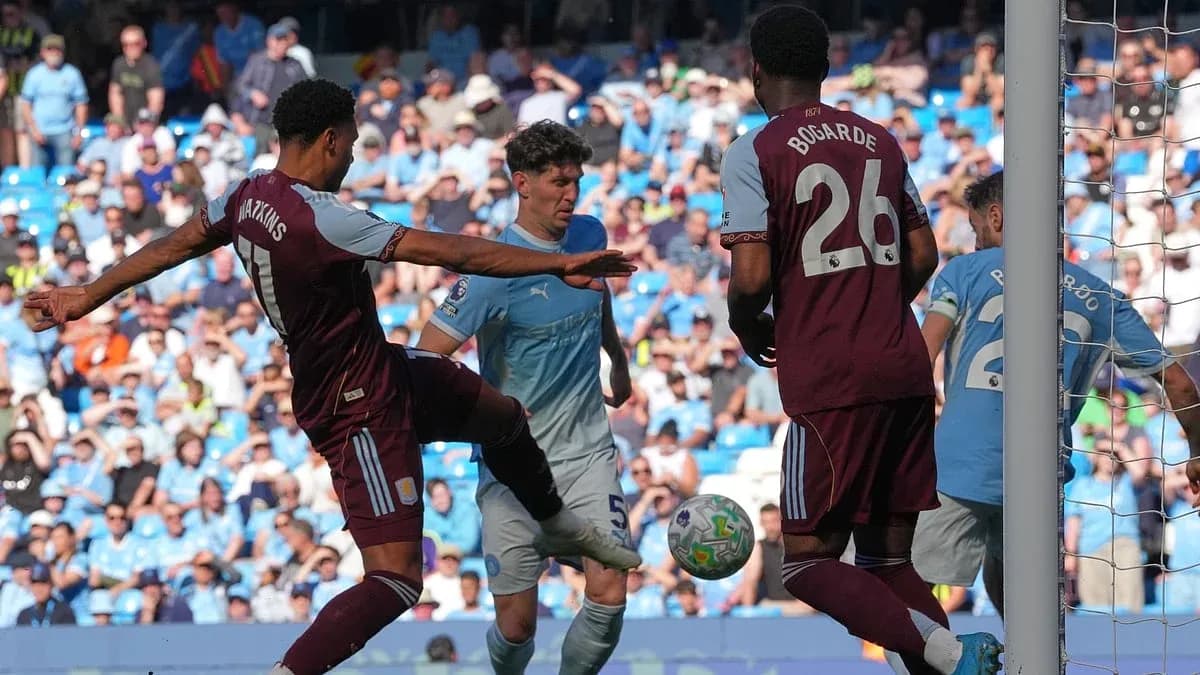
City’s response in the 58'-61' window revealed both tactical intent and structural risk. A. Semenyo (OUT) made way for R. Cherki (IN) at 58', and B. Silva (OUT) was replaced by M. Kovacic (IN) at 59'. Pep Guardiola effectively reconfigured his midfield, looking for more line-breaking dribbling and vertical passing to unsettle Villa’s block. However, this also altered City’s rest defence balance. Removing Bernardo, who is naturally diligent in defensive transitions, reduced City’s capacity to control counters in central areas. Just as these changes were bedding in, Watkins struck again on 61', assisted by Barkley, with VAR confirming the goal at 63'. Villa’s second was emblematic of their approach: efficient use of the central channels, quick connection from Barkley into Watkins, and clinical finishing.
From that point, City chased the game. The subsequent substitutions – T. Reijnders (OUT) for J. Doku (IN) and N. Ake (OUT) for R. Ait-Nouri (IN) at 77', followed by J. Stones (OUT) for J. Gvardiol (IN) at 78' – pushed even more attacking and progressive profiles onto the pitch. Doku’s introduction aimed to add 1v1 threat on the flank, while Ait-Nouri gave an overlapping option from full-back. Gvardiol’s ball-carrying from the back was another attempt to destabilise Villa’s mid-block. Yet Villa’s defensive structure held, and their discipline without the ball is reflected in committing only 4 fouls and receiving no yellow cards.
Villa’s triple change on 73' – Douglas Luiz (OUT) for Y. Tielemans (IN), V. Lindelof (OUT) for P. Torres (IN), and L. Bogarde (OUT) for A. Onana (IN) – was a clear rebalancing act from Emery. Tielemans offered more composure and passing from deep, Torres fresh legs and aerial presence at centre-back, and Onana physicality in midfield. Later, Barkley (OUT) for J. McGinn (IN) at 86' further tilted the side towards defensive solidity and game management. These moves helped Villa absorb City’s late pressure while still retaining enough structure to prevent chaos in their own box.
Defensively, M. Bizot (Aston Villa) was well protected, needing just 2 saves despite City’s volume of attempts. The key was Villa’s ability to restrict City’s shot quality – 10 of City’s 16 shots came inside the box, but the combination of blocks (2 for Villa) and pressure on the ball-carrier kept many efforts from being clean looks at goal. City’s single yellow card, to Rico Lewis at 82' for “Foul”, was more an illustration of their attempts to recover possession high than any breakdown in discipline, as they committed just 8 fouls overall.
Statistically, the match narrative is clear: City controlled more of the ball, passed slightly more but less accurately than Villa (88% vs 90%), and forced more set-piece opportunities. However, Villa’s attack was more incisive, reflected in the superior xG and shots on goal. Both goalkeepers’ goals prevented metrics at 0.28 underline that neither was overworked by extreme shot quality; instead, the game was decided by Villa’s ruthlessness in the key moments and City’s inability to translate territorial dominance into high-quality, on-target finishing. The late VAR intervention at 90+2', disallowing a potential Phil Foden goal, encapsulated City’s frustration: structurally on top for long stretches, but tactically second-best in the decisive actions.