.svg&w=384&q=75 "GoalGist logo")
Inter Dominates Lazio in Serie A Clash
The Stadio Olimpico under late-spring light felt like a stage built for tension: Lazio, 8th in Serie A with 51 points and a fragile goal difference of 2, hosting runaway leaders Inter, top of the table on 85 points with a towering goal difference of 54. Following this result, a 0-3 home defeat in Round 36, the gap in class was not just visible on the scoreboard; it was etched into the tactical story of the evening.
Maurizio Sarri stayed loyal to Lazio’s seasonal DNA, rolling out the familiar 4-3-3 that has been used in 34 league matches. Inter, under Cristian Chivu, arrived with the machine-like 3-5-2 that has started all 36 of their Serie A fixtures. On paper it was a clash of systems; in practice, it became a demonstration of how a well-drilled collective can suffocate a side already stretched by absences.
Lazio’s spine was compromised before a ball was kicked. The absence list was brutal in key zones: I. Provedel out with a shoulder injury, forcing E. Motta into goal; D. Cataldi missing from the base of midfield; and M. Zaccagni, one of their most aggressive ball-carriers and also among the league’s most carded, sidelined with a foot injury. That removed a natural outlet on the flank and a player who habitually drags defensive blocks out of shape.
Sarri’s back four of A. Marusic, Mario Gila, A. Romagnoli and L. Pellegrini had to protect a team that, heading into this game, conceded on average 1.3 goals at home and 1.0 overall. Gila’s season has been defined by rugged defending — 44 tackles, 16 successful blocks and 23 interceptions — and he again had to live on the front foot, stepping into channels to cover when Lazio’s full-backs advanced. Beside him, Romagnoli, who has 19 blocked shots and a history of disciplinary risk with one red card this season, was tasked with orchestrating the line against Inter’s dual threat.
In front of them, the midfield trio of N. Rovella, T. Basic and F. Dele-Bashiru lacked a natural deep-lying controller like Cataldi. Rovella was forced into double duty: screening Lautaro Martínez’s drops between the lines while also trying to connect with a front three of M. Cancellieri, T. Noslin and Pedro. Lazio’s season-long numbers tell of a side often starved of cutting edge: at home they average 1.4 goals, but overall only 1.1, and they have failed to score in 16 matches in total. That fragility surfaced again as Inter’s block compressed space between the lines.
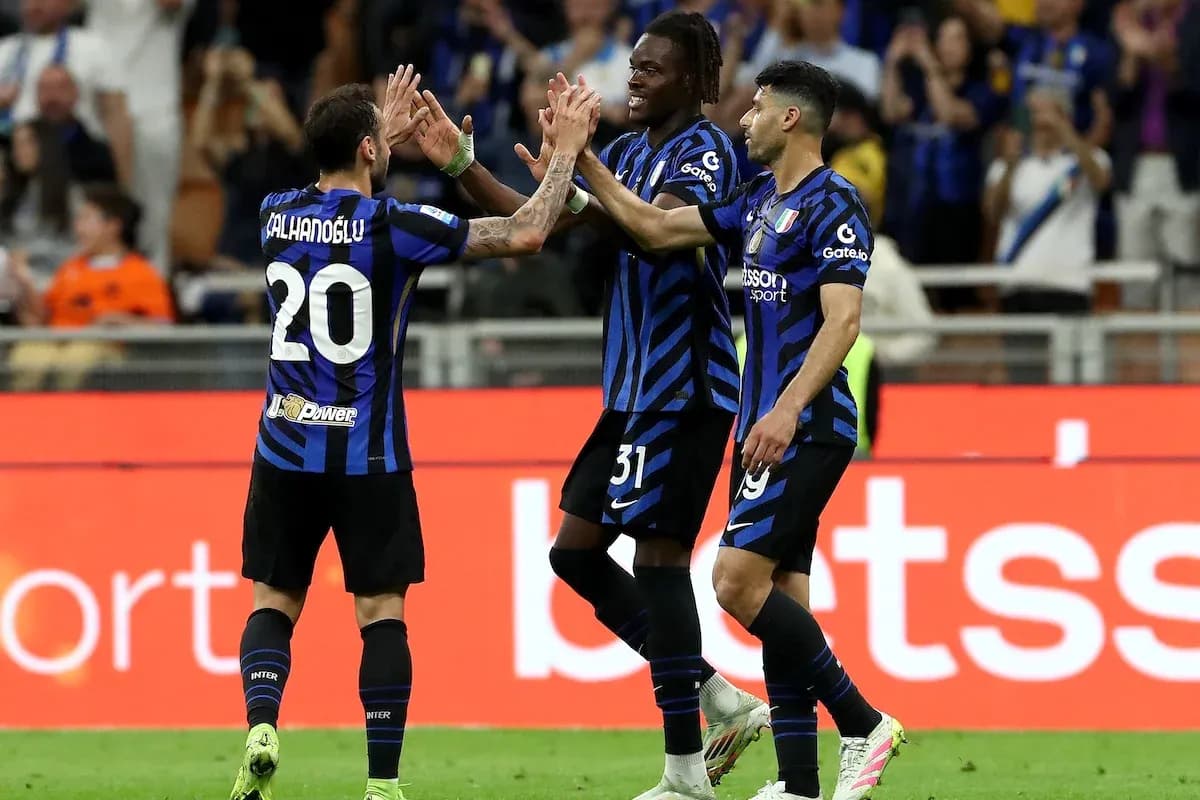
Inter, by contrast, looked every inch a champion-elect. On their travels they average 2.0 goals scored and just 0.9 conceded, and that away authority shaped their approach. The back three of Y. Bisseck, F. Acerbi and A. Bastoni formed a platform from which the wing-backs and midfield could surge. Acerbi’s familiarity with the Olimpico’s dimensions and Lazio’s tendencies added a layer of calm to Inter’s build-up.
The central band was where Chivu’s side truly imposed itself. Even without H. Çalhanoğlu, absent with a calf injury despite a season of 9 goals, 4 assists and 41 key passes, Inter’s midfield did not lose its rhythm. N. Barella, one of the league’s elite creators with 8 assists and 72 key passes, operated as the metronome, drifting into half-spaces to overload Rovella and Basic. P. Sucic and H. Mkhitaryan gave Inter verticality, while Carlos Augusto and A. Diouf stretched Lazio laterally from wing-back.
Up front, the “Hunter vs Shield” battle was brutally one-sided. Lautaro Martínez, the league’s leading scorer with 17 goals and 6 assists, and M. Thuram, on 13 goals and 6 assists, faced a Lazio defence that, heading into this game, had conceded 24 at home and 37 overall. Inter’s front two constantly manipulated Lazio’s centre-backs: Lautaro dropping to link with Mkhitaryan and Barella, Thuram attacking the space between full-back and centre-back.
Without minute-by-minute goal data, the timing narrative instead comes from disciplinary trends. Both teams are late-game flashpoints. Lazio’s yellow cards spike in the 76-90 minute window at 27.40%, and their red cards are even more dramatic there, with 62.50% of their dismissals coming in that late stretch. Inter mirror that late intensity: 30.65% of their yellows also arrive between 76-90 minutes. This match followed the same emotional script: as the scoreline drifted away from Lazio, their structure frayed, exactly the kind of scenario in which Romagnoli and Gila’s aggression can tip from calculated to reckless.
The “Engine Room” duel was decided in Inter’s favour. Barella’s two-way work, backed by Mkhitaryan’s intelligence between the lines, overwhelmed Rovella’s attempts to knit Lazio together. Without Zaccagni’s direct dribbling or Cataldi’s tempo control, Lazio’s counters were sporadic and easily funneled into wide, harmless zones by Bastoni and Carlos Augusto.
From a statistical prognosis standpoint, this 0-3 felt like the logical extension of the season’s patterns. Inter’s overall scoring average of 2.4 goals per game and defensive concession of just 0.9, combined with 18 clean sheets in total and only 2 matches all season in which they failed to score, describe a side that rarely loses control of a contest. Lazio, by contrast, entered with 11 defeats overall, a modest 13 wins, and a tendency to misfire in attack, particularly when key creative pieces are missing.
Following this result, the story is clear: Inter’s structural superiority, depth and attacking efficiency translated their season-long metrics onto the Olimpico pitch. Lazio’s 4-3-3, stretched by injuries and dulled in the final third, could not live with the league leaders’ 3-5-2 machine. The scoreline was emphatic, but it was the tactical inevitability behind it that truly underlined the gulf between 1st and 8th.