.svg&w=384&q=75 "GoalGist logo")
France's Tactical Masterclass in 3-0 Victory Over Sweden
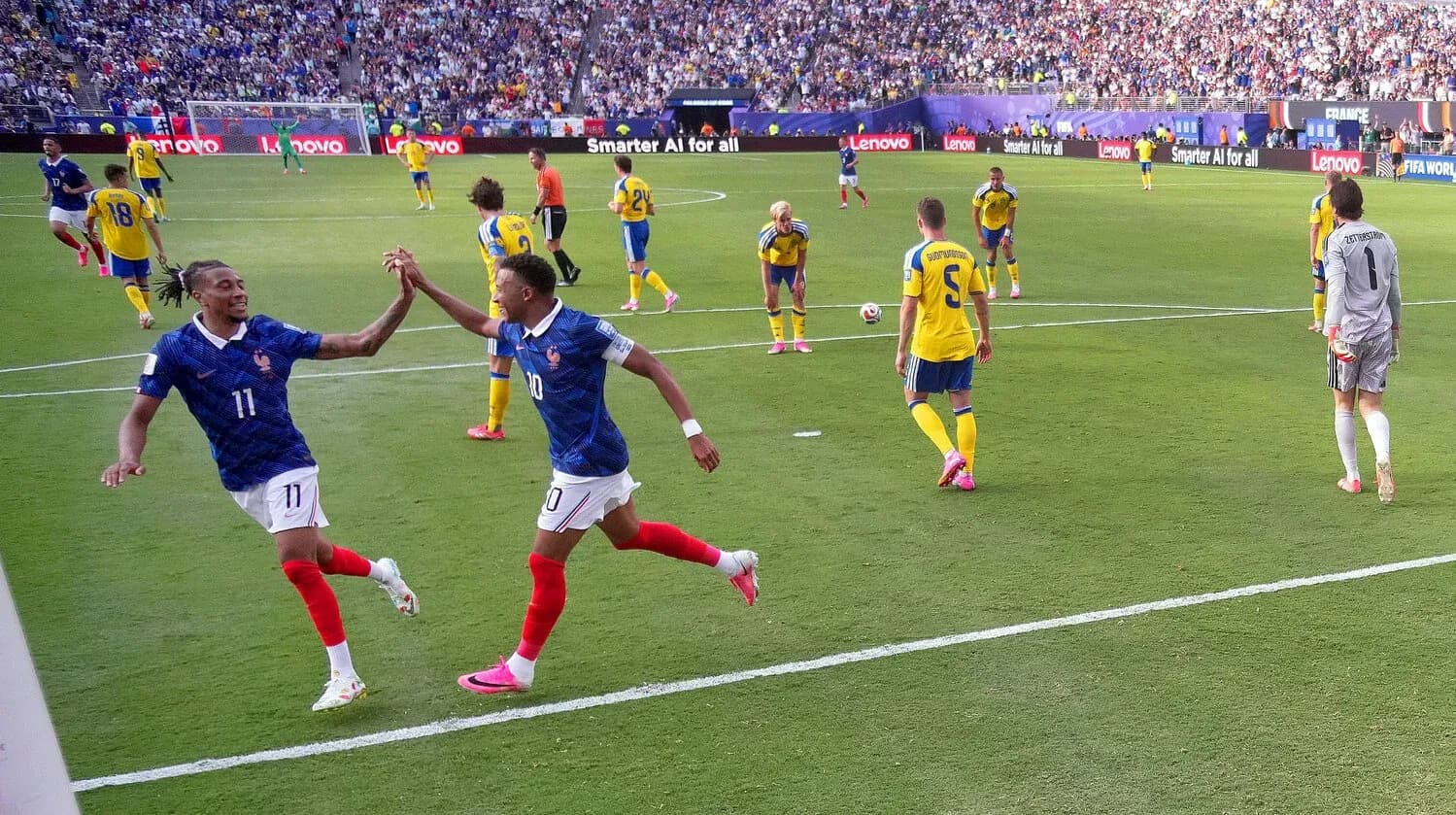
France’s 3-0 victory over Sweden at MetLife Stadium in this World Cup Round of 32 tie was a controlled, tactically coherent performance built on structural superiority in all phases. Didier Deschamps’ 4-2-3-1 not only dominated the ball (61% possession) but also generated sustained territorial pressure, reflected in a 25–8 shot count and a 3.17–0.65 xG split. Sweden, in Graham Potter’s 4-4-2, were largely forced into a low-to-mid block and sporadic transitions, unable to consistently connect their front two to the midfield line.
I. Executive Summary
France’s shape was textbook: Mike Maignan behind a back four of Jules Koundé, Dayot Upamecano, William Saliba and Lucas Digne; Aurélien Tchouaméni and Adrien Rabiot as the double pivot; Ousmane Dembélé, Michael Olise and Bradley Barcola supporting Kylian Mbappé. This gave France natural width, three advanced lanes between the lines, and a stable rest-defense platform. Sweden’s 4-4-2, with Anthony Elanga and Elliot Stroud wide and Viktor Gyökeres/Alexander Isak up front, sought to compress central spaces but was repeatedly stretched horizontally and vertically.
II. Scoring Sequence & Disciplinary Log
There were no cards issued, which aligns with the moderate foul count (France 14, Sweden 10) and a game that rarely tipped into chaos. The three goals followed France’s territorial logic.
At 45', Mbappé struck the opener, assisted by Dembélé. This came at the end of a half in which France had already established control of possession and field position; the timing was critical, rewarding their pressure and forcing Sweden to contemplate more risk after the break.
At 53', Barcola doubled the lead, assisted by Olise. This goal typified France’s wing dynamics: wide isolation, then combination to attack the half-spaces once Sweden’s full-backs were drawn out. With Sweden still in their 4-4-2 structure, the second goal effectively broke their compactness and forced more aggressive Swedish positioning.
At 74', Mbappé added his second, again from an Olise assist. By this stage, Sweden’s block had been stretched and disrupted by substitutions and accumulated defensive running. The third goal underlined the gap in attacking efficiency: France’s 12 shots on target versus Sweden’s 3.
No yellow or red cards were recorded, and there were no VAR interventions or goal cancellations to alter the rhythm of the match.
III. Tactical Breakdown & Personnel
France in possession
France’s 4-2-3-1 functioned as a 2-3-5 in settled attack. Upamecano and Saliba held a high, aggressive line, with Tchouaméni dropping between or alongside them to facilitate progression. Digne and Koundé provided width and height, pinning Sweden’s wide midfielders back. Rabiot often stepped higher to create a 3v2 against Sweden’s double pivot, while Olise and Barcola attacked the half-spaces, and Dembélé stayed wide right to stretch the block.
The passing metrics show the level of control: 551 total passes with 485 accurate (88%). France circulated the ball with patience, moving Sweden side to side until a lane opened to find Mbappé’s feet or release a winger in behind. The 16 shots inside the box out of 25 total shots underline how effectively they penetrated the penalty area rather than settling for speculative efforts (9 shots from outside the box).
Mbappé’s brace and Barcola’s goal were the output of this positional dominance. Olise’s two assists highlight his centrality as a connector in the right half-space, exploiting the gaps that opened when Sweden’s midfield line shifted laterally to deal with Dembélé’s width.
France out of possession
Without the ball, France’s 4-2-3-1 morphed into a compact 4-4-2 or 4-4-1-1 press, with Mbappé and the central attacking midfielder leading the line. The front unit screened passes into Sweden’s double pivot, while Tchouaméni and Rabiot stayed tight vertically to deny central progression. The shot profile conceded—only 8 total shots and 7 inside the box—suggests that when Sweden did reach the final third, France were usually set, forcing low-quality attempts.
Mike Maignan (France) made 3 saves, a modest workload that reflects how effectively his back line protected the danger zones. The goals prevented figure of 1.16 underlines that the few chances Sweden did create had some quality, but Maignan (France) dealt with them efficiently.
Sweden in possession
Sweden’s 4-4-2 aimed to use Gyökeres and Isak as dual reference points, with Elanga and Stroud providing width. However, with only 352 passes (280 accurate, 80%), they struggled to sustain possession or build cleanly through France’s press. The 39% possession share and 0.65 xG show a team mostly confined to counter-attacks and direct play.
Their 7 shots inside the box from 8 total attempts indicate that when they did attack, they reached advanced areas, but the volume was far too low to threaten the outcome. France’s centre-backs controlled aerial and physical duels, and Sweden rarely managed to isolate their forwards 1v1 in space.
Sweden out of possession
Defensively, Sweden’s 4-4-2 block was initially narrow and compact, but France’s width and circulation gradually stretched it. The single corner won (versus France’s 9) is a proxy for how rarely Sweden pinned France back. Jacob Widell Zetterström (Sweden) faced 12 shots on target and made 9 saves, with a goals prevented value of 1.16 that underlines how much he limited the damage in a structurally difficult game.
As fatigue set in and substitutions arrived—Besfort Zeneli and Taha Abdi Ali at 66', Benjamin Nygren and Mattias Svanberg at 82', and Gustaf Nilsson at 89'—Sweden gained some fresh legs but not a new structural solution. The shape remained a variation of 4-4-2, and France continued to find gaps between lines.
IV. The Statistical Verdict
The statistical profile is entirely consistent with the 3-0 scoreline. France’s 3.17 xG versus Sweden’s 0.65 quantifies the gulf in chance quality. France’s 25 shots to 8, 12 on target to 3, and 9–1 advantage in corners all point to territorial dominance. The blocked shot count (France 4, Sweden 1) further shows how often Sweden were forced into last-ditch defending, while France’s defensive line rarely had to resort to emergency blocks.
Possession and passing numbers reinforce the narrative: France’s 61% possession and high-volume, high-accuracy passing allowed them to control tempo, choose when to accelerate, and keep Sweden chasing. Sweden’s 80% pass accuracy is respectable but largely reflects safer, shorter sequences under pressure.
Discipline was balanced—14 fouls by France, 10 by Sweden, no cards—indicating a game controlled more by positional superiority than by tactical fouling or emotional swings. In sum, France’s structure, technical level, and efficiency in both boxes made this a tactically one-sided Round of 32 tie, with Sweden reliant on their goalkeeper and isolated counters to keep the scoreline from becoming even heavier.