.svg&w=384&q=75 "GoalGist logo")
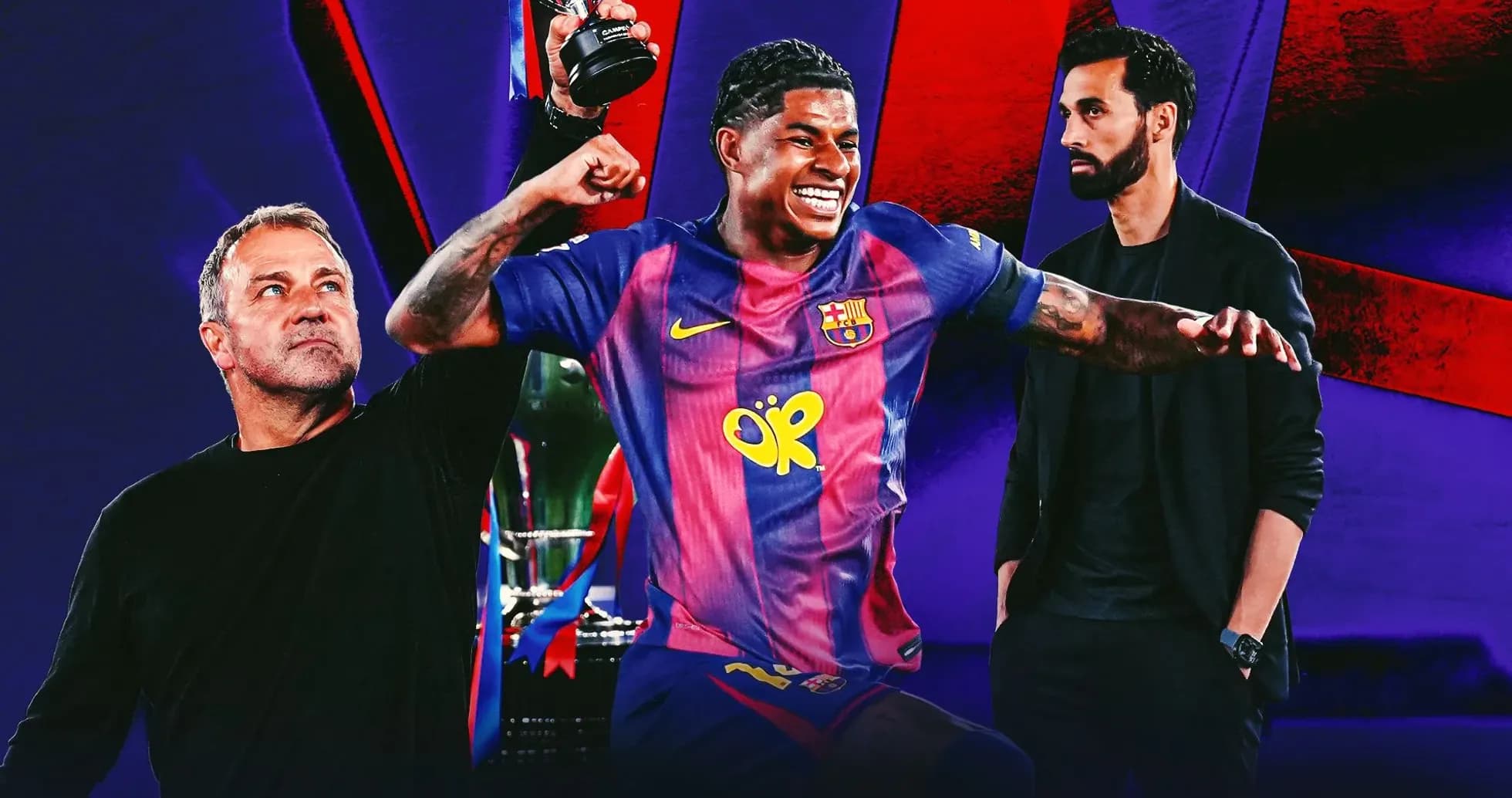
Barcelona Dominates Clasico Against Real Madrid
Barcelona did not so much win this Clasico as administer the final, ruthless act of a title race that Real Madrid had abandoned weeks ago.
From the first whistle at Spotify Camp Nou, there was only one team playing like champions. The other looked like a club counting the days until this season is over.
Nine minutes in, the tone of the night was set. Marcus Rashford, stationed wide on the right but drifting in with menace, stood over a free-kick. He didn’t float it. He didn’t look for a runner. He ripped it. The ball dipped viciously over the wall, flew beyond Thibaut Courtois’ full-stretch dive and slammed into the top corner. A goal of pure conviction, hit like a statement.
Barcelona smelled weakness and went straight for the throat.
The second goal was a different kind of beauty, born of imagination rather than power. Dani Olmo, back to goal, improvised a volleyed heel flick that sliced open Madrid’s back line and rolled perfectly into the path of Ferran Torres. One touch to steady himself, one cool finish past Courtois. 2-0, and the contest felt done before it had even developed.
Madrid were there for a hammering. They knew it. Everyone inside the stadium knew it.
Courtois prevented a full-blown humiliation before the break, standing tall to deny Rashford from a tight angle when a third goal seemed inevitable. The Belgian would go on to produce more saves after half-time, the only Madrid player to emerge with any credit, the one figure preventing the scoreline from turning into a scandal.
But the damage to Madrid went far beyond the numbers on the scoreboard.
Flick’s masterpiece on the hardest day
For Hansi Flick, this was not just another step in a successful season. It was a defining night.
His Barcelona have been almost relentlessly exciting since he walked through the door, transforming a possession-heavy side that had drifted into predictability into a team that attacks with speed, clarity and edge. This, quietly, ranked among their sharpest performances of the campaign.
They did it while patched up, too. No Lamine Yamal. Raphinha barely involved. A thin bench in midfield and at right-back. Robert Lewandowski only introduced from the sidelines. On paper, this was not Flick’s strongest hand.
Then came the personal blow. News filtered through that his father had passed away overnight. On a day like that, many coaches would simply get through the game. Flick did far more. He orchestrated it.
Barcelona pressed with intelligence, broke with purpose, and managed the game with a maturity that has not always been associated with this squad. The title stays in Catalonia, and it is no accident. It is back-to-back championships under the German, and with Madrid in disarray, a third in 2026-27 already feels within reach.
He is under contract until at least 2028. Nights like this explain exactly why the club are so determined to build around him.
Arbeloa left watching the wreckage
On the opposite bench, Álvaro Arbeloa cut the figure of a man trapped in a storm he never started and could not stop.
He was thrown into an impossible situation months ago, asked to coax life from a group that has stopped responding to anyone. The plan against Barcelona was the same gamble he has leaned on for weeks: put the biggest names on the pitch and hope individual quality bails the team out.
There was no plan B. There barely seemed to be a plan A.
As Barcelona sliced through Madrid’s lines, Arbeloa spent long stretches rooted to his technical area, more spectator than coach, watching a game that appeared to unfold beyond his influence. He has repeatedly tried to shoulder the blame this season, insisting that responsibility lies with him.
The truth is harsher and simpler. Madrid are broken in deeper places. They are wounded, outclassed, and corroded from within. Arbeloa has been a bystander to the decline, not the architect of it, and this Clasico only underlined how little control he has over a squad that no longer functions as a team.
Rashford answers the only way that matters
If this was an audition, Marcus Rashford delivered the kind of performance that lingers in boardrooms.
His future at Barcelona has been a live debate for weeks. The Manchester United loanee carries a €30 million option to buy, a fee that even a club of Barça’s stature must weigh carefully in their current financial state. This was his response, on one of the sport’s grandest stages.
Shunted out of his preferred left side and deployed on the right of the front three, he tormented Fran García from the outset. He drove at him, cut inside him, dragged him wide, always asking a new question. The free-kick was unorthodox, whipped across Courtois’ goal into the far top corner rather than curled in the traditional arc, but it spoke volumes about his vision and his striking technique.
Rashford has now produced four goals and an assist in his last six league games. Form is one thing; doing it in El Clasico, with a title on the line and your future in the balance, is another entirely.
For Barcelona’s decision-makers, wrestling with budgets and balance sheets, this display will be hard to ignore. At that price, and at this level of influence, a permanent deal suddenly looks less like a risk and more like an opportunity they cannot afford to pass up.
Mbappé absent, the noise deafening
Long before kick-off, the teamsheet told its own story. One name, above all, was missing.
Kylian Mbappé, La Liga’s leading scorer, did not recover from a hamstring injury in time to face Barcelona. On a purely sporting level, his absence was a major blow for a Madrid side that needed goals, belief and a spark.
But the context made it far more explosive.
In the days leading up to the game, Madrid had been consumed by anger over Mbappé’s decision to spend time in Italy with his girlfriend, Ester Expósito, rather than continue his rehabilitation at Valdebebas. Reports of a heated clash with a member of the backroom staff only deepened the sense of a club at war with itself.
Mbappé had returned to training after missing every match since the April 24 meeting with Real Betis. Even so, he was not deemed ready for this Clasico. In another season, at another club, that might have been a footnote.
Right now, at this Madrid, it feels like a symbol.
This defeat comes on the back of a series of internal bust-ups, the most serious of which left Fede Valverde in hospital with a head injury after a reported clash behind the scenes. The preparation for the club’s biggest domestic fixture could hardly have been more chaotic, and the performance on the pitch reflected it.
Barcelona lifted the trophy in front of their own fans, in the sightline of their greatest rivals. Madrid trudged away, exposed, their season ending not with a fight but with a whimper.
The question now is not how they lost this title. It is how long it will take them to repair the damage that nights like this have laid bare.

