.svg&w=384&q=75 "GoalGist logo")
World Cup 2026: Seven Teams, One South American Hope
The 2026 FIFA World Cup has been stripped back to its hard core. Seven nations left. Six from Europe. One lone heavyweight flying the South American flag.
Knockout football is cruel and simple: one bad night and the dream dies. Some of the favourites have marched on as expected. A couple of supposed supporting acts have elbowed their way into the spotlight. What’s left is a bracket loaded with storylines, star power and the sense that one moment of genius – or panic – could tilt the whole tournament.
France: Mbappé chases history
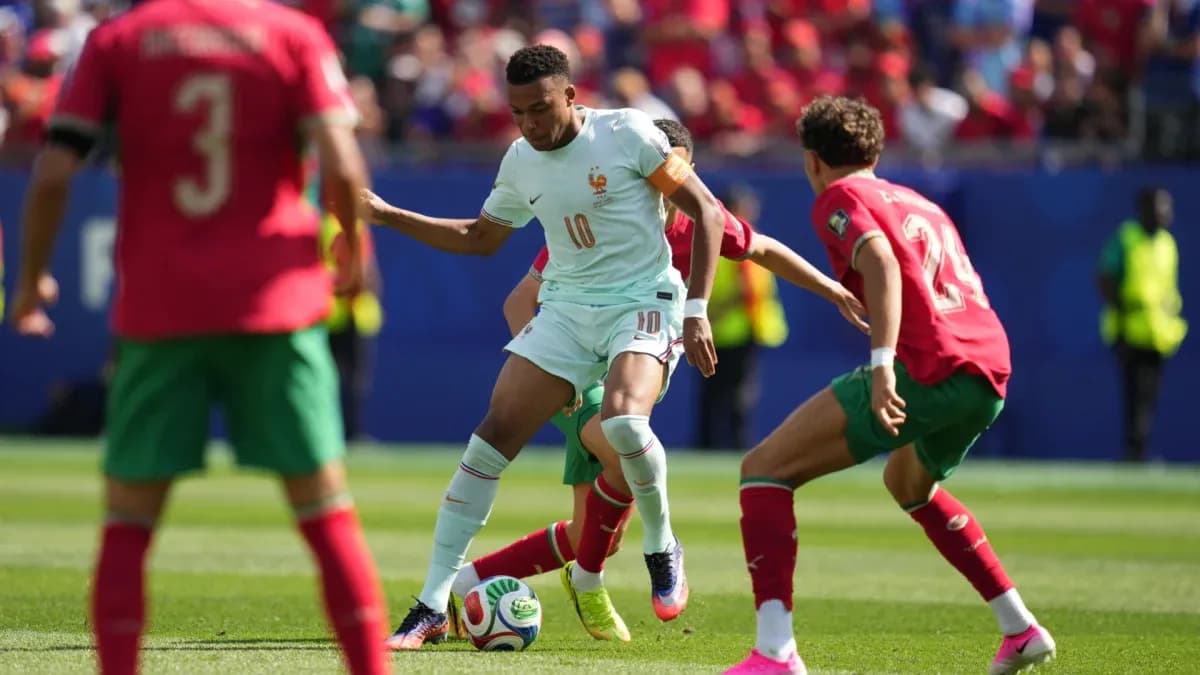
France are already waiting in the semi-finals, business handled, boots up. A 2-0 win over Morocco on Thursday booked their place at AT&T Stadium in Dallas on July 14, as the two-time champions stalk a historic hat-trick of World Cups.
Les Bleus have glided through this tournament with a ruthless calm. Group I was a procession: Senegal beaten 3-1, Iraq swept aside 3-0, Norway dismantled 4-1. The knockout rounds have been just as cold-blooded – Sweden taken apart 3-0, Paraguay squeezed out 1-0, Morocco dismissed without conceding.
The football is impressive. The numbers are brutal. But the story, as ever with France, is Kylian Mbappé.
The captain is already France’s all-time top scorer and is tearing through this World Cup like a man in a hurry. He leads the scoring charts in 2026 and has now drawn level with Lionel Messi on 17 non-penalty World Cup goals across his career. That’s not a chase anymore; that’s a direct comparison with the game’s modern benchmark.
Mbappé himself still points to Messi and Cristiano Ronaldo as the gold standard. His feet stay modest. His records don’t.
He did give France a scare with an ankle injury against Morocco, but his own verdict was brisk: “completely fine.” If he is anywhere near that description on Tuesday, Spain or Belgium will walk into a semi-final against the most devastating forward on the planet, in full flight and on the brink of yet more history.
Spain: La Roja’s new conductor
Spain arrive at the quarter-finals looking like a team that has rediscovered its edge. Ranked just behind Argentina in the FIFA standings, La Roja head into Friday’s clash with Belgium at SoFi Stadium in Los Angeles with the quiet confidence of a side that knows it belongs deep in this tournament.
Their path through Group H had a slow burn: a cagey 0-0 with Cabo Verde, then the throttle opened – Saudi Arabia thrashed 4-0, Uruguay edged 1-0. Austria were brushed aside 3-0 in the round of 16, Portugal then suffocated 1-0. It’s not the tiki-taka of a decade ago, but it has the same undertone: control, patience, and then the knife.
At the heart of this version of Spain stands Lamine Yamal. Just 18, just back from a hamstring injury, and already carrying the air of a long-term reference point.
He admitted before the tournament he was still building up to 90-minute sharpness. The talent has never been in doubt. A right winger who can both unpick a defence and rip through it, Yamal has already shown in previous competitions that the stage doesn’t intimidate him. Now, with Belgium in front of him and a possible semi-final against France beyond that, the spotlight only grows harsher.
Spain haven’t lifted the World Cup since 2010. With this squad, and this emerging star, 2026 feels like their best shot at reclaiming that aura.
Belgium: Lukaku against the noise
Belgium were meant to be fading out of the conversation. Instead, they walked into the United States’ own party and turned off the music.
A 4-1 demolition of Team USA on Monday didn’t just knock the hosts out of their home World Cup; it silenced a week of noise. FIFA had suspended Folarin Balogun’s red card to allow him to play, a decision Donald Trump publicly claimed a role in. Betting markets swung towards the Americans. The narrative was written.
Belgium tore it up.
De Rode Duivels had eased through the group with a pair of tight draws against Egypt (1-1) and Iran (0-0), before unleashing themselves on New Zealand in a 5-1 hammering. Senegal were then edged 3-2 in the round of 16. The U.S. were simply overwhelmed.
Even after that, coach Rudi Garcia was blunt enough to say that “everyone thinks [they] are going home.” That sense of dismissal has become fuel.
Romelu Lukaku is at the centre of it. Belgium’s all-time top scorer has turned this World Cup into his personal late-show. He has scored in each of Belgium’s last three matches, coming off the bench every time, becoming the first player in World Cup history to score as a substitute in four separate games.
Impact player? Yes. But the numbers scream for more. With Spain next, and a potential reunion with France in the semi-final, Lukaku has the chance to turn a doubted campaign into a defiant one – and to drag Belgium into a conversation most thought they’d left behind.
Norway: Haaland tears up the script
Norway were not supposed to be here. Not really. A nation with a thin World Cup history now stands 90 minutes from a semi-final, their quarter-final against England set for Saturday at Hard Rock Stadium in Miami.
For Landslaget, this is already uncharted territory – their best-ever World Cup performance. The way they’ve done it suggests they’re not finished.
Drawn alongside France in Group I, they were thumped 4-1 by the reigning champions. That could have broken them. Instead, it sharpened them. Iraq were beaten 4-1, Senegal edged 3-2, and Norway slipped into the knockouts with a growing sense of belief.
Then came the real statement. Côte d'Ivoire beaten 2-1. Brazil, five-time world champions, knocked out by the same scoreline. Suddenly, this isn’t a novelty run. It’s a threat.
At the heart of it is Erling Haaland, a striker built for these kinds of tournaments. His name is already mentioned alongside Messi and Ronaldo, even if he himself swerves those comparisons. The numbers drag him back into that conversation.
Norway’s all-time top scorer has 60 goals in just 53 senior internationals, his 60th arriving in that win over Côte d'Ivoire. Messi and Ronaldo needed more than twice as many games to reach the same mark. That is not normal output. That is a phenomenon.
England now stand between Haaland and a World Cup semi-final. They know exactly what’s coming. The question is whether they can stop it.
England: Kane’s window
England keep finding ways to stay alive. It has not always been smooth, but it has been effective, and that’s all that matters in July.
The Three Lions emerged from Group L with a 4-2 win over Croatia, a goalless draw with Ghana, and a controlled 2-0 victory against Panama. In the knockouts, they edged the Democratic Republic of Congo 2-1 and then survived a 3-2 thriller against Mexico.
It leaves them three wins from a World Cup they have chased, and suffered for, for generations.
Harry Kane remains the compass of this team. Captain, focal point, and England’s all-time leading scorer, he has six goals at this World Cup – fourth on the charts behind Mbappé, Messi and Haaland. That company tells its own story.
Kane already owns a Golden Boot from 2018. This season, he has piled up 73 goals in the 2025-26 campaign, a total bettered only by Messi’s legendary 2011-12 haul. He is in the kind of form that defines careers and rewrites records.
Norway will not sit back. Haaland will not allow them to. The quarter-final in Miami looks less like a tactical chess match and more like a duel between two of the most ruthless finishers of their generation. For Kane, at 32, this may be the clearest, and perhaps last, World Cup window in which everything feels aligned.
Argentina: Messi and the last stand of South America
Amid the European swarm, one blue-and-white shirt still cuts through the noise. Argentina, ranked No. 1 in the world, carry the weight of a continent into their quarter-final against Switzerland at Arrowhead Stadium in Kansas on Saturday.
La Albiceleste have played like a top seed. Group J was handled with authority: Algeria beaten 3-0, Austria 2-0, Jordan 3-1. Cabo Verde were then dispatched 3-2 in the round of 16, Egypt beaten by the same scoreline in the last 16. There have been nervy spells, but Argentina have always found a way through.
Lionel Messi remains the axis around which everything spins. Head coach, captain, and still the game’s enduring reference point, he walks into every stadium as both a living legend and an active problem to solve.
He was the first player ever to win the World Cup’s Golden Ball twice. In this tournament alone, he has already pushed the bar higher again: the most goals in World Cup history, now up to 21 and counting, and the first player to score in eight consecutive World Cup matches.
For many, he is already the greatest of all time. For Messi, this World Cup is another chance to add distance between himself and everyone else.
Argentina stand as the only non-European side left in the competition, but there is nothing underdog about them. They are the hunted, not the hunters. Switzerland know exactly what they are trying to topple.
Switzerland: Xhaka and the art of resistance
Switzerland have been here before – resilient, awkward, hard to beat – but rarely with stakes like this. Ranked 19th in the world, they now stare up at the game’s highest mountain: Argentina, Messi, and a semi-final spot on the line.
Nati emerged from Group B with a 1-1 draw against Qatar, then a 4-1 dismantling of Bosnia and Herzegovina and a 2-1 win over Canada. In the knockouts, they shut down Algeria 2-0, then outlasted Colombia in a goalless grind decided 4-3 on penalties.
It has been a campaign built on structure and stubbornness, not fireworks. Perfect preparation for a date with Messi.
Granit Xhaka embodies this Swiss side. The captain and defensive midfielder has already led his country to their first World Cup quarter-final since 1954, dictating games not with goals but with positioning, passing lanes and tempo. His role is not to finish moves but to start them, to break through pressure and give his forwards room to breathe.
Switzerland have openly relished the idea of facing Messi. Admiration is there, but so is ambition. They don’t just want to share a pitch with him; they want to send him home.
If Xhaka can smother Argentina’s rhythm and turn this into a grind, the upset door creaks open. If he can’t, Messi and company will walk through to the last four and keep South America’s flame burning a little longer.
Seven teams remain. Titans, late bloomers, and one enduring genius. The margins are shrinking, the stakes are climbing, and every game now feels like it could define a generation. Who blinks first?

