.svg&w=384&q=75 "GoalGist logo")
Villarreal vs Sevilla: Tactical Analysis of a 2-3 Defeat
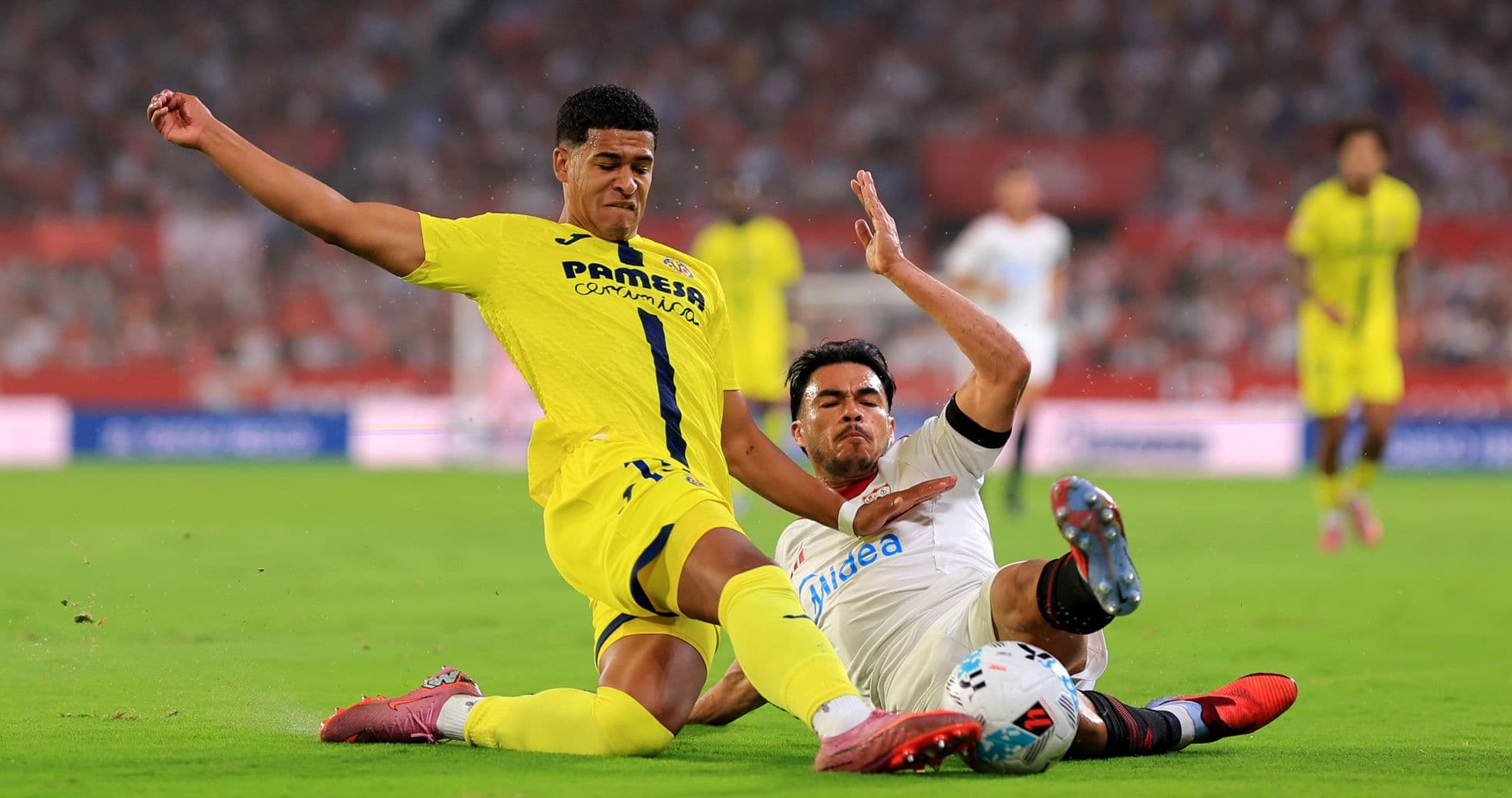
Villarreal’s 2-3 home defeat to Sevilla at Estadio de la Ceramica unfolded as a tactical inversion of control versus efficiency. In a La Liga Regular Season - 36 fixture refereed by Mateo Busquets Ferrer, Marcelino’s 4-4-2 dominated the ball with 63% possession and superior passing volume, yet Luis Garcia Plaza’s 5-3-2 absorbed pressure and struck with precision. Villarreal led 2-0 by the 20th minute but went in at half-time at 2-2 and were ultimately overturned after the break. The underlying story is of a Villarreal side structurally on the front foot but vulnerable in defensive transitions, against a Sevilla block that maximised limited possession and shot quality.
The scoring sequence reflected a game that swung sharply after Villarreal’s early control. On 13', Gerard Moreno (Villarreal) finished a well-constructed move, assisted by Georges Mikautadze, exploiting Sevilla’s back five before it could settle. Seven minutes later, on 20', the roles reversed: Mikautadze (Villarreal) scored, assisted by Alberto Moleiro, as Villarreal’s front two combined with their advanced left-sided midfielder to carve through the visitors again. Sevilla’s response began on 36', when Oso (Sevilla), assisted by Lucien Agoume, converted to pull it back to 2-1, capitalising on space as Villarreal’s midfield line failed to reset behind the ball. The comeback was complete right on 45', as Kike Salas (Sevilla), assisted by Rodrigo Vargas, struck to make it 2-2, punishing Villarreal’s set-piece or second-phase organisation just before the interval. The decisive moment arrived on 72': Aleix Adams (Sevilla), assisted by Djibril Sow, finished Sevilla’s best transition of the second half to make it 2-3, a lead they protected to full time.
Disciplinary Log
The disciplinary log was light but telling. There were three yellow cards in total: Villarreal 2, Sevilla 1, Total: 3. All cards and reasons, in chronological order, were:
- 81' Ayoze Pérez (Villarreal) — Foul
- 90+2' Renato Veiga (Villarreal) — Foul
- 90+3' José Ángel Carmona (Sevilla) — Time wasting
These bookings underlined Villarreal’s increasing urgency and Sevilla’s game management once in front.
Tactical Analysis
Tactically, Villarreal’s 4-4-2 was built to dominate possession and territory. With 554 passes, 499 accurate (90%), they circulated the ball confidently, particularly through Dani Parejo and Pape Gueye in the first hour, then with Santi Comesana from 70' after he replaced Parejo (S. Comesana (IN) came on for D. Parejo (OUT) at 70'). The wide midfielders, Nico Pepe on the right and Moleiro on the left, held high positions, creating a de facto 2-4-4 in settled attacks. This produced 6 total shots, 4 on goal, and 0.81 xG: a modest shot volume considering the territorial control, pointing to Sevilla’s compact box defending.
The early goals illustrated Villarreal’s best patterns: vertical connections into Mikautadze’s feet, lay-offs into Moreno, and underlapping support from Moleiro. However, once 2-0 up, Villarreal’s rest defence faltered. The back four of Alfonso Pedraza, Renato Veiga, Pau Navarro and A. Freeman were often left with only one screening midfielder in front when both wide men and one central midfielder pushed high. Sevilla’s first goal came as Villarreal’s midfield line was caught ahead of the ball; the second exposed their vulnerability to deliveries and second balls around the box.
Marcelino’s substitutions at 60' and 70' shifted the structure but did not resolve the underlying transition issue. At 60', Thomas Partey (IN) came on for Pape Gueye (OUT), and Tajon Buchanan (IN) came on for Nico Pepe (OUT), with Partey intended to stabilise the centre and Buchanan to inject 1v1 threat on the flank. Later, at 70', Ayoze Pérez (IN) came on for Georges Mikautadze (OUT), adding a more roaming forward profile. These changes tilted Villarreal even more towards attack, but Sevilla’s low block and compact back five narrowed central channels, forcing Villarreal into wider, less dangerous areas. The late yellow for Ayoze Pérez for Foul at 81' reflected his aggressive attempts to regain possession high as the game slipped away.
Defensively, Villarreal’s goalkeeper Arnau Tenas faced 13 Sevilla shots, 5 on goal, making 2 saves. With goals prevented at -0.22, his performance statistically underperformed the xG on target he faced, suggesting at least one of the three goals was relatively saveable. More importantly, the team’s Defensive Index on the day was compromised by structural exposure rather than pure individual errors: Sevilla generated 0.88 xG from just 37% possession, a sign that Villarreal allowed too many clean looks when their press was broken.
Sevilla’s 5-3-2 under Luis Garcia Plaza was designed to concede territory but protect central zones. The back five of Oso, Gonzalo Montiel’s role equivalent in Oso, G. Suazo, Kike Salas, Cesar Azpilicueta and José Ángel Carmona stayed narrow, with wing-backs timing their jumps to Villarreal’s wide midfielders. In midfield, R. Vargas, Agoume and Sow formed a compact triangle, screening passes into Moreno and Mikautadze. On the ball, Sevilla were selective: 325 passes, 276 accurate (85%), reflecting a more direct, vertical approach. They produced 13 total shots, 5 on goal, and 0.88 xG, a higher shot and xG output than Villarreal despite far less possession.
The attacking plan hinged on quick transitions once the first line of Villarreal’s press was beaten. Adams and Neal Maupay initially pinned Villarreal’s centre-backs, then attacked the channels vacated by advancing full-backs. Oso’s goal at 36' and Adams’s winner at 72' both came from sequences where Sevilla broke through the first pressure and attacked an unbalanced back line. The substitution pattern reinforced this: at 68', J. Sanchez (IN) came on for R. Vargas (OUT) to add fresh legs in midfield; at 72', A. Sanchez (IN) came on for N. Maupay (OUT) to refresh the front line just before Adams scored. Later, N. Gudelj (IN) came on for D. Sow (OUT) at 86' and Castrin (IN) came on for A. Adams (OUT) at 86', clearly aimed at shoring up the block and defending the 2-3 lead. Carmona’s 90+3' yellow for Time wasting encapsulated Sevilla’s late-game posture: compact, pragmatic, and focused on closing the match out.
Statistical Overview
In statistical terms, the verdict is clear: Villarreal’s overall form in this match was possession-dominant but chance-poor, while Sevilla’s was the inverse. Villarreal’s 63% possession, 554 passes and 90% pass accuracy indicate strong control phases, but only 6 shots and 0.81 xG reveal a lack of incision against a deep block. Their 11 Fouls and 2 yellow cards for Foul show a team increasingly stretched and reactive in defensive transitions. Sevilla, with 37% possession and 325 passes at 85% accuracy, turned their limited ball time into 13 shots and 0.88 xG, embodying a high-efficiency, low-volume attacking model. Defensively, both goalkeepers registered 2 saves (Villarreal) and 1 save (Sevilla), with each side’s goals prevented at -0.22, suggesting neither keeper overperformed expectations. Ultimately, Sevilla’s superior transition structure and set-piece or second-phase sharpness outweighed Villarreal’s territorial dominance, justifying the 2-3 scoreline at Estadio de la Ceramica.