.svg&w=384&q=75 "GoalGist logo")
Rayo Vallecano's Tactical Masterclass Against Villarreal
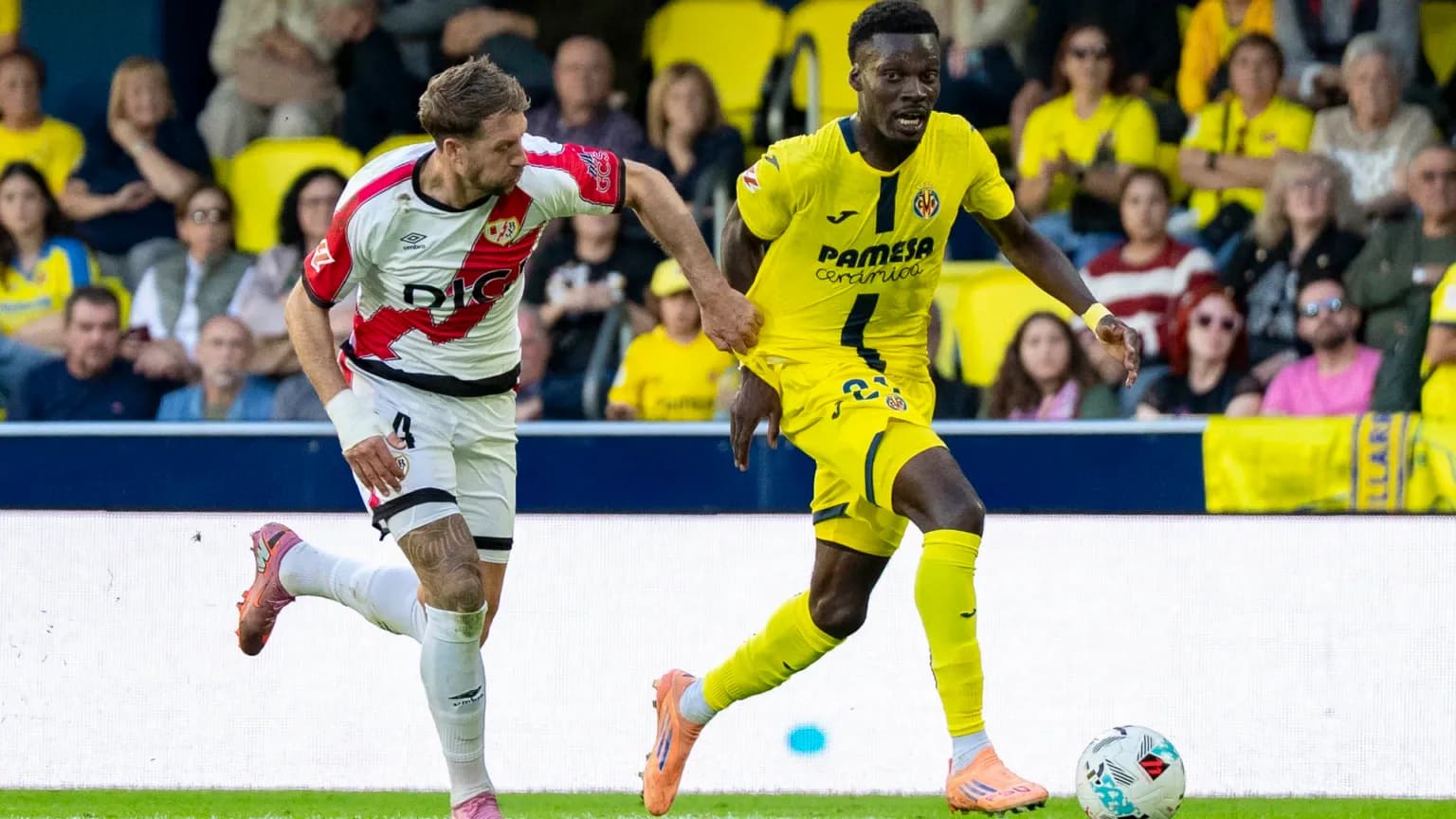
The late-afternoon light over Campo de Futbol de Vallecas caught a home side playing like a team determined to finish a season on its own terms. Following this result, Rayo Vallecano’s 2-0 win over Villarreal in La Liga’s Regular Season - 37 was more than an upset of the league’s 3rd-placed side; it was a tactical assertion from a group that has quietly built one of Spain’s most awkward home identities.
Rayo came into the day 8th in the table on 47 points, with a goal difference of -4 (39 scored, 43 conceded overall). That negative GD hides a split personality: at home they had scored 24 and conceded 15, while on their travels they had managed only 15 for and 28 against. Vallecas has been their fortress, and Inigo Perez leaned into that, sending out his trusted 4-2-3-1 once again — a shape Rayo have used in 23 league matches this season.
Across from them, Villarreal arrived as one of the division’s most entertaining heavyweights. Third place, 69 points, and a goal difference of +22 (67 for, 45 against overall) told the story of a side that overwhelms opponents, especially at home. But on their travels the Yellow Submarine have been more human: 24 goals scored and 27 conceded away, with 7 wins, 5 draws, and 7 defeats. Marcelino stuck to his 4-4-2, the formation that has underpinned 36 of their league outings, but in Vallecas that familiar structure was bent out of shape.
First Half
The opening act belonged to Rayo’s structure and intensity. With A. Batalla behind a back four of A. Ratiu, P. Ciss, F. Lejeune and P. Chavarria, Perez effectively built a hybrid line: nominally a flat four, but with Ciss stepping into midfield when Rayo had the ball, mirroring his season profile as a midfielder who can defend high and aggressively. In front of them, the double pivot of U. Lopez and O. Valentin provided the platform for a fluid three of J. de Frutos, O. Trejo and S. Camello behind Alemao.
If Villarreal’s season DNA is about verticality and incision — 1.8 goals per game overall, with 2.4 at home and 1.3 away — they were smothered early. Rayo, who average 1.3 goals at home and concede only 0.8, played to their strengths: compact distances, aggressive pressing triggers, and a front four willing to run.
The first goal before the interval, with Rayo leading 1-0 at half-time, encapsulated that identity. De Frutos, Rayo’s leading scorer this season with 10 league goals and 1 assist, repeatedly found pockets between Villarreal’s full-backs and centre-backs. His season numbers — 49 shots, 28 on target, and 30 key passes — mark him as the home side’s “hunter”, and Villarreal’s away profile (27 conceded, 1.4 goals against per game on their travels) suggested vulnerability when dragged wide and forced to defend crosses or cut-backs. Vallecas exploited exactly that channel.
Behind him, Lopez and Valentin controlled the “engine room”. Lopez’s metronomic passing dovetailed with Valentin’s willingness to shuffle laterally and plug gaps. Against Villarreal’s central duo of S. Comesana and P. Gueye, the battle was as much about body orientation as it was about tackles. Comesana’s season line — 1208 completed passes, 46 tackles, 15 blocked shots and 30 interceptions — paints him as an all-phase midfielder. But in this game, he was frequently forced to turn toward his own goal, pressed by Trejo and Camello curving their runs to cut off passing lanes into A. Moleiro.
Moleiro, one of Villarreal’s most dangerous creators with 10 goals and 5 assists this campaign, started wide but constantly drifted inside to find the half-spaces. Yet Rayo’s full-backs and pivots read those movements well. Ratiu, who has 38 interceptions and 69 tackles this season, stepped in aggressively when Moleiro came inside, while Lopez tracked the secondary runs. The result: Villarreal’s usual rhythm from deep — often built through Comesana into Moleiro and then into the forwards — was broken into disjointed phases.
Second Half
In the “Hunter vs Shield” matchup, Rayo’s attacking spearhead was less about a single striker and more about a collective swarm. Alemao offered depth, but it was De Frutos and Trejo who repeatedly attacked the seams. Villarreal’s back line, with S. Mourino and W. Kambwala centrally, had the physical tools, yet the numbers hint at why they struggled: on their travels, Villarreal concede 1.4 per game, and their biggest away defeat (4-1) underscores what happens when their midfield screen is bypassed. In Vallecas, that pattern resurfaced. Mourino, who has committed 53 fouls and picked up 10 yellow cards this season, again found himself dragged into uncomfortable duels wide and high, a sign that Villarreal’s defensive block was being stretched horizontally.
Absences sharpened these dynamics. Rayo were without Isi Palazon, suspended after a red card and one of La Liga’s most carded players (10 yellows, 1 red), along with I. Akhomach, A. Garcia, Luiz Felipe and D. Mendez through injury. Without Isi’s directness and set-piece threat, there was a risk of losing edge between the lines. Instead, De Frutos stepped into that responsibility, while Trejo’s intelligence in tight spaces ensured Rayo still had a creative hub.
Villarreal, missing J. Foyth and R. Veiga, lost both a defensive stabiliser and a midfield runner. Foyth’s absence on the right removed a natural 1v1 defender and ball-carrier from the back, which mattered against Rayo’s wide overloads. Veiga’s suspension reduced Marcelino’s options to add late energy and pressing from midfield when chasing the game.
Disciplinary trends also framed the contest. Rayo’s season-long yellow card distribution shows a clear late-game spike: 19.80% of their yellows between 61-75 minutes and 15.84% between 76-90, while Villarreal’s yellows peak even more dramatically in the final quarter-hour (25.32% between 76-90). This is a fixture structurally primed for chaos as legs tire and spaces open. Yet Rayo’s 2-0 full-time scoreline, built on a 1-0 half-time lead, suggested they managed that emotional edge better, leveraging their 8 home clean sheets this season and a defensive record of just 0.8 goals conceded per home match.
From a statistical prognosis standpoint, the upset feels less like an anomaly and more like a clash of profiles tilting toward the hosts. Rayo’s home solidity — 7 wins, 10 draws, only 2 defeats in 19 home games — collides with Villarreal’s more volatile away numbers. Even without explicit xG data, the season patterns are clear: Villarreal’s attack is elite, but their away defensive structure leaves windows open. Rayo, who have failed to score at home in only 3 matches this season, created enough volume and quality to punish those gaps.
Following this result, the narrative is of a mid-table side with European aspirations out-thinking and out-fighting a Champions League-bound giant. Rayo’s 4-2-3-1, anchored by Ciss’s dual role and illuminated by De Frutos between the lines, proved the more coherent system. Villarreal’s 4-4-2, so often devastating, was reduced to straight lines and hopeful surges.
In Vallecas, the numbers and the eye test aligned: a defensively disciplined, tactically drilled Rayo Vallecano side leveraged their home identity to shut down one of La Liga’s most potent attacks and write a statement win into the final chapter of their season.