.svg&w=384&q=75 "GoalGist logo")
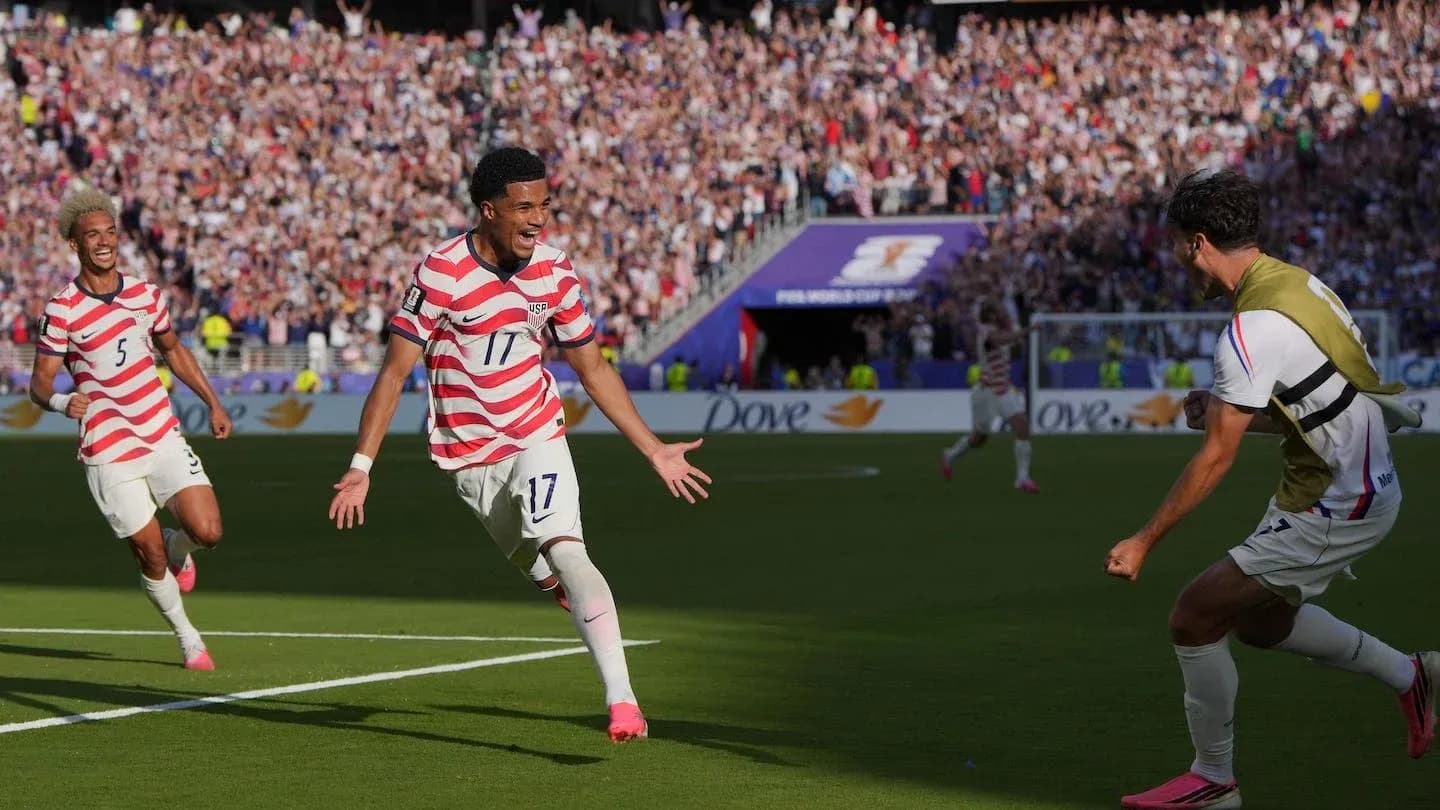
USA Triumphs Over Bosnia & Herzegovina in World Cup Knockout
Levi’s Stadium, draped in World Cup colour rather than club allegiance, hosted a Round of 32 tie that felt like a tactical thesis on modern tournament football. USA versus Bosnia & Herzegovina ended 2–0 to the Americans, but the real story lay in how Mauricio Pochettino’s side bent the game to their structural strengths, and how Sergej Barbarez’s five-man defence oscillated between resilience and resignation.
I. The Big Picture
Heading into this game, USA arrived as group winners from Group D, ranked 1st with 6 points and a goal difference of 4, built on 8 goals scored and 4 conceded across 3 matches. Their World Cup campaign overall had been defined by aggression at “home” venues: 3 wins from 3 as the designated home side, with 8 goals scored and only 1 conceded, an average of 2.7 goals for and 0.3 against at home. On their travels they had been more vulnerable, losing once, with 2 goals scored and 3 conceded, averaging 2.0 for and 3.0 against away.
Bosnia & Herzegovina, 3rd in Group B with 4 points and a goal difference of -1 (5 scored, 6 conceded in the group), came into the knockout phase with a more fragile defensive profile. Across the World Cup, they had played 4 fixtures: 1 at home and 3 away. At home they were explosive but exposed, averaging 3.0 goals for and 1.0 against. Away, however, they were far more subdued, with only 0.7 goals scored and 2.3 conceded on average. This Round of 32 tie, played on neutral ground but logged as an away outing in their seasonal pattern, always threatened to mirror that away fragility.
Pochettino’s USA leaned into their attacking DNA with a 4-3-3, while Barbarez pivoted from Bosnia’s more frequent 4-4-2 to a 5-3-2, signalling respect for American firepower and a desire to compress the central lane.
II. Tactical Voids and Selection Choices
USA’s squad sheet contained two quiet but important absences: M. McKenzie (bruised foot) and C. Roldan (muscle bruise) were unavailable. Neither is a headline name, but in tournament football, losing a rotation defender and a versatile midfielder narrows the manager’s in-game adjustment options. That made the starting back four of A. Robinson, T. Ream, C. Richards and A. Freeman all the more critical, with M. Freese trusted in goal.
In front of them, a midfield triangle of T. Adams, W. McKennie and M. Tillman was clearly designed to suffocate transitions. Adams anchored, McKennie roamed as the box-to-box disruptor, and Tillman connected to the front three of S. Dest, F. Balogun and C. Pulisic. Dest’s listing as a forward was a tactical tell: he would invert and overload zones rather than hug the touchline.
Bosnia & Herzegovina’s 5-3-2 was a structural hedge. The back five of S. Kolasinac, S. Radeljic, T. Muharemovic, N. Katic and A. Dedic screened N. Vasilj in goal, with a midfield of K. Alajbegovic, I. Sunjic and A. Gigovic tasked with closing passing lanes rather than dictating play. Up front, the pairing of E. Dzeko and E. Demirovic offered a classic “target plus runner” dynamic, but with limited support expected from deep.
Discipline had been a live-wire theme for both sides in the group phase. USA’s yellow cards clustered most heavily between 46–60 minutes (40.00%) and then split between 16–30, 76–90 and 91–105 (each 20.00%). Their single red card this tournament had arrived between 61–75 minutes. Bosnia’s yellows peaked late, with 37.50% shown between 76–90 minutes and 25.00% between 46–60, and they too had a red card, arriving in that same 76–90 window. That shared tendency towards second-half volatility hung over this knockout, especially with the stakes magnified.
III. Key Matchups
Hunter vs Shield
At the heart of USA’s attack stood F. Balogun, one of the World Cup’s more efficient forwards. Heading into this game he had 3 goals in 3 appearances, from 8 shots with 4 on target. His 7.23 average rating reflected more than just finishing: 38 passes attempted at 63% accuracy, 7 dribbles with 3 successful, and 7 fouls drawn highlighted his role as both finisher and pressure valve. His disciplinary record was a double-edged sword: 1 yellow and 1 red card in the tournament, making him both talisman and potential liability.
Opposite him, Bosnia’s central defence was anchored by T. Muharemovic, whose World Cup so far had been defined by steady, sometimes desperate, resistance. He had completed 157 passes at 84% accuracy, made 8 interceptions and blocked 1 shot, and won 16 of 24 duels. Yet he too carried a red card in this tournament, a reminder that his aggression could overstep the line.
This duel crystallised the tactical narrative: Balogun’s movement between the lines, dragging centre-backs into awkward zones, against a defender who excels when the game is in front of him and the line is deep. USA’s wide forwards, Pulisic and Dest, repeatedly pinning Bosnia’s wing-backs, stretched the back five into a back three, isolating Muharemovic and his partners in precisely the situations they least wanted.
Engine Room
In midfield, T. Adams and W. McKennie formed the hinge of USA’s control. Their job was twofold: protect Ream and Richards against Dzeko’s hold-up play, and suffocate the passing angles into Demirovic. Bosnia’s answer lay with I. Sunjic and A. Gigovic, who had to shuttle laterally in a narrow band, constantly deciding whether to step into McKennie or drop onto Adams.
With Bosnia & Herzegovina having failed to keep a single clean sheet in the tournament overall and conceding 8 goals in 4 matches, their midfield shield had already shown cracks. USA, conversely, had 2 clean sheets at home and only 1 goal conceded in those 3 home-designated fixtures, suggesting that once their midfield got on top, they rarely allowed opponents back into games.
IV. Statistical Prognosis and Tactical Verdict
From a statistical vantage point, the 2–0 scoreline aligned with the broader seasonal currents. USA’s overall attack, averaging 2.5 goals per game across the campaign, once again found a way through, while their defence, conceding only 1.0 on average overall and 0.3 at home, comfortably contained a Bosnia side that had averaged just 1.3 goals per match and only 0.7 on their travels.
The disciplinary subtext remained important. With both Balogun and Muharemovic already carrying red cards in this World Cup, the second half was always likely to tilt on who managed their aggression better. USA, whose yellows spike just after the interval, had to balance their trademark intensity with control; Bosnia, prone to late yellows and a red between 76–90 minutes, risked implosion if forced into a chasing game. In the end, USA’s superior structure and game-state management kept them on the right side of that fine line.
There were no penalties awarded, and with both teams yet to score or miss from the spot in this tournament, the contest remained decided in open play. That suited USA’s expansive 4-3-3, which maximised their attacking talent, and exposed Bosnia’s away-travel defensive average of 2.3 goals conceded per match as a structural weakness rather than a statistical blip.
Following this result, the narrative is clear: USA look every inch a knockout machine when allowed to impose their tempo, their 4-3-3 now the dominant template after being used in 2 of their 4 World Cup line-ups. Bosnia & Herzegovina, meanwhile, depart with the story of a side that flirted with solidity in a 5-3-2, but whose season-long defensive numbers and late-game disciplinary fragility finally caught up with them on the biggest stage.