.svg&w=384&q=75 "GoalGist logo")
Tottenham and Leeds Share Points in Tense Premier League Clash
Under the London lights at Tottenham Hotspur Stadium, a 1–1 draw between Tottenham and Leeds closed out a tense Premier League evening that felt like a crossroads for both clubs. Following this result in Round 36, the table still paints Spurs as a side flirting with danger in 17th on 38 points, while Leeds, 14th with 44 points, continue to live in the grey zone between safety and genuine progress.
I. The Big Picture – Two Seasons, One Shared Fragility
Tottenham’s season-long profile is stark. Overall they have won 9 of 36, drawn 11 and lost 16, with 46 goals for and 55 against – a goal difference of -9 that underlines a campaign built on instability. At home the numbers are even more jarring: only 2 wins from 18, with 21 goals scored and 31 conceded. An average of 1.2 goals for and 1.7 against at home tells the story of a team that cannot turn this stadium into a fortress.
Leeds arrive from a different emotional place but with similar statistical scars. Overall they sit on 10 wins, 14 draws and 12 defeats, with 48 goals scored and 53 conceded – a goal difference of -5. At Elland Road they have been solid, but on their travels the picture is fragile: 2 away wins in 18, 9 draws, 7 defeats, scoring 20 and conceding 32. Their away average of 1.1 goals for and 1.8 against mirrors Tottenham’s home frailty almost exactly.
The 1–1 scoreline feels like a mathematical meeting point of two sides whose season-long Expected Goals patterns (even without raw xG values here) are defined by vulnerability rather than dominance: Spurs concede too much at home, Leeds leak too much away.
II. Tactical Voids – The Weight of Absence
This fixture was shaped as much by who was missing as by who took the pitch.
Tottenham were stripped of an entire spine and creative tier: Guglielmo Vicario, Cristian Romero, Ben Davies, Mohammed Kudus, Dejan Kulusevski, Wilson Odobert, Xavi Simons and Dominic Solanke all listed as “Missing Fixture”. It forced Roberto De Zerbi to lean into a 4-2-3-1 that looked like a patchwork: A. Kinsky in goal, a back four of Pedro Porro, K. Danso, Micky van de Ven and Destiny Udogie, with João Palhinha and Rodrigo Bentancur shielding. Ahead, Randal Kolo Muani, Conor Gallagher and Mathys Tel supported Richarlison as the lone striker.
Without Romero’s aggression and distribution, van de Ven’s red-card history and physicality took on even more weight. His season has already included 4 goals, 1 assist, 38 tackles and 21 successful blocks; here, he again had to be the organiser and last line. Porro, one of the league’s most carded full-backs with 9 yellows, brought his usual duality: 49 key passes this season but also a readiness to step into risky duels.
Leeds were also depleted: J. Bogle, Facundo Buonanotte, Ilia Gruev, Gudmundsson and Noah Okafor all absent. Daniel Farke responded with a 3-5-2 built on defensive density: Karl Darlow behind a trio of Joe Rodon, Jaka Bijol and Pascal Struijk, a midfield band of Daniel James, A. Stach, Ethan Ampadu, Ao Tanaka and James Justin, with Dominic Calvert-Lewin and Brenden Aaronson up front.
Disciplinary trends from the season hinted at the game’s tone. Tottenham’s yellow-card distribution peaks between 61–75 minutes at 25.26%, suggesting a side that grows increasingly desperate as the second half wears on. Leeds’ yellows spike in the same late-middle phase (23.33% from 61–75), with another surge between 76–90 (16.67%). The pattern promised a scrappy, card-heavy closing act, and the draw reflected two sides who oscillate between control and panic as the clock ticks down.
III. Key Matchups – Hunter vs Shield, Engine Room vs Enforcer
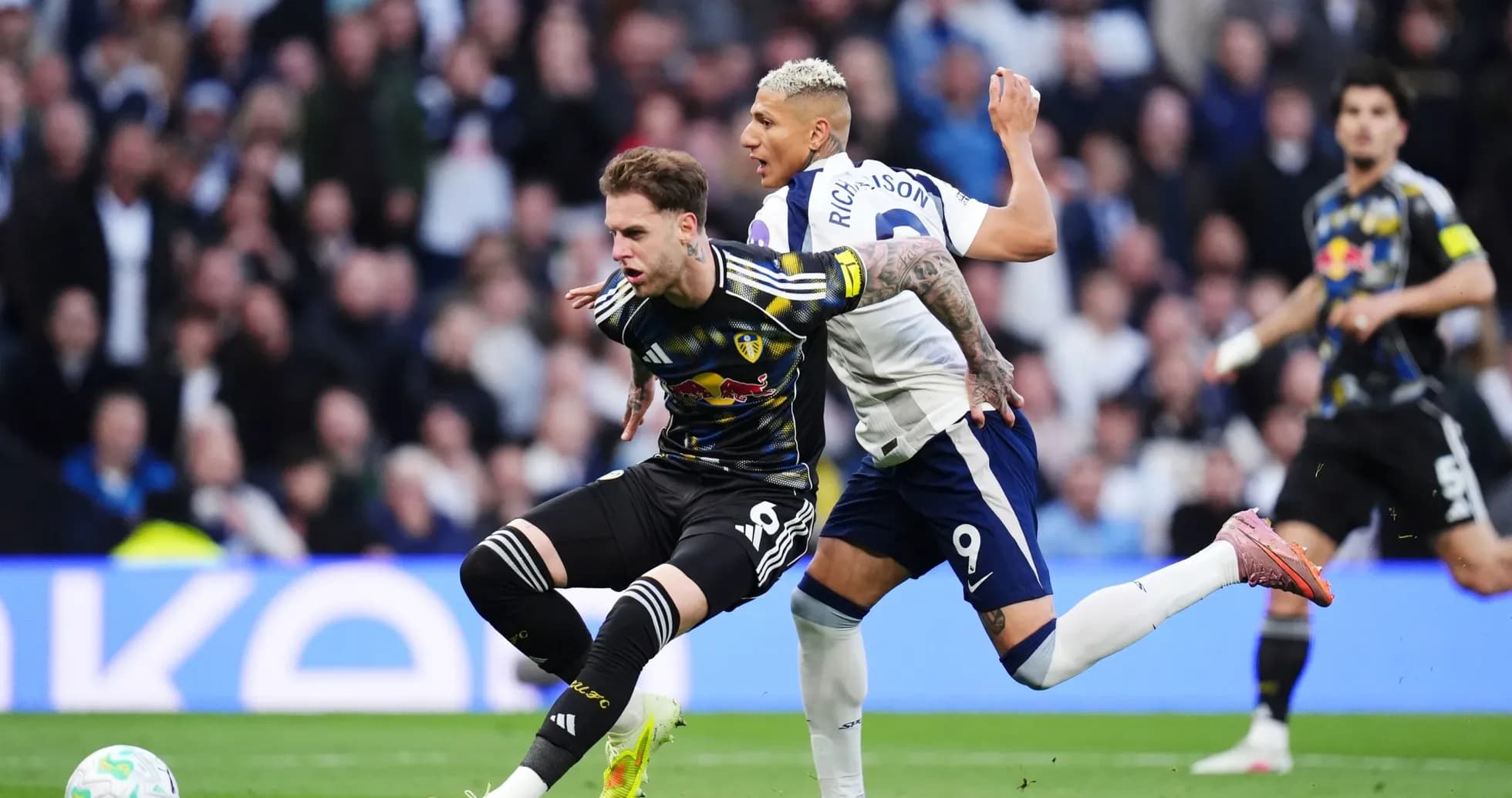
The headline duel was always going to be Richarlison versus the Leeds back three. With 10 goals and 4 assists this season, plus 42 shots (24 on target), the Brazilian has carried much of Tottenham’s attacking threat. His 294 duels with 123 won underline a forward who relishes physical contact, and against Rodon, Bijol and Struijk he constantly tested Leeds’ aerial and ground resilience.
On the other side, Dominic Calvert-Lewin arrived as one of the league’s most productive strikers: 13 goals and 1 assist, 64 shots with 32 on target. Crucially, his penalty record is not spotless – 4 scored but 1 missed – an important detail for a Leeds side whose season-long penalty output (6 scored from 6 as a team) masks individual imperfections. His duel volume (444, with 174 won) speaks to a centre-forward who lives in the thick of the battle, pinning centre-backs and creating chaos.
Behind him, Brenden Aaronson functioned as Leeds’ creative scalpel. With 5 assists, 32 key passes and 80 dribbles attempted (28 successful), his role between the lines was to pull Spurs’ double pivot out of shape. His task was complicated by Palhinha, a pure destroyer whose presence allowed Bentancur and Gallagher to step higher.
The true “Engine Room” clash, though, centred on Ethan Ampadu. Across 33 appearances he has completed 1,628 passes at 85% accuracy, made 78 tackles, 16 successful blocks and 50 interceptions, all while collecting 9 yellow cards. He is Leeds’ metronome and enforcer rolled into one. His duel with Gallagher – a perpetual presser and connector – and with Kolo Muani drifting inside from the band of three, defined who controlled the game’s rhythm.
IV. Statistical Prognosis – A Draw that Fits the Numbers
Following this result, the numbers still suggest both sides are what they appear to be: flawed, dangerous, and inconsistent. Tottenham’s overall scoring average of 1.3 goals for and 1.5 against, combined with Leeds’ mirror image of 1.3 for and 1.5 against, makes a 1–1 feel almost inevitable in Expected Goals terms: neither side has the defensive solidity to shut the other out, nor the attacking clarity to run away with it.
Tottenham’s chronic home issues – 2 wins in 18, only 2 home clean sheets – underline why even with Richarlison’s threat and Gallagher’s energy, they could not close the game down. Leeds’ away profile – just 2 wins, 32 goals conceded on their travels – explains why they could not turn phases of control into a decisive victory.
In narrative terms, this was a night where the Hunter and the Shield cancelled each other out. Calvert-Lewin’s penalty imperfection lingered as a subtext, Richarlison’s streaky finishing as another, but the real story was structural: two teams whose xG landscapes are built on openness and risk, producing exactly the kind of fragile, finely balanced contest their seasons have promised all along.