.svg&w=384&q=75 "GoalGist logo")
Switzerland's Tactical Masterclass Against Algeria in World Cup Round of 32
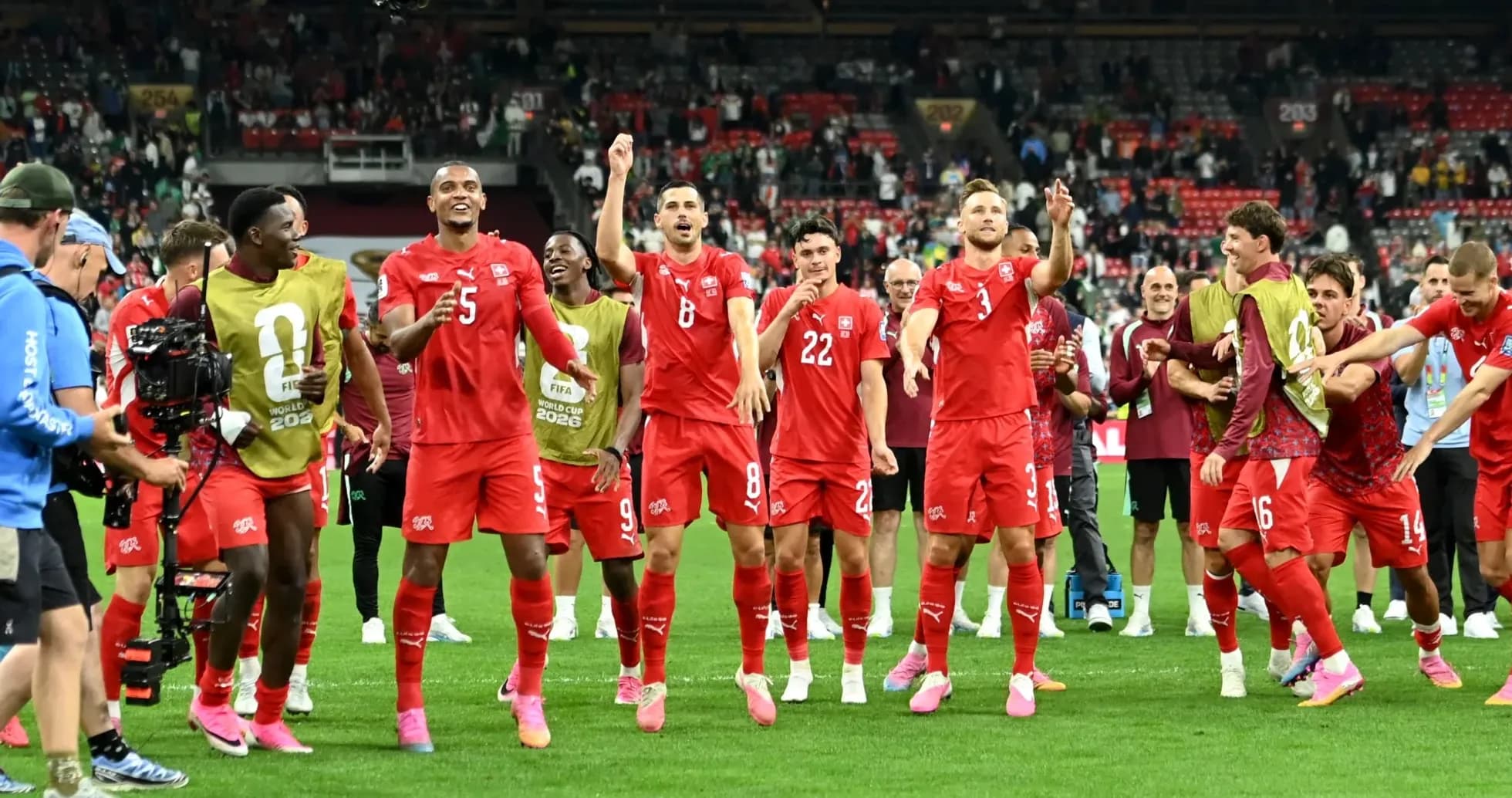
Switzerland’s 2-0 win over Algeria at BC Place was a clinic in control without the ball and efficiency in both boxes. In a World Cup Round of 32 tie where Algeria saw more of the ball (55% possession, 561 passes at 85% accuracy), Murat Yakin’s 4-2-3-1 was structurally superior, repeatedly turning compactness and vertical running into clear chances, reflected in a commanding 2.56 xG to 0.73.
Out of possession, Switzerland’s shape was the foundation. Granit Xhaka and Remo Freuler formed a tight double pivot in front of a back four of Ricardo Rodríguez, Manuel Akanji, Nico Elvedi and Denis Zakaria. The line held relatively high but narrow, with wingers Dan Ndoye and Rubén Vargas tucking in alongside Johan Manzambi to create a dense central block. That 4-2-3-1 morphed into a 4-4-2 without the ball, as Manzambi stepped up alongside Breel Embolo to screen Algeria’s first line and force play wide.
Algeria’s 4-3-3 under Vladimir Petkovic aimed to dominate circulation through Nabil Bentaleb, Ramiz Zerrouki and Farès Chaïbi, but the structure struggled to convert possession into penetration. Despite their passing edge, Algeria managed only 8 total shots, 5 inside the box and just 2 on target. Switzerland’s back four controlled the Algerian front three of Riyad Mahrez, Ibrahim Maza and Houssem Aouar by compressing the space between lines and winning first contacts, with Xhaka and Freuler sweeping up second balls.
Switzerland were far more direct and purposeful with less of the ball. Their 11 shots included 9 from inside the box, underlining how cleanly they attacked space once they broke Algeria’s midfield. Early on, the pattern was clear: quick vertical passes from Xhaka or Freuler into Manzambi between the lines, then immediate releases into the channels for Ndoye and Vargas, with Embolo occupying both centre-backs.
The 10th-minute opener encapsulated that plan. Switzerland drew Algeria’s midfield forward, then played through them. Manzambi found a pocket, turned, and released B. Embolo, who finished to make it 1-0. It was a classic exploitation of the gap between Algeria’s midfield trio and their back four: Zerrouki and Bentaleb were pulled towards the ball, Chaïbi was late to cover, and the centre-backs were left exposed to Embolo’s run.
At 1-0, Switzerland became even more comfortable in their mid-block. They did not press recklessly, preferring to hold their 4-4-2 shell and wait for Algeria to overplay. Algeria’s attempts to build through Aïssa Mandi and Ramy Bensebaini were rarely progressive enough; when they did reach Mahrez or Aouar in advanced zones, the Swiss full-backs stayed tight while the nearest midfielder doubled, forcing play backwards or into low-probability crosses.
The second half began with a decisive tactical blow. Just after the restart, D. Ndoye struck in the 46th minute for 2-0. Coming from the right side of the Swiss line of three behind Embolo, Ndoye’s timing into the half-space again punished Algeria’s loose rest defence. With their full-backs advanced and their midfield spread, Algeria left gaps between the lines and in transition; Switzerland’s second goal grew directly from that structural imbalance.
Chasing the game, Algeria leaned further into possession and personnel changes. The double substitution on 58 minutes — Amine Gouiri (IN) came on for R. Zerrouki (OUT) and Jaouen Hadjam (IN) came on for H. Aouar (OUT) — tilted the side towards a more attacking profile, but also weakened their central protection. Later, at 71 minutes, Anis Hadj Moussa (IN) came on for R. Mahrez (OUT) and Hicham Boudaoui (IN) came on for N. Bentaleb (OUT), pushing even more creative and vertical profiles on the pitch. However, this stripped Algeria’s midfield of control and left their back line increasingly exposed to Swiss counters.
Switzerland’s substitutions were calibrated to maintain structure and energy. Fabian Rieder (IN) came on for R. Vargas (OUT) and Noah Okafor (IN) came on for J. Manzambi (OUT) at 71 minutes, refreshing the wide and central attacking lanes without changing the basic 4-2-3-1 framework. Later, Zeki Amdouni (IN) came on for B. Embolo (OUT) at 83 minutes, then Silvan Widmer (IN) came on for D. Zakaria (OUT) and Michel Aebischer (IN) came on for D. Ndoye (OUT) at 87 minutes. Each change preserved the double pivot and back-four integrity, keeping Switzerland compact while adding fresh legs to press and run in transition.
Defensively, Switzerland balanced aggression and control well, committing 10 fouls to Algeria’s 12. Notably, they avoided any bookings, while Algeria collected two yellows: at 36 minutes, F. Chaibi (Algeria) — Tripping, and at 72 minutes, H. Boudaoui (Algeria) — Roughing. Those moments reflected Algeria’s increasing frustration as Switzerland shut down central lanes and forced riskier defensive actions in midfield.
In goal, Gregor Kobel (Switzerland) was rarely overworked but remained solid, making 2 saves behind a defence that limited Algeria’s shot quality to 0.73 xG. His opposite number, Luca Zidane (Algeria), also registered 2 saves, but Switzerland’s 5 shots on target from 11 attempts, largely from high-value zones, were simply more dangerous. The fact that both goalkeepers are credited with identical goals prevented values underlines how both defences allowed more than the scoreline alone might suggest, but Switzerland’s structure ensured that the majority of Algeria’s efforts were manageable.
Statistically, the game tells a clear tactical story. Algeria’s 55% possession and superior passing volume (561 passes to Switzerland’s 436) did not translate into control of territory or chances. Switzerland, with 81% passing accuracy (354 accurate) versus Algeria’s 85% (476 accurate), were more selective and vertical, using their possession to create rather than to circulate. Their 9 shots inside the box compared to Algeria’s 5, and a 2.56 xG total, show a side that consistently reached premium zones.
Corner counts (4-2 in Switzerland’s favour) further reflect their territorial edge once they broke forward. The foul profile and card distribution underline Switzerland’s composure: they defended with structure rather than desperation. Ultimately, this Round of 32 tie was decided by the contrast between Algeria’s sterile dominance of the ball and Switzerland’s clear, well-executed plan to compress space, spring vertical attacks, and protect their penalty area with a disciplined 4-2-3-1.