.svg&w=384&q=75 "GoalGist logo")
Sweden's Dominance Over Tunisia in World Cup Opener
Under the lights of Estadio BBVA in Monterrey, Sweden’s 5-1 dismantling of Tunisia felt less like an opening group game and more like a statement of intent. Following this result, Sweden sit top of Group F in the World Cup, first in the standings with 3 points and a goal difference of +4, while Tunisia are anchored to fourth with 0 points and a goal difference of -4. Over 90 minutes, Graham Potter’s side unveiled a clear tactical identity: an aggressive, front‑foot 3-1-4-2 that bends the game into the half-spaces and punishes any hesitation.
I. The Big Picture – Structures and Seasonal DNA
Potter’s 3-1-4-2 was not just a formation on paper; it was a territorial claim. With K. Nordfeldt behind a back three of G. Lagerbielke, I. Hien and V. Lindelof, Sweden built calmly from deep, using J. Karlstrom as the single pivot to connect defence and midfield. Ahead of him, a band of four – G. Gudmundsson, Y. Ayari, B. Nygren and A. Bernhardsson – stretched Tunisia horizontally, creating lanes for the strike partnership of V. Gyökeres and A. Isak to attack.
The statistical profile matches the eye test. At home this World Cup, Sweden have played 1 fixture, winning it 5-1. At home they average 5.0 goals for and 1.0 goal against, for an overall average of 5.0 scored and 1.0 conceded. The minute distribution is telling: 20.00% of their goals came between 0-15 minutes, 20.00% between 16-30, another 20.00% from 46-60, and a ruthless 40.00% in the 76-90 window. This is a side that starts sharp, regroups after half-time, and then finishes with a late‑game surge.
Tunisia, by contrast, lined up in a conservative 5-3-2 under Sabri Lamouchi. A. Chamakh was protected by a back five of Y. Valery, O. Rekik, M. Talbi, M. Ben Hamida and A. Abdi. In front, a midfield trio of R. Khedira, E. Skhiri and H. Mejbri was tasked with screening and springing transitions towards E. Saad and A. Slimane.
On their travels in this World Cup, Tunisia have played 1 match and lost it 5-1. Away they average 1.0 goal for and 5.0 against, mirroring their overall numbers. Their only goal so far arrived in the 31-45 minute range (100.00% of their total), while defensively they have bled in almost every segment: 20.00% of goals conceded in 0-15, 20.00% in 16-30, 20.00% in 46-60, and a damaging 40.00% between 76-90. Structurally, they are stretched early and overwhelmed late.
II. Tactical Voids – Discipline and Absences
There were no recorded suspensions or confirmed absences in the data, allowing both coaches to lean on their preferred blueprints. Sweden’s disciplinary record remains pristine: across their campaign so far, they have not picked up a yellow or red card in any minute range. That clean slate reflects the control they exerted; they defended more by positioning than by last-ditch interventions.
Tunisia, however, have already been forced into reactive defending. Their yellow-card profile shows 1 caution in the 46-60 minute window, accounting for 100.00% of their bookings so far. That timing matters: as they tried to push back into the game after half-time, structural cracks widened, forcing desperate interventions that neither stabilized the block nor stopped the bleeding.
III. Key Matchups – Hunter vs Shield, and the Engine Room
Hunter vs Shield
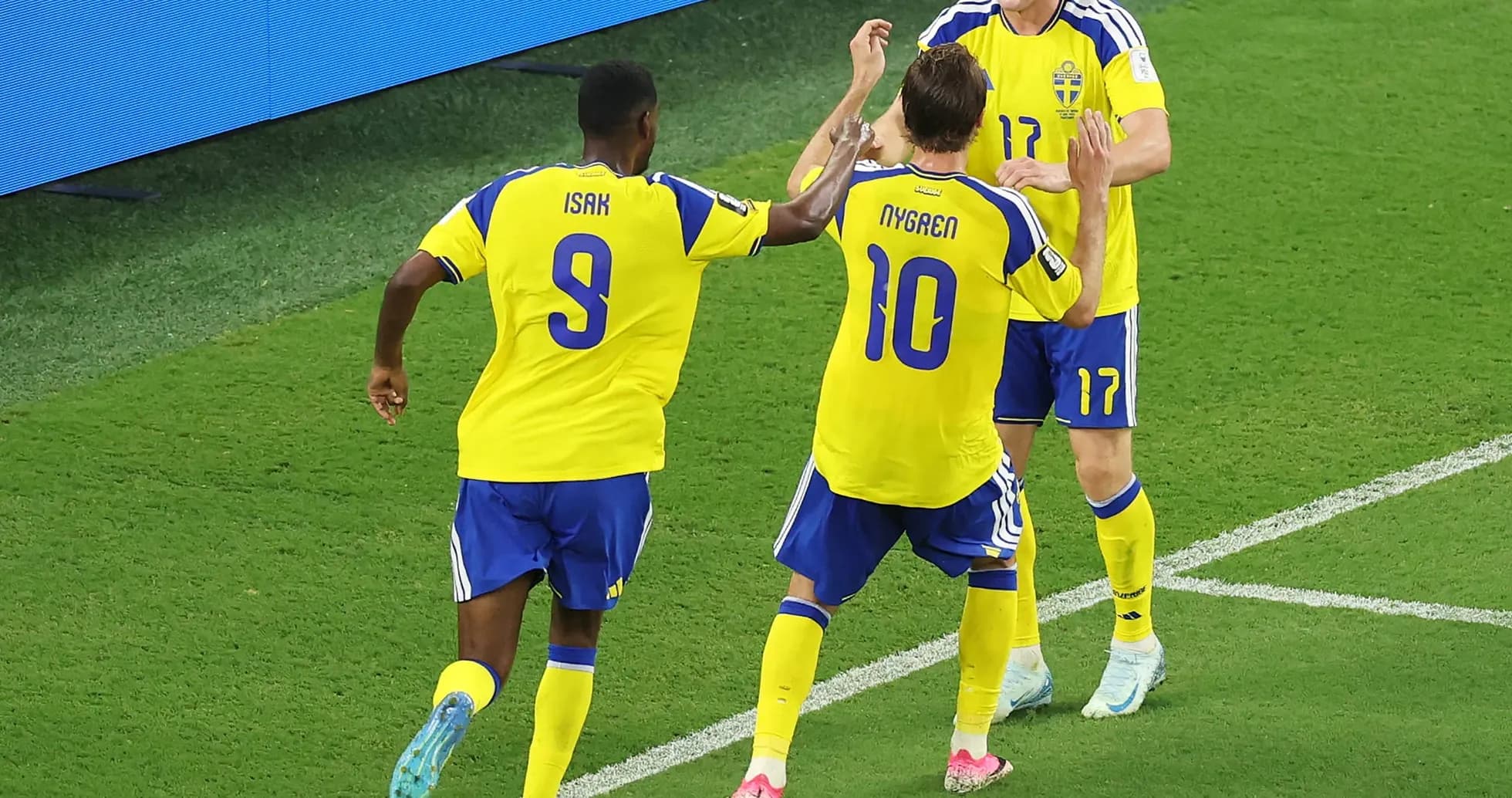
The headline duel was Sweden’s front line against Tunisia’s deep block. Statistically, Sweden’s attacking spear is led by Y. Ayari, A. Isak and V. Gyökeres.
Ayari, operating from midfield but constantly arriving in the box, has 2 goals in total this World Cup, from 2 shots on target, with a rating of 8.6. He is the late-arriving hunter, ghosting into pockets that a five-man defence struggles to track. His timing dovetails perfectly with Sweden’s late-game surge, where 40.00% of their goals arrive between 76-90 minutes.
Isak, with 1 goal and 2 assists in total, is Sweden’s all‑purpose forward. Across 89 minutes, he produced 2 shots on target, 2 key passes and an 82% pass accuracy. He drifts wide, drops between lines, and then bursts in behind. His dual role as finisher and creator is underlined by his presence in both the top scorers and top assists lists.
Gyökeres adds a more direct, power-running threat: 1 goal, 1 assist, 4 total shots (2 on target) and 4 key passes from 19 total passes at 84% accuracy. He drags centre-backs into uncomfortable channels, opening gaps for Ayari and Isak to exploit.
Against them, Tunisia’s “shield” has so far conceded 5 goals on their travels, with the same minute pattern as Sweden’s scoring profile but inverted. The critical intersection is brutal: Sweden’s 40.00% late surge (76-90) aligns exactly with Tunisia’s 40.00% of goals conceded in that same window. When Tunisia’s legs tire and their wing-backs are pinned deep, Sweden’s forwards and late-arriving midfielders find another gear.
Engine Room – Playmaker vs Enforcer
In midfield, the duel was about control and second balls. For Sweden, Karlstrom anchored the structure, allowing Ayari and Nygren to push higher. Ayari’s 27 passes, including 2 key passes, and 3 tackles with 1 interception show a two-way midfielder who not only breaks lines but also breaks up play.
Tunisia’s response centred on E. Skhiri and R. Khedira as the enforcers. Their task was to screen the spaces in front of M. Talbi and O. Rekik, and to prevent Sweden’s midfielders from turning. But with Tunisia conceding in four different time bands and failing to keep a clean sheet, the data suggests they were consistently forced backwards, unable to step out and compress the central lanes.
From the bench, Sweden also showed they can change the rhythm. M. Svanberg came in and needed only 13 minutes to score once from his single shot on target, while L. Bergvall added an assist and 1 key pass in 25 minutes. These impact substitutes hint at depth: even when the initial wave subsides, Potter can introduce fresh technical quality between the lines.
IV. Statistical Prognosis – xG Echoes and Defensive Solidity
While the raw xG numbers are not provided, the pattern of chances implied by the scoreline and distributions is clear. Sweden’s home average of 5.0 goals for and 1.0 against, combined with their 100% record of going over every goals threshold from 0.5 up to 4.5, points to a high‑volume, high‑quality chance creation model. Their failure to keep a clean sheet – with 100.00% of goals conceded arriving in the 31-45 window – is a small warning sign: there is a brief lapse before half-time where concentration dips.
Tunisia’s away profile, with 5.0 goals conceded on average and over 0.5, 1.5, 2.5, 3.5 and 4.5 in every case, suggests an xG against figure that is likely far too high for knockout-level ambitions. Their inability to cluster defensive resistance in any specific time band means opponents can access chances early, mid and late.
Following this result, the tactical balance of Group F is clear. Sweden look like a side whose underlying numbers back up the eye test: a structured back three, a disciplined pivot, and a front four of creators and finishers who can hurt you in every phase, especially in the final quarter-hour. Tunisia, meanwhile, must repair a leaking block that collapses just as opponents hit their stride, or risk being overrun again by teams that, unlike Sweden, may not even need a late surge to finish them off.