.svg&w=384&q=75 "GoalGist logo")
Sweden's Tactical Superiority in 5-1 Victory Over Tunisia
Sweden’s 5-1 dismantling of Tunisia at Estadio BBVA was rooted in a clear structural superiority rather than territorial dominance. Despite ceding a marginal 51% share of the ball, Graham Potter’s 3-1-4-2 created repeated overloads between Tunisia’s lines and ruthlessly converted them into high-quality chances, reflected in 13 total shots, 9 from inside the box and 7 on goal. Tunisia’s 5-3-2, designed for compactness, was repeatedly stretched horizontally and vertically, leaving the back five exposed against Sweden’s dual strikers and aggressive wide midfielders.
In possession, Sweden’s back three of Gustaf Lagerbielke, Isak Hien and Victor Lindelöf set a stable platform. Jesper Karlström operated as the single pivot in front, but the real damage came from the line of four: Alexander Bernhardsson and Gabriel Gudmundsson providing width, with Benjamin Nygren and Yasin Ayari attacking the half-spaces. This gave Sweden a 3-1-4-2 that often looked like a 3-1-2-4 in sustained attacks, pinning Tunisia’s wing-backs and isolating the outside centre-backs.
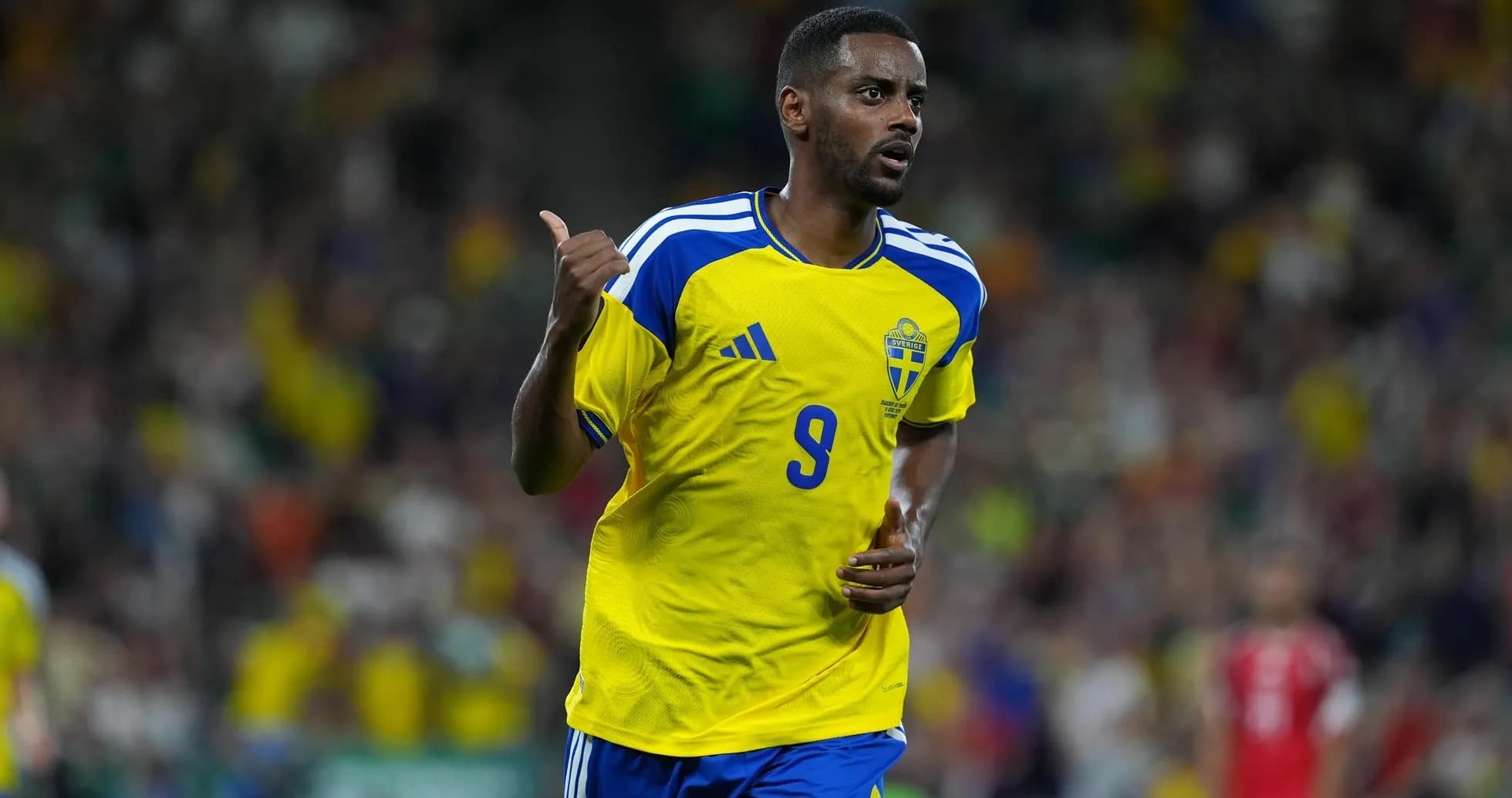
The opening goal at 7 minutes encapsulated the structural idea: Ayari, nominally a midfielder, arrived high between the lines to finish, benefiting from the numerical superiority Sweden consistently manufactured around Tunisia’s central trio. Alexander Isak and Viktor Gyökeres complemented this by constantly splitting Tunisia’s central defenders, one dropping into pockets while the other threatened depth. That movement underpinned Sweden’s second goal at 30 minutes, with Isak finishing after Gyökeres linked play, and later flipped for Sweden’s third at 59 minutes when Gyökeres scored from an Isak assist. The front two’s reciprocity made it extremely difficult for Tunisia’s central block to fix reference points.
Out of possession, Sweden’s 3-1-4-2 morphed into a compact 5-3-2 only sporadically; more often it was a high 3-5-2 press. Wing-backs stepped aggressively onto Tunisia’s full-backs, while one of the advanced midfielders jumped onto the deepest Tunisian midfielder. This front-foot approach limited Tunisia to just 6 total shots, only 2 on goal, and forced them into 8 fouls and 6 offsides as they tried to break the line too early. Sweden’s foul count (10) remained controlled, indicating they were rarely chasing desperate recovery situations.
Tunisia’s 5-3-2 under Sabri Lamouchi aimed to build from a back five of Yan Valery, Omar Rekik, Montassar Talbi, Amine Ben Hmida and Ali Abdi, with Rani Khedira, Ellyes Skhiri and Hannibal Mejbri in midfield behind Elias Saad and Anis Ben Slimane. On paper, this offered central stability, but in practice the midfield three were outnumbered and outmanoeuvred. Mejbri tried to connect play and did provide the assist for Rekik’s 43rd-minute goal, but Tunisia’s only goal came more from an isolated attacking pattern than a sustained tactical plan.
The defensive issues were stark: Tunisia allowed 9 shots inside their own box and conceded 5 times from Sweden’s 7 shots on target. Their own attacking structure produced only 2 shots inside the box and 4 from distance, underlining how rarely they broke Sweden’s last line with control. The single yellow card, to Khedira for “Tripping” at 54 minutes, symbolised a midfield forced into reactive interventions rather than proactive control.
The substitutions further highlighted the tactical trajectories. Potter’s changes were additive: Elliot Stroud (IN) came on for Gabriel Gudmundsson (OUT) and Lucas Bergvall (IN) for Benjamin Nygren (OUT) at 65 minutes, refreshing the energy in the wide and half-space channels without altering the basic 3-1-4-2 framework. Later, Mattias Svanberg (IN) came on for Jesper Karlström (OUT) at 84 minutes, then immediately advanced from midfield to score Sweden’s fourth, again off an Isak assist, illustrating how the system allowed fresh midfielders to attack high zones without destabilising the rest defence.
At 90 minutes, Anthony Elanga (IN) replaced Alexander Isak (OUT), and at 90+1’ Daniel Svensson (IN) came on for Alexander Bernhardsson (OUT), preserving the wing structure while giving minutes to the bench. Bergvall’s earlier introduction was rewarded deep into added time when he assisted Ayari’s second goal at 90+6’, Sweden’s fifth, a late confirmation of their ability to keep creating overloads even with rotated personnel.
Lamouchi’s response at 72 minutes was to inject more attacking profiles: Sebastian Tounekti (IN) for Elias Saad (OUT), Mohamed Belhadj Mahmoud (IN) for Yan Valery (OUT), and Elias Achouri (IN) for Ellyes Skhiri (OUT). This trio of substitutions effectively shifted Tunisia towards a looser, more offensive posture, but it also weakened their already struggling central shield. Later, Ismael Gharbi (IN) replaced Khedira (OUT) at 83 minutes and Firas Chaouat (IN) came on for Anis Ben Slimane (OUT) at 84 minutes, pushing numbers forward but removing defensive balance in midfield. The result was more space for Sweden to transition and combine between the lines, rather than a meaningful Tunisian resurgence.
Statistically, the game underlines how Sweden’s tactical plan maximised chance quality rather than volume. Their xG of 1.36 against 13 shots indicates high efficiency in finishing and perhaps some overperformance in front of goal, but the pattern of chances – 9 inside the box – shows that the 5-1 scoreline was supported by territorial and positional dominance in key zones. Tunisia’s xG of 0.28 from 6 shots confirms that their 51% possession was largely sterile, circulating in safer areas without accessing dangerous central channels.
Passing data reinforces the picture of two sides comfortable on the ball but with very different outputs. Sweden completed 280 of 353 passes (79%), Tunisia 288 of 364 (79%), near-identical accuracy. Yet Sweden turned that circulation into vertical penetrations and box entries, while Tunisia’s similar volume produced only 2 shots in the area. Sweden’s 4 corner kicks to Tunisia’s 2 further reflect their sustained territorial pressure.
In goal, Kristoffer Nordfeldt (Sweden) was largely untroubled, officially required for just 1 save, a testament to the protection offered by the back three and the midfield screen. At the other end, Abdelmouhib Chamakh (Tunisia) also registered only 1 save, but the defensive structure in front of him collapsed repeatedly, as indicated by Tunisia’s negative goals prevented figure. The underlying metrics and positional patterns together paint a clear picture: Sweden’s 3-1-4-2 was superior in design, execution and adaptability, turning near-parity in possession and passing into a comprehensive tactical and scoreboard victory.