.svg&w=384&q=75 "GoalGist logo")
Spain and Cape Verde Islands Draw in World Cup 2026 Opener
Under the closed roof of Mercedes-Benz Stadium, Spain and Cape Verde Islands opened their World Cup 2026 stories with a goalless draw that said more about structure, nerve and discipline than it did about cutting edge. Following this result, both sides sit on 1 point in Group H, Spain in 3rd and Cape Verde Islands in 4th, each with a goal difference of 0 after 1 match played. It is a stalemate on the scoreboard, but not in identity.
I. The Big Picture – Two blueprints collide
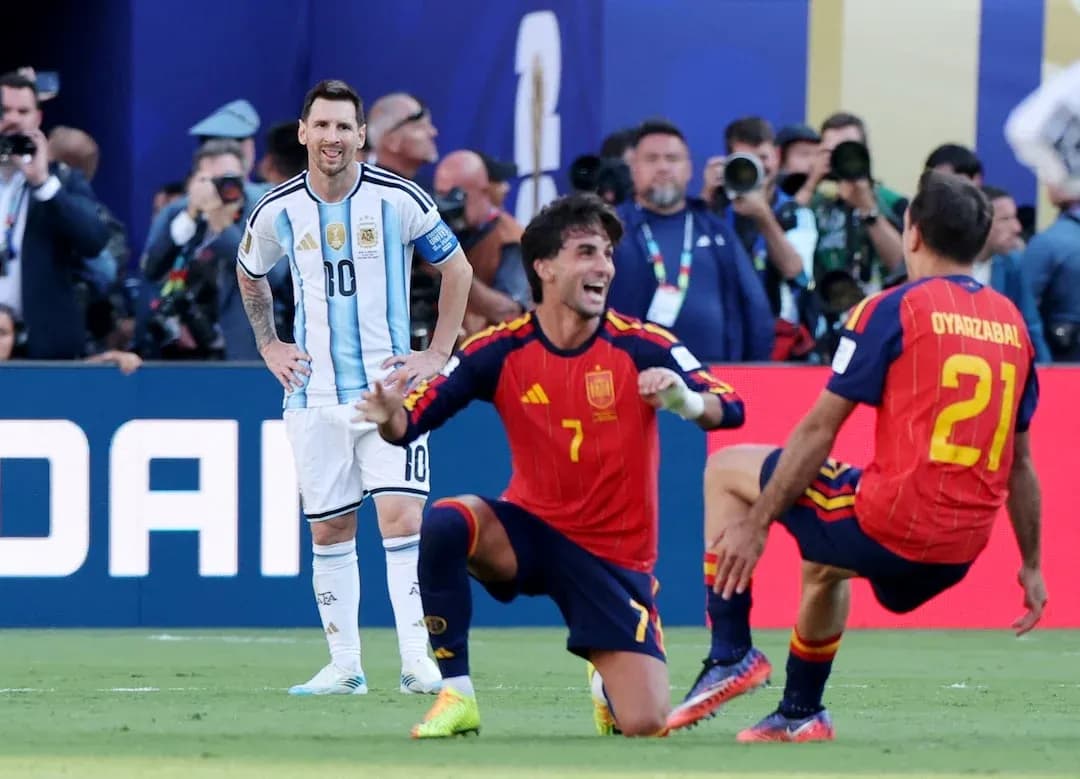
Spain arrived as the archetype of possession orthodoxy, lining up in a 4-3-3 that has already become their default shape in this tournament: the statistics confirm they have used this formation in their only lineup so far. Luis de la Fuente anchored his side around the ball, with U. Simon behind a back four of M. Cucurella, A. Laporte, P. Cubarsi and M. Llorente. Ahead of them, a midfield triangle of Pedri, Rodri and F. Ruiz set the rhythm, feeding a fluid front three of Gavi, M. Oyarzabal and F. Torres.
Cape Verde Islands, by contrast, leaned into compact resilience. Their 4-1-4-1 – also their established tournament shape, used in their single lineup to date – was built around a narrow spine: Vozinha in goal, a back four with S. Lopes Cabral at left-back, D. Borges and R. Lopes centrally, S. Moreira on the right, and K. Lenini screening as the single pivot. Ahead, a hard-running band of four – J. Cabral, J. Monteiro, L. Duarte and R. Mendes – worked around lone forward D. Livramento.
The numbers underline how cautious both sides have been to start this World Cup. Heading into this game, Spain’s campaign profile showed 1 match played in total, with 0 wins, 1 draw and 0 defeats. They had yet to score a goal in total and had not conceded in total either, combining a clean sheet total of 1 with a failed-to-score total of 1. Cape Verde Islands mirrored that balance on their travels: 1 away match, 0 wins, 1 draw, 0 defeats, 0 goals for and 0 against in total, with a clean sheet total of 1 and a failed-to-score total of 1. Two teams, two clean sheets, and two attacks still waiting to ignite.
II. Tactical Voids – Discipline, but little chaos
There were no official absentees listed for either side, so the tactical voids came not from missing personnel but from the choices each coach made within their preferred structure.
For Spain, the most striking absence was conceptual: no orthodox penalty-box striker. With Gavi starting nominally as a forward and M. Oyarzabal and F. Torres operating as wide forwards rather than pure number nines, Spain’s 4-3-3 often resembled a 4-3-3/4-6-0 hybrid, with rotations between lines but few fixed reference points in the area. This preserved their capacity to overload midfield zones but left them short of a pure finisher to attack low crosses and second balls.
Cape Verde Islands accepted that trade-off. Pedro Leitao Brito’s 4-1-4-1 was designed to compress the central corridor, forcing Spain’s creative trio to receive under pressure or drift wide. K. Lenini’s role as a single pivot was crucial: he sat just in front of the centre-backs, stepping out only when the ball entered his zone, ensuring that Spain’s interior midfielders could not simply turn and run at the back line.
Disciplinary patterns from the early tournament data also framed the emotional tone. Heading into this game, Spain’s only recorded yellow card had come very late, in the 91-105 minute window, a 100.00% concentration of their cautions in stoppage time – a hint of frustration or late-game strain rather than reckless aggression. Cape Verde Islands, by contrast, had their lone yellow in the 16-30 minute band, also 100.00% of their cautions, suggesting an early, perhaps over-eager challenge as they tried to establish a physical presence.
On the individual level, S. Lopes Cabral stands out as a symbol of Cape Verde Islands’ edge. In his 76 minutes played, he committed 1 foul but drew 2, picked up 1 yellow card, and still managed 17 passes at 82% accuracy, 2 tackles and multiple interceptions across the two statistical snapshots. He walked the line between aggression and control without tipping into red – despite his inclusion on both the top yellow and top red card lists, his actual red card count remains 0.
III. Key Matchups – Hunter vs Shield, Engine Room vs Enforcer
With neither side having scored in total this campaign, the “Hunter vs Shield” dynamic becomes more theoretical than statistical. For Spain, the threat is distributed: F. Torres attacking the right half-space, M. Oyarzabal drifting inside from the left, and Gavi making disruptive runs between the lines. Yet the real “hunter” is the collective ability to pin opponents back, not any single finisher.
Cape Verde Islands’ shield has been immaculate so far. On their travels, they have conceded 0 goals in total, with a goalsAgainst average of 0.0 away and in total. That resilience is built on more than just deep defending: S. Lopes Cabral and S. Moreira can step out to engage wingers, while D. Borges and R. Lopes hold the central lane. With K. Lenini dropping in, the 4-1-4-1 often morphed into a back five in the deepest phase, suffocating Spain’s attempts to slip runners through the inside channels.
The true battle, though, is in the “Engine Room.” Rodri is Spain’s metronome and enforcer in one, operating as the single pivot in front of Laporte and P. Cubarsi. His presence allows Pedri and F. Ruiz to play between the lines, trusting that transitions will be slowed at source. On the other side, K. Lenini mirrors that role, but with a more destructive than constructive brief, while J. Monteiro acts as the creative outlet higher up, trying to connect with D. Livramento and the wide midfielders.
The clash between Rodri’s control and Cape Verde Islands’ central congestion defines the tempo. When Rodri can receive cleanly and turn, Spain’s 4-3-3 stretches into a 2-3-5 in possession, with full-backs high and interiors between the lines. When K. Lenini and the second line close him down, Spain are forced wide and into lower-percentage deliveries.
IV. Statistical Prognosis – A defensive tournament start
From a pure numbers perspective, both sides are defensive machines so far. Spain’s goalsFor average in total is 0.0, matched by a goalsAgainst average in total of 0.0. Cape Verde Islands share the same 0.0 in total for both scoring and conceding. Clean sheets total 1 for each, and both have failedToScore totals of 1.
There is no explicit xG data in the snapshot, but the patterns are clear: a Spain side that dominates structure and territory yet has not converted that into goals, and a Cape Verde Islands team that has embraced the role of spoiler, defending with discipline and picking their moments to break.
Following this result, the tactical prognosis for the group is that Spain will need to find a sharper edge in the final third without sacrificing the control that has kept their goal intact, while Cape Verde Islands will continue to lean on their 4-1-4-1’s solidity, hoping that D. Livramento and the supporting cast can turn scarce chances into decisive moments. For now, both remain unbeaten, both unbreached – and both still searching for the attacking statement that will define their World Cup.