.svg&w=384&q=75 "GoalGist logo")
Spain vs Austria: Tactical Showdown in Round of 32
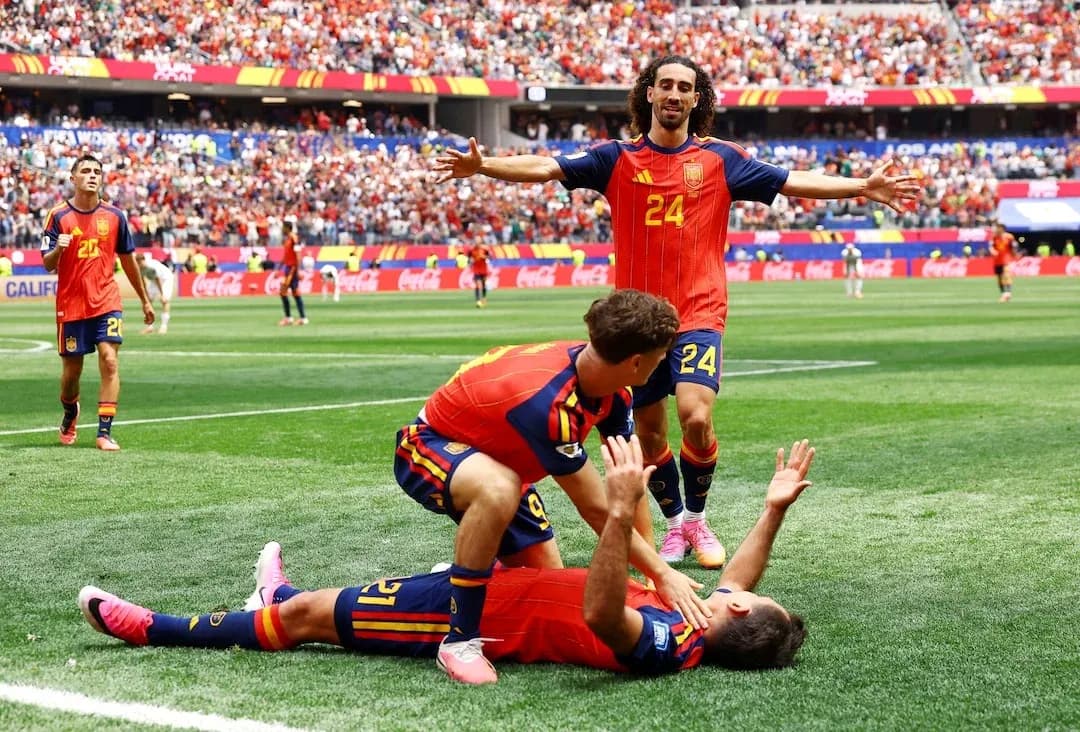
SoFi Stadium, under the glare of knockout‑stage tension, stages a Round of 32 clash that feels like a meeting of opposites. Spain arrive as a side defined by control and defensive perfection; Austria come as volatility incarnate, capable of flurries of goals but also of unraveling in their own third. The final scoreline – Spain 3, Austria 0 – ultimately reads like a confirmation of those identities rather than a surprise.
Spain's Seasonal Profile
Heading into this game, Spain’s seasonal profile in this World Cup was almost unnervingly clean. Overall, they had played 4 matches, winning 3 and drawing 1, with no defeats. At home in this tournament they had played 3 times, winning 2 and drawing 1, and on their travels they had 1 away win. Across all venues they had scored 8 goals in total and conceded none, an overall average of 2.0 goals for and 0.0 against. At home, that attacking average rose to 2.3 while still conceding 0.0; away, they added 1.0 goal per match and again allowed nothing. The goal difference overall – 8 scored, 0 conceded – stood at +8 and framed Spain as the most balanced side in their group stage, a picture reinforced by 4 clean sheets in 4 outings.
Austria's Path
Austria’s path could hardly have contrasted more. Overall, they had played 4 matches with 1 win, 1 draw and 2 defeats. At home they had played once and won, while on their travels they had played 3 times without a victory, drawing 1 and losing 2 away. They had scored 6 goals in total – 3 at home and 3 away – at an overall attacking average of 1.5 goals per match, with 3.0 at home and 1.0 on their travels. Yet defensively, the numbers were stark: 9 goals conceded overall, 1 at home and 8 away, an overall average of 2.3 against, rising to 2.7 away. The overall goal difference – 6 for, 9 against – left them at −3, the profile of a team that always leaves the door open.
Coaches and Tactics
Both coaches doubled down on their preferred identities with mirrored 4‑2‑3‑1 shapes. Luis de la Fuente trusted a Spain XI that blended youth and rhythm: Unai Simón behind a back four of Pedro Porro, Pau Cubarsí, Aymeric Laporte and Marc Cucurella. Rodri and Pedri formed the double pivot, with Lamine Yamal and Álex Baena flanking Dani Olmo in the line of three, and Mikel Oyarzabal as the nominal striker.
Ralf Rangnick answered with his own 4‑2‑3‑1, but one tilted towards transition. Alexander Schlager started in goal, shielded by Stefan Posch, Kevin Danso, David Alaba and Konrad Laimer. In front of them, Nicolas Seiwald and Xaver Schlager were tasked with stemming Spain’s central carousel, while Romano Schmid, Paul Wanner and Marcel Sabitzer supported Michael Gregoritsch up front.
Key Tactical Matchups
The tactical void for Austria lay precisely where Spain are strongest: central control and defensive security. Spain’s overall record of 0.0 goals conceded per match, with 4 clean sheets in 4, meant that any Austrian plan reliant on chaotic, end‑to‑end exchanges was unlikely to prosper. Austria had not kept a single clean sheet overall, and on their travels they were allowing 2.7 goals per match; that fragility was always going to be tested by a Spain side averaging 2.3 goals at home.
The “Hunter vs Shield” duel was personified by Mikel Oyarzabal against Austria’s back line. Oyarzabal entered as one of the World Cup’s sharpest forwards: 4 goals and 1 assist overall in 4 appearances, from 15 shots with 8 on target. His overall rating of 7.7 reflected not just finishing but movement and link play, with 69 completed passes and 2 key passes. Austria’s shield, by contrast, was creaking. Posch, a mainstay at right‑back, had accumulated 2 yellow cards and even appeared among the tournament’s red‑card leaders, a statistical hint of how often he is forced into desperate interventions. His 7 fouls committed overall, against only 3 drawn, underscored the imbalance: Austria’s defensive line spends more time reacting than dictating.
Midfield Battles
In the engine room, Rodri and Pedri faced Seiwald and Xaver Schlager. Spain’s structure – alternating between 4‑3‑3 and 4‑2‑3‑1 over the tournament, each used twice – allowed Rodri to anchor while Pedri slid into half‑spaces, giving Lamine Yamal and Baena the freedom to step inside. Austria’s double pivot, meanwhile, had to cover vast horizontal distances whenever Spain switched play through Porro and Cucurella. Given Austria’s disciplinary profile – 5 yellow cards overall, with a pronounced late‑game surge of 60.00% of those bookings arriving between 76‑90 minutes – the risk of fatigue‑induced errors as Spain circulated the ball was always high.
Card Distribution
Spain’s own card distribution told a different story: only 2 yellow cards overall, both arriving after the interval (one between 46‑60 minutes and one between 91‑105), suggesting a side that rarely needs to foul early to regain control. That composure underpins their perfect defensive record and made them ideally suited to manage knockout‑stage stress.
Austrian Threats
Austria’s attacking volatility was not without threat. Overall, they had already produced a 3‑1 home win and had scored 3 goals on their travels despite their struggles, including a successfully converted penalty (1 taken, 1 scored, 0 missed overall). But against a Spain side that had yet to concede a single goal overall, and whose biggest home win was a 4‑0, the margin for error was razor‑thin. Any Austrian surge forward risked exposing a back line that had already suffered a 3‑0 away defeat in this tournament.
Conclusion
Following this result, the narrative feels almost inevitable. Spain’s structure, their refusal to concede, and the ruthless efficiency of Oyarzabal in the box translated statistical superiority into a 3‑0 scoreline. Austria’s willingness to play on the edge, their late‑game bookings and away‑day vulnerability, all reappeared under the bright lights of Inglewood.
In tactical terms, this was less an upset and more a crystallisation of the numbers: a side with an overall goal difference of +8 and four clean sheets imposing its rhythm on a team with an overall goal difference of −3 and no clean sheets. In knockout football, such clarity is rare. Spain seized it, and marched on.