.svg&w=384&q=75 "GoalGist logo")
Saudi Arabia vs Uruguay: Tactical Duel in World Cup 2026
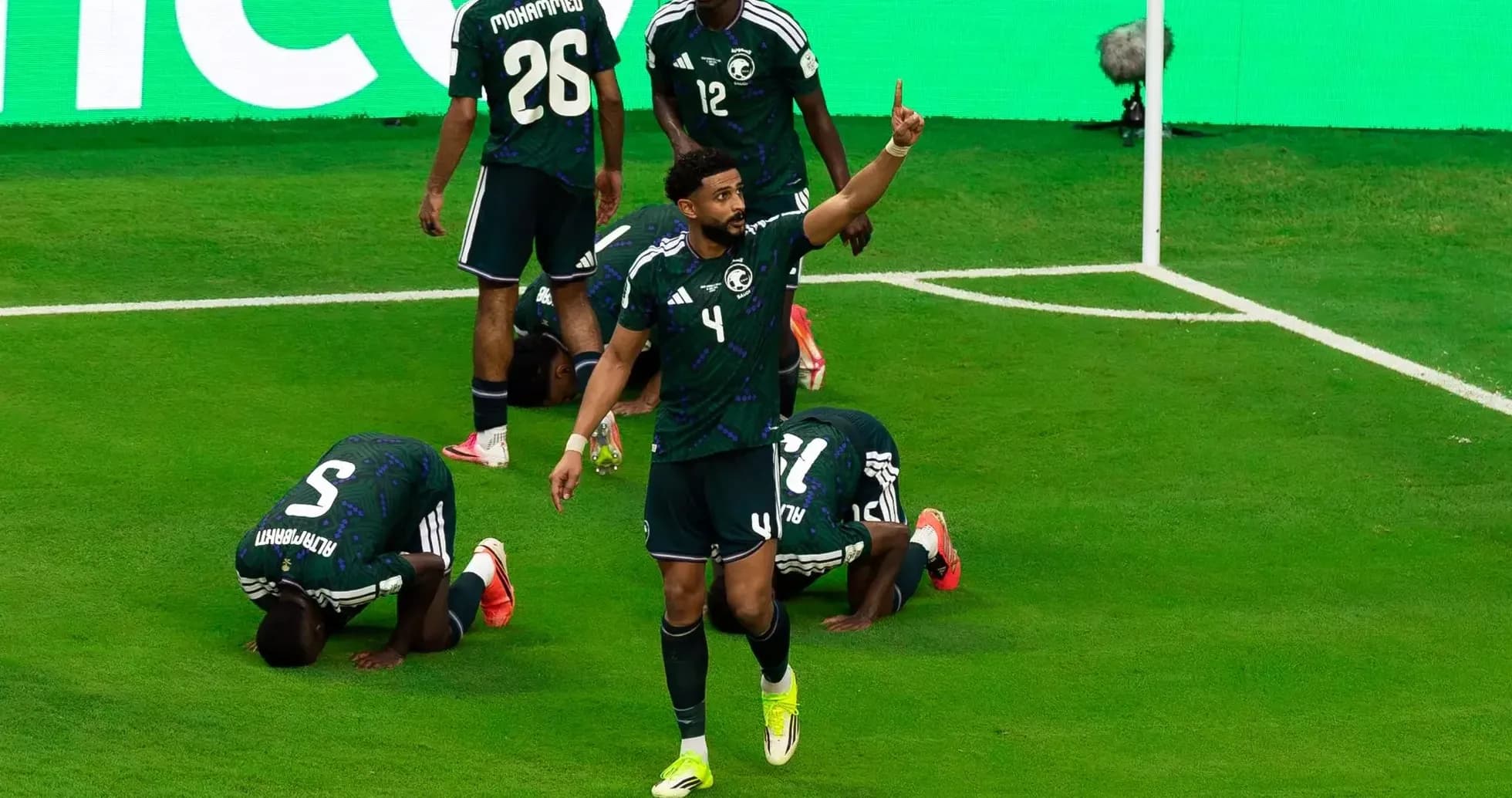
Under the Miami lights at Hard Rock Stadium, Saudi Arabia and Uruguay opened their World Cup 2026 journeys with a 1–1 draw that felt less like a settled verdict and more like the first chapter of a tactical duel that will echo through Group H. Following this result, Uruguay sit 1st and Saudi Arabia 2nd in the group, both on 1 point with a goal difference of 0, and both revealing clear identities that will shape the rest of the group stage.
I. The Big Picture – Two blueprints, one stalemate
Georgios Donis committed fully to a classic 4-4-2 for Saudi Arabia, a structure that framed the night: two banks of four, disciplined distances, and a front pair tasked with both pressing and providing the penalty-box presence. The data confirms the early pattern of their campaign: in total this World Cup, Saudi Arabia have played 1 match, drawing it, with 1 goal scored and 1 conceded. All of that production has come at home in this fixture, with a home average of 1.0 goal for and 1.0 goal against.
The timing of those moments is revealing. Heading into the next game, 100.00% of Saudi Arabia’s goals for have arrived between 31–45 minutes, while 100.00% of their goals against have come in the 76–90 window. It paints a picture of a side that starts cautiously, grows into the contest, and then struggles to close the door late on.
Uruguay, under Marcelo Bielsa and set up in a 4-2-3-1, lived up to their manager’s reputation for verticality and intensity, but the numbers show a team still calibrating risk and reward. On their travels, they have played 1 match, drawing it, scoring 1 and conceding 1, for an away average of 1.0 goal for and 1.0 goal against. Their attacking identity is almost a mirror image of Saudi Arabia’s: 100.00% of Uruguay’s goals for so far have come between 76–90 minutes, while 100.00% of their goals against have been conceded in the 31–45 window.
The intersection is stark: Saudi Arabia’s offensive peak is 31–45; Uruguay’s defensive weakness is also 31–45. Conversely, Uruguay’s late surge from 76–90 crashes directly into Saudi Arabia’s late-game vulnerability in that same 76–90 range. This match, ending 1–1 with Saudi Arabia leading at half-time and Uruguay rescuing it late, felt almost pre-written by those distributions.
II. Tactical Voids and Discipline – Edges still to be found
Injuries and absences are not flagged in the data, so both coaches essentially had their full tactical decks available. That makes the choices more revealing.
Donis doubled down on structure. The 4-4-2 that has been used in 1 out of 1 matches so far is not a stopgap; it is the spine of Saudi Arabia’s campaign. The flanks were entrusted to S. Abdulhamid and M. Al Harbi at full-back, with S. Al Dawsari and M. Abu Al Shamat providing width higher up. Central ballast came from M. Kanno and A. Al Khaibari, a pairing tasked with both shielding and sparking transitions.
Disciplinary data underlines how Saudi Arabia walk a fine line in that midfield. In total this campaign, 100.00% of their yellow cards have come in the 31–45 window, the same stretch in which they have scored their only goal. They are at their most aggressive and most productive in that phase, but also at their most combustible. That edge can tilt either way as the group progresses.
Uruguay’s card profile is blank so far: no yellow, no red, in any minute range. Under Bielsa, that suggests a team pressing in synchronised waves rather than hacking in desperation. It also hints at a squad that may have more disciplinary headroom to increase intensity if the group tightens.
III. Key Matchups – Hunter vs Shield, Engine vs Engine
Hunter vs Shield
For Saudi Arabia, the “hunter” role is less about a single poacher and more about the tandem of F. Al Buraikan and M. Al Juwayr. Both started up front, operating off complementary movements: Al Buraikan as the more central reference, Al Juwayr drifting into pockets to connect with the midfield line. The fact that Saudi Arabia’s only goal so far has come in that 31–45 spell speaks to how effectively this pair can exploit the moment when opponents are still adjusting to their rhythm.
They ran directly into Uruguay’s “shield”: a back four of G. Varela, S. Caceres, M. Olivera and M. Vina, fronted by the double pivot of M. Ugarte and R. Bentancur. On their travels this campaign, Uruguay have conceded 1 goal, and crucially it landed in their documented weak zone of 31–45. That is where the line between proactive defending and over-commitment blurs. If Uruguay are to tighten up, that junction between the centre-backs and the pivots is where adjustments must be made.
On the other side, D. Nunez led the line as the primary hunter, supported by an attacking midfield trio of F. Valverde, F. Vinas and M. Araujo. Uruguay’s only goal so far, arriving between 76–90, reflects both Nunez’s relentlessness and Bielsa’s insistence that the team keep pouring forward. It also directly targets Saudi Arabia’s biggest defensive flaw: in total this campaign, 100.00% of Saudi Arabia’s goals conceded have come in that 76–90 window. Late concentration, legs, and bench impact will decide whether this pattern continues.
Engine Room – Playmaker vs Enforcer
The midfield battle was the true heart of this contest. For Saudi Arabia, M. Kanno is the fulcrum. Stationed centrally in the 4-4-2, he links short passes into the feet of Al Dawsari and Abu Al Shamat, while A. Al Khaibari sits slightly deeper, screening the back four and allowing the full-backs to edge forward selectively.
Opposite them, Uruguay’s double pivot of Ugarte and Bentancur is one of the most balanced in the tournament. Ugarte is the pure enforcer, hunting second balls and shutting passing lanes. Bentancur, while capable of the dirty work, is the more natural playmaker, connecting with Valverde’s third-man runs and feeding Nunez early. Behind them, F. Muslera’s presence adds calm, encouraging Uruguay to recycle and build again rather than force low-percentage entries.
This “engine vs engine” clash will define how both teams evolve. Saudi Arabia’s structure is compact but can be stretched laterally; Uruguay’s is aggressive but can be punctured if the first line of pressure is beaten.
IV. Statistical Prognosis – xG shadows and defensive solidity
We do not have explicit xG values in the data, but the patterns of goals and timing allow a reasonable tactical projection.
Saudi Arabia’s overall record so far: 1 match played, 0 wins, 1 draw, 0 losses, with 1 goal for and 1 against. Uruguay mirror that exactly on their travels: 1 match, 0 wins, 1 draw, 0 losses, 1 goal for, 1 against. The goal difference for both is 0, precisely matching 1 scored minus 1 conceded.
The under/over profiles for both sides are almost identical: in total this campaign, both teams have gone over 0.5 goals in 1 out of 1 matches, and stayed under 1.5, 2.5, 3.5 and 4.5 in all 1 out of 1. That suggests contests that are tight, low-scoring, and decided by fine margins rather than chaotic shootouts.
Defensive solidity, therefore, becomes the decisive metric. Neither side has kept a clean sheet yet, and neither has failed to score: Saudi Arabia’s clean sheet total is 0, failed-to-score total is 0; Uruguay’s are identical. Both are functioning in that fragile equilibrium where a single mistake or moment of brilliance swings the result.
From a tactical preview perspective for their next outings, the statistical prognosis is clear:
- Saudi Arabia must address the 76–90 lapse. Their late-game concession profile will invite opponents to hold back and then surge late, exactly as Uruguay did. Donis may need fresher legs in the full-back zones and perhaps a more conservative reshaping of the midfield after 70 minutes, using options like A. Yahya or N. Al Dawsari from the bench to preserve structure and ball retention.
- Uruguay, conversely, must shore up the 31–45 vulnerability. Their high line and aggressive pressing can be exploited just before half-time, when mental fatigue and tactical impatience creep in. Rotations involving J. Gimenez for added aerial security or a slightly more conservative role for the full-backs could reduce that exposure.
Without penalties taken or missed by either side (penalty totals stand at 0 for both, with 0 scored and 0 missed), there is no safety net from the spot. Every goal so far has been from open play, born from structure and timing rather than set-piece fortune.
In a group where every detail matters, this 1–1 in Miami was more than a shared point. It was a tactical blueprint: Saudi Arabia’s mid-half surges against Uruguay’s late-game relentlessness, two engines clashing in the centre, and two defences still searching for their first clean sheet. The numbers say these sides are evenly matched; the patterns suggest the story of Group H will be written in those fragile windows just before and just after the clock ticks past 45 and 75 minutes.