.svg&w=384&q=75 "GoalGist logo")
Saudi Arabia and Uruguay Draw 1-1 in Group H Clash
Saudi Arabia 1-1 Uruguay at Hard Rock Stadium leaves Group H finely balanced, with both sides moving to 2 points, 2 goals for and 2 against, and an unchanged goal difference of 0 after back-to-back draws. Uruguay stay top of the group on rank 1, Saudi Arabia remain rank 2, but this result tightens the margins heading into the final round of group fixtures.
Match Report
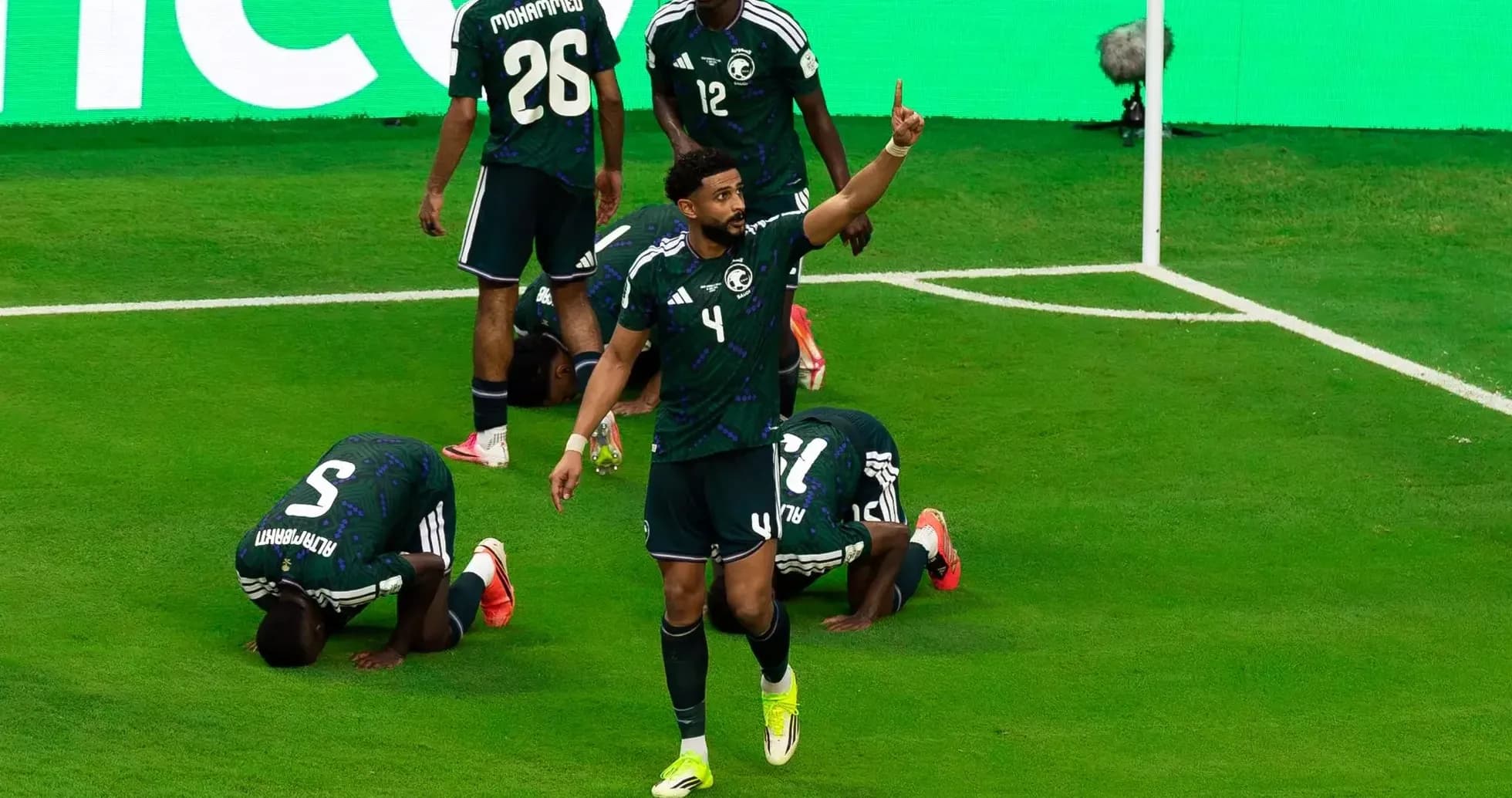
The game’s first major incident arrived on 41', when Saudi Arabia struck against the run of play. A Saudi Arabia goal — A. Al Amri (unassisted) — came from a set-piece situation, the centre-back reacting first to a loose ball in the box to give the hosts a 1-0 lead. On 44', the scorer was booked: 44' A. Al Amri (Saudi Arabia) — yellow card (Roughing), reflecting the increasing defensive desperation as Uruguay pushed for a response before the interval.
At half-time, Marcelo Bielsa reacted immediately. On 46', Uruguay made a double change to inject more energy down the left and fresh legs up front: 46' J. Sanabria replaced M. Viña (Uruguay), reshaping the left flank, and 46' A. Canobbio replaced D. Núñez (Uruguay), adding more mobility and pressing in the forward line.
Saudi Arabia responded with their own adjustments to protect the lead and add running power. On 63', 63' N. Al Dawsari replaced M. Al Juwayr (Saudi Arabia), a like-for-like attacking change aimed at freshening the front line’s pressing and transition threat.
Uruguay continued to dominate territory and possession, and Bielsa added more creativity from deep on 72': 72' N. de la Cruz replaced M. Ugarte (Uruguay), sacrificing a pure holding midfielder for a more progressive passer to break Saudi Arabia’s compact block.
The pressure finally told on 80'. Uruguay goal — M. Araujo (unassisted) — as Maximiliano Araújo cut inside from the left and finished a solo effort, rewarding Uruguay’s sustained attacking volume and levelling the score at 1-1. Immediately after scoring, Uruguay sought fresh width: 81' B. Rodriguez replaced M. Araujo (Uruguay), maintaining the same structural threat on the flank with a new runner.
Saudi Arabia, now under siege, reinforced both full-back and wide areas. On 81', 81' N. Boushal replaced M. Abu Al Shamat (Saudi Arabia), shoring up the right side and adding defensive solidity against Uruguay’s overloads.
As the match entered its final phase, Uruguay made one last attacking tweak at 90': 90' R. Aguirre replaced F. Vinas (Uruguay), introducing a more direct central forward to attack crosses and second balls.
In stoppage time, Saudi Arabia used all three remaining substitutions to run down the clock and add defensive resilience. On 90+3', 90+3' A. Lajami replaced S. Abdulhamid (Saudi Arabia), 90+3' A. Al Hamdan replaced M. Al Harbi (Saudi Arabia), and 90+3' A. Hejji replaced F. Al Buraikan (Saudi Arabia), collectively tightening the back line and sacrificing attacking outlets to preserve the point. No further goals followed, and the match closed at 1-1.
Fixture Statistics & Tactical Audit
- xG: Saudi Arabia 0.99 vs 1.48 Uruguay
- Possession: Saudi Arabia 35% vs 65% Uruguay
- Shots on Target: Saudi Arabia 3 vs 9 Uruguay
- Goalkeeper Saves: Saudi Arabia 8 vs 2 Uruguay
- Blocked Shots: Saudi Arabia 1 vs 5 Uruguay
The underlying numbers underline how much of this contest was played on Uruguay’s terms. With 65% possession and a heavy 24-7 advantage in total shots (including 9-3 on target), Uruguay were dominant in territory and chance volume. Their xG edge of 1.48 to 0.99 suggests they created the better overall shot quality, particularly through repeated entries into the box (15 shots inside the area). Saudi Arabia’s performance was largely reactive and defensive, but highly resilient: 8 saves from Mohammed Al-Owais and 5 blocked shots by Uruguay’s defence at the other end indicate a match where the South Americans were consistently on the front foot, while Saudi Arabia relied on moments and set plays. A 1-1 draw is slightly flattering for Saudi Arabia relative to xG and shot volume, but it is not wildly out of line given that both sides generated at least one high-quality chance and Uruguay’s finishing lacked precision.
Standings Update & Seasonal Impact
For Saudi Arabia, this second consecutive 1-1 draw moves them to 2 points, with 2 goals scored, 2 conceded, and a goal difference of 0. They remain in 2nd place in Group H, still within the Round of 32 qualification zone but leaving themselves little margin for error in the final group match.
Uruguay also move to 2 points, with 2 goals for, 2 against, and a goal difference of 0, holding on to 1st place in Group H thanks to tie-breakers beyond points and goal difference. While they stay in the Round of 32 qualification positions, back-to-back draws mean they will likely need a win in their last group game to secure top spot and avoid a tougher knockout opponent.
Lineups & Personnel
Saudi Arabia Starting XI
- GK: Mohammed Al-Owais
- DF: Moteb Al-Harbi, Hassan Altambakti, Abdulelah Al-Amri, Saud Abdulhamid
- MF: Salem Al-Dawsari, Abdullah Al-Khaibari, Mohamed Kanno, Mohammed Abu Al-Shamat
- FW: Musab Al Juwayr, Firas Al-Buraikan
Uruguay Starting XI
- GK: Fernando Muslera
- DF: Matías Viña, Mathías Olivera, Sebastián Cáceres, Guillermo Varela
- MF: Rodrigo Bentancur, Manuel Ugarte, Maximiliano Araújo, Federico Viñas, Federico Valverde
- FW: Darwin Núñez
Post-Match Verdict
From a tactical perspective, this was a resilient Saudi Arabia display built on deep defensive organisation and a high-impact set-piece goal, set against a Uruguay side that was dominant in possession (65%) and chance creation (24 total shots, 1.48 xG) but insufficiently ruthless in the box. Saudi Arabia’s low block and compact 4-4-2 limited clear central openings, forcing Uruguay to rely on volume rather than clarity; the hosts then maximised their limited attacking moments with a well-taken, unassisted strike from A. Al Amri and disciplined game management once ahead. Uruguay, meanwhile, showed strong control phases and pressing structure but lacked a clinical edge (9 shots on target for only 1 goal) and were occasionally vulnerable to transitions when overcommitting. In the end, Saudi Arabia’s defensive resilience (8 goalkeeper saves) matched Uruguay’s territorial dominance, and the draw reflects a contest where structure and discipline narrowly outweighed attacking intent.