.svg&w=384&q=75 "GoalGist logo")
Saudi Arabia's Challenge at Gulf Cup 27: Managing Crisis and Expectations
Saudi Arabia walk into Gulf Cup 27 with a ball at their feet and a storm at their back.
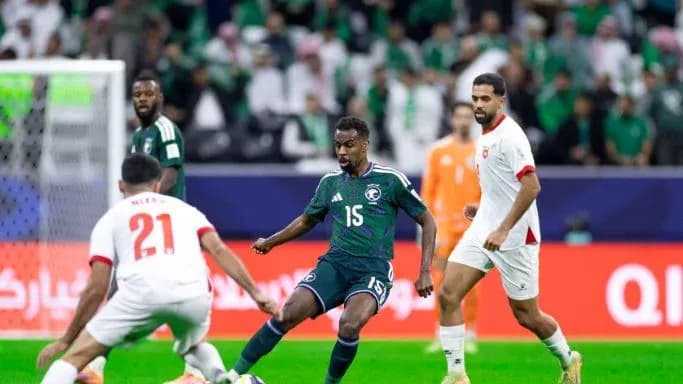
The football issue is clear enough. The absence of Al-Juwair strips Georgios Donis of one of his few midfielders able to dictate tempo, stitch the team’s lines together and then surge forward to help in the build-up. He wasn’t just another body in the middle. He was a reference point.
Mukhtar Ali’s call-up fills the empty seat on the team sheet, not the empty role. The two midfielders offer different qualities, and that forces Donis into a reshuffle. Responsibilities must move. Passing lanes must change. Some of the control and link-up duties Al-Juwair handled will now need to be shared out across the unit rather than handed to a single organiser.
That is the tactical headache. The real danger sits elsewhere.
This crisis threatens to live longer in the corridors than on the pitch. Players listen. They scroll. They talk. When the dressing room keeps hearing about an excluded team-mate, management statements and the backlash around them, part of the group’s attention drifts from training pitches to timelines. For a short tournament with no room to reset, that kind of noise can be lethal.
Donis and the administrative staff now have a second job: crisis managers. A successful camp is never just a question of fitness tests and tactical boards. It needs calm. It needs a clear hierarchy and a daily routine where every player understands that his main task is the session and the match, not chasing the latest comment on television or social media.
Saudi Arabia arrive at Gulf Cup 27 needing more than results. They need a reset. Recent performances have dented the image of the national team, so this tournament doubles as a chance to rebuild confidence and correct their direction, not simply to add another trophy to the cabinet.
That mission becomes harder when the pre-tournament narrative drifts away from how to improve the side and fix its flaws, and instead circles endlessly around who mishandled the Al-Juwair case, who leaked what, and who should carry the blame.
The risk grows with every microphone placed in front of a former player. Hazazi has already criticised the way the situation has been dealt with, calling it “a distraction” for the national team. Al-Mefreg, on the other hand, has underlined that the regulations must apply to everyone, warning that stepping back from them could create chaos in the camp. Between those two positions, the squad finds itself trapped in a debate that is already larger than the sporting issue that sparked it.
This is how a limited disciplinary matter swells into a real problem. If the federation and staff close ranks, handle it internally, and everyone respects the decision, the story can shrink quickly into a footnote: an incident that happened before the tournament and went no further. If not, it hangs over every training session, every press conference, every team talk.
The margin for error is tiny because the schedule is brutal. Saudi Arabia open against Kuwait on 23 September, face Oman on 26 September and then finish the group stage against Iraq on 29 September. Three games in six days. No time to dwell, no space to indulge side stories.
Those matches will not just measure quality. They will measure nerve.
A strong start against Kuwait could smother much of the noise in one night. Players feel that shift instantly when a win arrives; the conversation swings back to tactics, line-ups and goals. But any early stumble would rip open every file that has been stacked on this crisis and fold the Al-Juwair affair into a bigger question about the team’s mentality and their ability to handle pressure when it truly counts.
The most convincing reply will not be delivered behind a desk or in a TV studio. It will come in the intensity of the press, the discipline of the block, the courage to take the ball when the stadium is restless.
No one can claim that Saudi Arabia have already thrown away Gulf Cup 27 because of the Al-Juwair saga. The tournament has not kicked off. The group is intact. The route forward is still there.
What is clear is that they cannot afford to let this story grow by the day while publicly insisting the goal is to fight for the title. If the players can draw a line between what happened off the field and what awaits them on it, the crisis can fade into the background. If they cannot, they may find themselves locked in a mental battle long before the first whistle blows in Kuwait.