.svg&w=384&q=75 "GoalGist logo")
AS Roma vs Inter: A Title-Race Dress Rehearsal
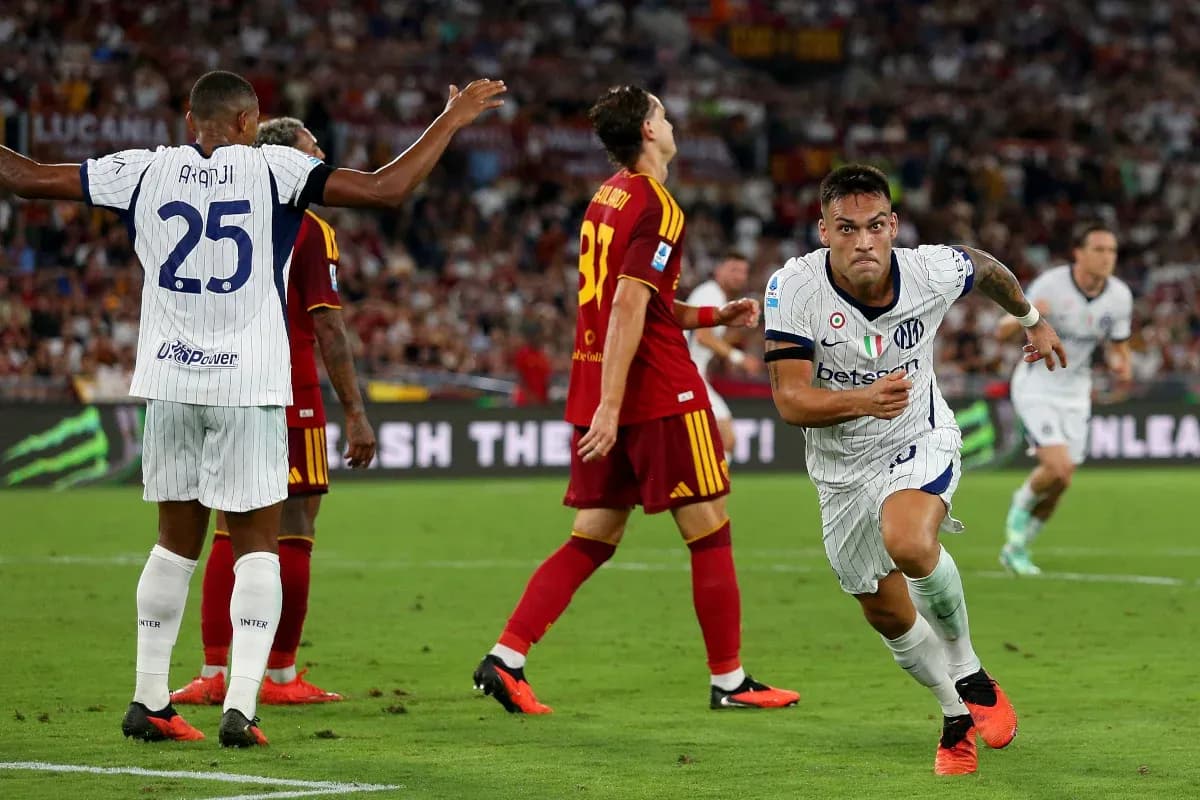
Stadio Olimpico had the feel of a title‑race dress rehearsal: first against second, both unbeaten, both on 13 points, and both having spent the opening five rounds imposing their will on Serie A. Yet the final image was of balance rather than supremacy – AS Roma racing to a 2–0 half-time lead, Inter clawing back to 2–2 by full time – a scoreline that mirrors how evenly matched these squads are built.
Heading into this game, Roma’s season profile was ruthless. Top of the table with 4 wins and 1 draw from 5 matches, they had scored 14 goals and conceded 3 overall, a goal difference of +11. At home they had taken 7 points from 3 games, scoring 8 and conceding 3, while away they were perfect: 2 wins from 2, 6 scored, none conceded. Inter, second only on goal difference, had the more explosive attack – 15 goals for and 8 against overall, a goal difference of +7 – with a particularly heavy home scoring rate (12 at home, 3 away). This was, in every sense, the league’s sharpest attack testing itself against its most balanced machine.
I. The Big Picture – System vs System
Piero Gasperini Gian doubled down on Roma’s early-season identity with his preferred 3‑4‑2‑1. M. Svilar anchored a back three of G. Mancini, L. Balerdi and Mario Hermoso, a unit that has underpinned Roma’s league‑best defensive record. Ahead of them, the wing‑to‑wing quartet of Wesley Franca, B. Cristante, M. Kone and N. Molina was designed less as a flat line and more as a rotating carousel: Cristante as the fixed point, Kone and Wesley as the carriers, Molina as the vertical outlet.
In the half‑spaces, P. Dybala and M. Soule floated behind D. Malen, the league’s leading scorer with 6 goals from 5 appearances. Dybala arrived as Serie A’s top assist provider with 4 assists and 23 key passes, and this structure is built to give him maximum freedom: two aggressive wide midfielders to drag full‑backs away, a mobile No. 9 who loves to run the channels, and a left‑footed creator in Soule who can mirror his movements on the opposite side.
Cristian Chivu responded with a 3‑1‑4‑2 that tilted heavily towards control. J. Martinez started behind a back three of Y. Bisseck, M. Akanji and A. Bastoni, with P. Zielinski stepping into the holding role to link defence and midfield. The band of four – A. Diouf, N. Barella, C. Jones and F. Dimarco – was the game’s key structural feature: two high‑energy interiors in Diouf and Barella, a technical controller in Jones, and Dimarco providing width and crossing threat from the left. Up front, Lautaro Martinez and M. Thuram formed a classic “Hunter and Target” pairing: Lautaro the penalty‑box predator with 4 goals heading in, Thuram the runner and facilitator with 2 goals and 2 assists.
II. Tactical Voids – The Absences That Shaped the Contest
Both sides arrived without a key structural piece. Roma’s list was short but significant: M. Bah, out with a knee injury, removed one of Gasperini’s more dynamic depth options in wide areas, subtly tightening the rotation in the wing‑back roles.
Inter’s absences were more glaring and more systemic. H. Calhanoglu, missing with a muscle injury, stripped Chivu of his primary deep playmaker and set‑piece specialist. Without him, Zielinski had to drop deeper, reducing his ability to arrive late in the box. The injuries to D. Spence and J. Stones further constrained Inter’s flexibility in the back line and at wing‑back, making the starting three of Bisseck, Akanji and Bastoni almost non‑negotiable.
Disciplinary trends added another layer. Roma’s yellow‑card distribution this season shows a clear late‑game spike: 37.50% of their cautions have come between 61–75 minutes, and 25.00% between 76–90. Inter, by contrast, have been at their most reckless just after half‑time, with 50.00% of their yellows in the 46–60 window. In a match of fine margins, those patterns foreshadowed phases where each side might wobble: Roma under pressure as legs tire, Inter risking momentum with post‑interval fouls.
III. Key Matchups – Hunter vs Shield, Engine Room vs Engine Room
The headline duel was always going to be D. Malen against Inter’s back three. Malen’s 6 goals from 16 shots (10 on target) illustrate a striker in ruthless form, and his movement is tailor‑made to stress a high defensive line. M. Akanji, who has already accumulated 2 yellow cards and sits among the league’s leading card collectors, was the natural “shield” – aggressive in the duel (25 duels won from 34) but walking a disciplinary tightrope. Any mistimed step into Malen’s path threatened to tilt the game.
Behind Malen, Dybala’s battle with Inter’s central block was the tactical heart of the contest. With 237 completed passes and an 84% accuracy, plus 23 key passes in just 5 games, he is Roma’s creative metronome. His zones overlapped directly with Barella and Jones, and with Diouf shuttling across. Diouf’s own profile – 159 completed passes at 91% accuracy, 13 key passes, 6 tackles – made him Inter’s answer to Dybala in terms of influence, even if from a deeper starting point.
On the flanks, F. Dimarco and Thuram attacking Roma’s right side brought G. Mancini and Molina into constant defensive action. Mancini’s numbers – 9 tackles, 8 interceptions, 5 key passes – show a defender who steps out aggressively, but that same front‑foot instinct could be exploited by Thuram’s diagonal runs and combination play with Lautaro.
IV. Statistical Prognosis – Margins of a Title Race
Heading into this game, Roma’s overall attacking average stood at 2.8 goals per match, with 2.7 at home, while conceding only 0.6 overall and 1.0 at home. Inter’s profile was more volatile: 3.0 goals scored per match overall (4.0 at home, 1.5 away) and 1.6 conceded overall (2.0 at home, 1.0 away). On their travels, Inter had scored 3 and conceded 2 in 2 games, a slimmer margin than at San Siro but still indicative of a side that always carries threat.
Overlaying these numbers on the tactical structures suggested a narrow edge for Roma in defensive solidity, balanced by Inter’s capacity to generate high‑value chances through their front two and the Diouf‑Barella axis. With neither side having missed a penalty all season and both boasting multiple clean sheets (Roma 3 overall, Inter 1), this was always more likely to be decided by open‑play quality and late‑game management than by set‑piece chaos.
The 2–2 draw ultimately reflected that equilibrium. Roma’s 3‑4‑2‑1 once again showcased Dybala’s orchestration and Malen’s cutting edge; Inter’s 3‑1‑4‑2 underlined the resilience of Akanji and Bastoni and the enduring menace of Lautaro and Thuram. For a title race still in its early chapters, this felt less like a conclusion and more like a prologue – two squads revealing their blueprints, and discovering that, for now, they are mirror images rather than clear superiors.