.svg&w=384&q=75 "GoalGist logo")
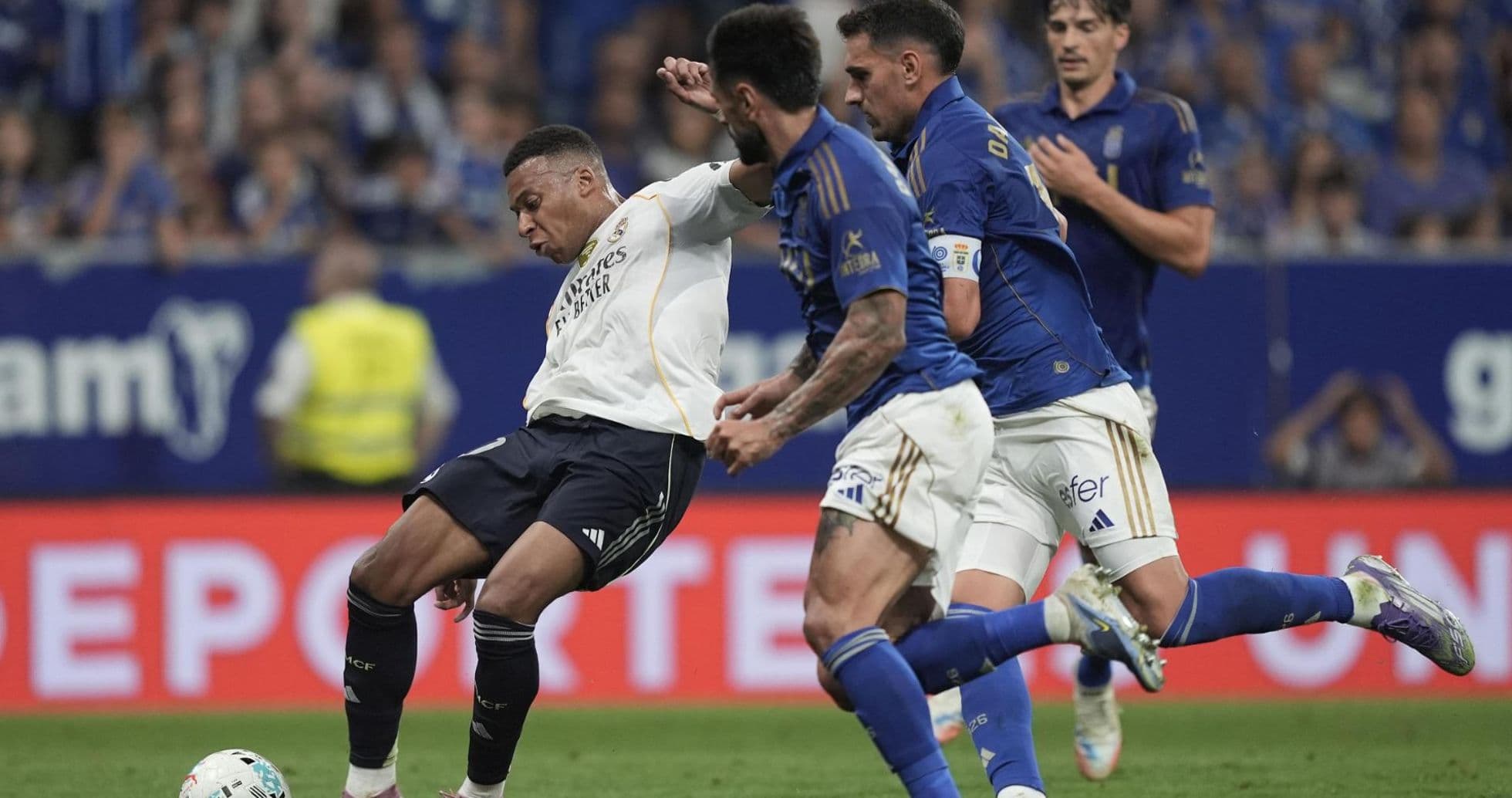
Real Madrid Dominates Oviedo in 2-0 Victory
Real Madrid’s 2-0 win over Oviedo at Estadio Santiago Bernabéu was a controlled, structurally coherent performance built on territorial dominance and a clear right-sided attacking bias, with late-game vertical threats from the bench consolidating the result. The match followed the statistical pattern of a heavyweight against a compact visitor: 65% possession, 616 passes and 19 shots for Real Madrid versus Oviedo’s 35% possession, 325 passes and 9 shots. Yet the underlying xG — 1.46 to 1.03 — shows that while Madrid controlled the ball and territory, Oviedo still manufactured a handful of meaningful situations, forcing Real Madrid to balance their aggressive structure with disciplined rest-defense.
In possession, Alvaro Arbeloa’s 4-4-2 behaved like a 3-2-5 in settled attacks. T. Alexander-Arnold, starting as the right-back, often stepped inside to form a double pivot alongside A. Tchouameni, while A. Carreras provided width on the left and B. Diaz pushed high from the right midfield line. E. Camavinga operated as the connective midfielder, shuttling into the left half-space to link Carreras and Vinicius Junior, while F. Mastantuono initially balanced the right interior lane before his withdrawal. Up front, G. Garcia and Vinicius Junior split the Oviedo centre-backs, with Garcia frequently dropping to receive between the lines, creating overloads against Oviedo’s midfield trio.
First Goal
The first goal on 44 minutes encapsulated Madrid’s structural superiority. Sustained pressure and circulation against Oviedo’s 4-3-3 mid-block eventually stretched the visitors horizontally. With Oviedo’s wingers pinned deep by the advanced full-backs, Madrid could rotate the ball into the right half-space where B. Diaz found a pocket. His assist to G. Garcia was the product of repeated right-side combinations: Alexander-Arnold’s inside positioning drew Oviedo’s left-sided midfielder centrally, Diaz received between the lines, and Garcia attacked the space behind a disorganized back line. The timing of the goal, just before half-time, rewarded Madrid’s territorial control and patient probing rather than any chaotic transition moment.
Defensive Structure
Defensively, Madrid’s structure without the ball was a 4-4-2 mid-press. The front two screened Oviedo’s pivots, while Diaz and Mastantuono narrowed inside to protect the half-spaces, trusting Carreras and Alexander-Arnold in wide duels. Oviedo still managed 7 shots inside the box out of 9 total, which, combined with an xG of 1.03, suggests that when they did break Madrid’s first line, they reached dangerous zones. However, with only 1 shot on target, Oviedo’s final actions were rushed or well-contested, and T. Courtois’ 1 save aligned with Real Madrid’s goals prevented figure of 0.16 — evidence that the goalkeeper was rarely exposed to high-quality, on-target chances despite some box entries.
Guillermo Almada Alves Jorge’s Oviedo lined up in a 4-3-3 but often sank into a 4-5-1 without the ball. The wingers, I. Chaira and T. Fernandez, were forced deep by Madrid’s full-backs, leaving F. Vinas isolated against two centre-backs and Tchouameni stepping out. Oviedo’s offensive plan revolved around quick vertical play once possession was recovered: direct balls into the channels for the wide forwards, and second-ball contests around N. Fonseca and S. Colombatto. Their 5 shots off target and 3 blocked shots show they reached shooting positions but struggled to create clean looks, a function of Real Madrid’s compact box defending and proactive shot blocking.
Second Half Changes
The second half was shaped by substitutions that sharpened Madrid’s vertical threat and allowed them to manage energy and control. At 54 minutes, Oviedo introduced S. Cazorla for I. Chaira, seeking more composure and passing quality between the lines. Arbeloa responded on 64 minutes with a like-for-like but intensity-focused double change: D. Carvajal (IN) came on for T. Alexander-Arnold (OUT), and J. Bellingham (IN) came on for A. Tchouameni (OUT). These moves subtly shifted Madrid’s attacking dynamics. Carvajal provided more traditional overlap and defensive security on the right, while Bellingham added late runs into the box and improved counterpressing in central zones.
On 69 minutes, K. Mbappe (IN) came on for G. Garcia (OUT), and H. Hassan (IN) came on for T. Fernandez (OUT), transforming the attacking profiles on both sides. For Madrid, Mbappe’s presence immediately stretched Oviedo’s back line vertically, forcing them to defend deeper and opening central lanes for Bellingham. For Oviedo, Hassan offered a more direct, penalty-box-oriented threat, but with limited supply given Madrid’s possession dominance.
Decisive Tactical Moment
The decisive tactical moment arrived on 80 minutes with the second goal: J. Bellingham, assisted by K. Mbappe, finished a move that showcased Madrid’s transition quality. With Oviedo committing more numbers forward after their 79-minute double change — L. Ahijado (IN) for N. Vidal (OUT) and P. Agudin (IN) for N. Fonseca (OUT) — their rest-defense weakened. Mbappe exploited the increased space in behind, and Bellingham’s timing from midfield into the box punished Oviedo’s stretched shape. This sequence underlined the impact of Madrid’s bench: Mbappe and Bellingham directly combined for the goal that sealed control.
Late substitutions from Madrid — C. Palacios (IN) for B. Diaz (OUT) and D. Yanez (IN) for F. Mastantuono (OUT) at 77 minutes — were primarily about game management: fresh legs to sustain counterpressing and maintain width, ensuring Oviedo could not build sustained pressure despite chasing the game.
Statistical Overview
Statistically, Real Madrid’s 19 shots to Oviedo’s 9, combined with a 7–1 advantage in shots on goal, reflect the territorial and qualitative superiority of their attacking phases. The passing profile — 616 total passes, 570 accurate (93%) — underscores a high technical level and a controlled tempo, contrasting with Oviedo’s 325 passes, 275 accurate (85%), which signal a more direct, lower-possession approach. Despite the shot volume, Madrid’s xG of 1.46 suggests many efforts came from moderate positions; their efficiency in scoring 2 from that profile speaks to the quality of execution from G. Garcia and J. Bellingham rather than sheer shot quality.
Oviedo’s 14 fouls to Madrid’s 7 align with their underdog defensive posture: frequent interventions to disrupt rhythm and prevent Madrid from turning circulation into clean final-third penetrations. Yet with no yellow or red cards recorded for either side, their aggression remained within disciplinary limits, and the match flowed without major interruptions from bookings.
From a defensive index perspective, Madrid’s low goals prevented figure for Courtois (0.16) and Oviedo’s identical 0.16 for A. Escandell indicate that neither goalkeeper was forced into extraordinary shot-stopping heroics; instead, the match was decided by structural dominance, field control, and the superior quality of Madrid’s attacking patterns and substitutions. Overall form-wise, this performance reflects a mature, late-season display from Real Madrid: high-possession control, intelligent in-game adjustments, and decisive contributions from a deep bench to secure a 2-0 home win in La Liga’s Regular Season - 36.