.svg&w=384&q=75 "GoalGist logo")
Patrick Vieira's Homecoming as Senegal Coach: A New Era Begins
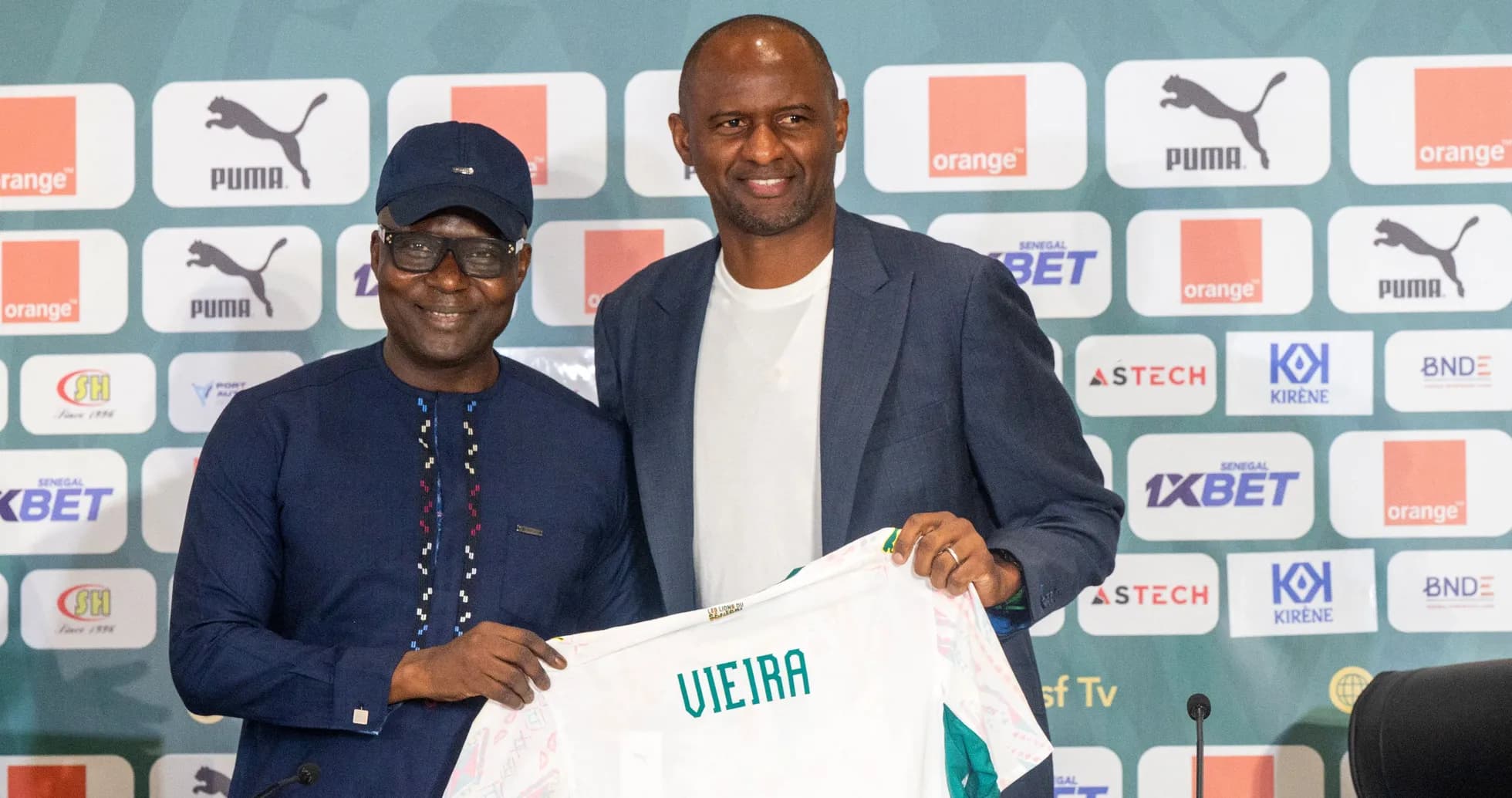
Patrick Vieira walked back into Dakar not as a visiting legend, but as the man now responsible for the heartbeat of a nation.
Presented officially as Senegal’s new head coach, the 50-year-old has been handed a four-year mandate: keep the Lions of Teranga at the sharp end of international football and build a team ready to peak by 2030. For Abdoulaye Fall, president of the Senegalese Football Federation, this was not a luxury hire. He called Vieira’s arrival an “absolute necessity” for the national side.
For Vieira, born in Dakar and gone to France at eight, the word he kept returning to was different: home.
“This is not a new step in my career, it is a homecoming,” he said, making it clear this job sits deeper than any club role he has held in Europe. He framed his decision as emotional, not financial, and promised total commitment to a country that already knows his name but will now judge his work.
No Mané, big statement
His first major decision was ruthless in optics, if not in intent.
Vieira named an expanded 29-man squad for his opening camp, reshaping the group with tactical tweaks and fresh faces. The glaring omission was immediate: no Sadio Mané.
The Al-Nassr forward remains the symbol of Senegal’s golden era, and his absence dominated the questions. Vieira moved quickly to cool any hint of controversy, explaining that Mané is dealing with a minor physical issue after the pair spoke directly by phone.
“Regarding Sadio’s absence, whom I spoke to on the phone, he has a physical issue and that is why he will not be with us for this camp, but he surely will be for the next one,” Vieira said.
So this is not a break-up. It is a pause. But it still leaves Vieira to launch his tenure, and his ideas, without the team’s talisman on the pitch.
Evolution, not revolution
If anyone expected a sweeping clear-out, they misread Vieira’s opening move.
“The important thing is not to start from scratch,” he stressed. “I'm not going to tear everything down or throw everything out the window, but to preserve what has been achieved and begin a four-year cycle.”
His list backs that up. The spine of Senegal’s recent success remains, yet the edges of the squad have been sharpened with new competition and new profiles.
With Edouard Mendy having retired from international duty, the goalkeeping department has been deliberately overloaded. Four keepers are called, including first-time inclusions for Monza’s Ngagne Demba Thiam and AS Saint-Etienne’s Mamour Ndiaye. It is a clear signal: no position is ring-fenced, and the succession plan starts now.
Across the 29, seven debutants get their chance. Monaco centre-back Sadibou Sane steps into a defensive unit that has long been a strength. Auxerre full-back Lamine Sy adds energy and width in an area where modern full-backs can redefine a system. Higher up the pitch, FC Metz forward Pape Moussa Fall joins the attacking options, another young piece in a frontline that must learn to function both with and without Mané.
This is not a demolition job. It is a remodel with the doors and windows left intact.
Immediate trial by fire
There is no gentle bedding-in period.
Senegal’s retooled group assembles straight away for a demanding international window that will test both Vieira’s authority and his ideas. The Lions open their 2027 AFCON qualification campaign away to Mozambique in Maputo on September 25, a fixture that carries real stakes from the first whistle.
Four days later, they head to Ethiopia on September 29. Then comes a different kind of examination: a friendly against Comoros in Marseille on October 4, a match that will unfold on French soil but with Senegalese expectations in the stands and on the touchline.
Three games. Three different contexts. One glaring constant: no Mané to lean on.
For Vieira, the schedule is both risk and opportunity. He must install his tactical principles at speed, blend continuity with the seven newcomers, and show that his “homecoming” is more than an emotional slogan.
The romance of returning to Dakar is over. The next four years will be defined by what happens in Maputo, Addis Ababa, and Marseille — and by how quickly Patrick Vieira can turn a nation’s nostalgia into a new era of control.