.svg&w=384&q=75 "GoalGist logo")
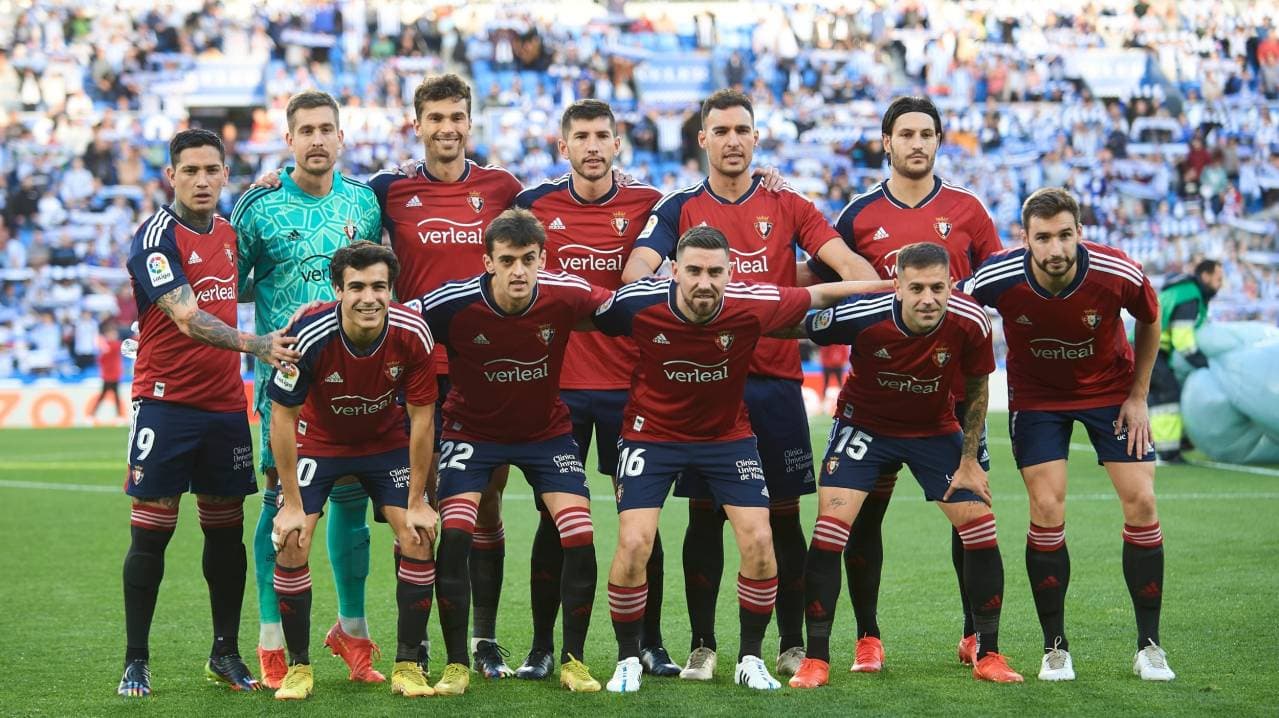
Osasuna vs Espanyol: Tactical Analysis of La Liga Clash
Osasuna’s 1-2 defeat to Espanyol at Estadio El Sadar was defined by territorial dominance versus structural efficiency. Alessio Lisci’s side, in a 4-2-3-1, controlled the ball with 68% possession and a heavy 24-7 shot advantage, but Manolo Gonzalez’s compact 4-4-2, plus clinical use of wide spaces, turned far fewer attacks into a decisive away win in this La Liga Round 37 fixture.
Espanyol struck first through C. Romero in the 27th minute, a moment that underlined their plan: full backs advancing selectively and exploiting Osasuna’s high line. With Osasuna’s back four spread to build from deep, Romero’s presence as the left back in a flat back four became an attacking weapon, stepping into space when Osasuna’s wingers tucked inside. The goal, one of only three shots on target from Espanyol, showed the visitors’ willingness to commit just enough numbers forward while keeping their rest defense intact.
Osasuna’s 4-2-3-1 was built around double pivot control. L. Torro and J. Moncayola initially provided the platform, with V. Munoz, A. Oroz and R. Garcia between the lines behind A. Budimir. The structure worked in terms of volume: 515 passes, 442 accurate (86%), and 18 of 24 shots coming from inside the box. The ball circulation was patient and wide, using full backs A. Bretones and V. Rosier to pin Espanyol’s wingers and create crossing lanes. However, the tempo in the final third was often one-paced, allowing Espanyol’s central defenders C. Riedel and L. Cabrera to defend their box with numbers and clear the many blocked shots (10 for Osasuna).
Second Half
The second half opened with Osasuna’s best spell. V. Munoz’s 49th-minute equaliser, assisted by centre-back F. Boyomo, reflected a structural tweak: Osasuna’s central defenders stepped higher in possession, compressing the pitch and adding an extra man to overload Espanyol’s first line. Boyomo’s involvement as provider showed how the hosts tried to break Espanyol’s compact 4-4-2 mid-block by creating a spare player between the lines. Once level at 1-1, Osasuna’s shape looked more like a 2-3-5 in attack, with both full backs high and the double pivot staggering to cover transitions.
Yet Espanyol’s response on 53 minutes, when K. Garcia scored from a T. Dolan assist, exposed the risk in Osasuna’s aggressive rest defense. With both full backs high and the pivots spread, Espanyol’s forwards found space to attack the channels. Dolan, starting wide on the right of midfield, drifted into the half-space and released Garcia, whose movement between the centre-backs punished Osasuna’s advanced line. It was a textbook counter to Osasuna’s territorial squeeze: quick verticality from a compact defensive block.
From there, the match became a study in game management and bench usage. Gonzalez’s substitutions were clearly aimed at preserving structure and energy. On 55 minutes, Pol Lozano, already booked for a Foul in the 11th minute, was withdrawn for C. Pickel, adding fresh legs in central midfield to cope with Osasuna’s growing pressure. Later, Exposito and K. Garcia made way for F. Calero and R. Fernandez Jaen at 64 minutes, effectively shifting Espanyol towards a more conservative, defense-first posture with additional defensive presence and a fresh outlet up front.
Osasuna’s triple change on 58 minutes – A. Oroz (OUT) for R. Garcia (IN), L. Torro (OUT) for I. Munoz (IN), and J. Moncayola (OUT) for M. Gomez (IN) – was a clear attempt to increase vertical threat and energy. R. Garcia (shirt 9) gave a more direct presence around Budimir, M. Gomez added attacking impetus, and I. Munoz injected dynamism into midfield. Structurally, Osasuna tilted towards a more attacking 4-1-4-1/4-4-2 hybrid, with greater central occupation. However, this also reduced the positional discipline that had previously protected their centre-backs in transition.
Further changes – J. Galan for A. Bretones on 67 minutes and K. Barja for V. Rosier on 78 minutes – underlined Lisci’s intent to keep width and crossing volume high until the end. By then, Osasuna were essentially camped in Espanyol’s half, reflected in their 9 corner kicks to Espanyol’s 2 and their 9 shots on goal. Yet the visitors’ low block and compact central lanes forced many efforts into crowded zones, explaining the high number of blocked shots and the inability to convert their 1.61 xG into more than a single goal.
In goal, S. Herrera faced only three shots on target and made 1 save, with a goals prevented figure of -0.23, indicating he conceded slightly more than the post-shot xG suggested. On the other side, M. Dmitrovic made 6 saves from Osasuna’s 9 shots on target, also with goals prevented at -0.23. Despite the negative goals prevented metric, his shot-stopping under constant pressure was central to Espanyol’s ability to withstand the late onslaught, especially as Osasuna flooded the box with forwards and attacking midfielders.
Discipline and duels also framed the tactical story. Espanyol committed 13 Fouls to Osasuna’s 10, consistent with their reactive, block-oriented game plan. The booking of Pol Lozano for Foul at 11 minutes signalled early that Espanyol’s midfield would contest aggressively. Osasuna’s Iker Muñoz received a yellow card at 83 minutes for Foul, a by-product of their increasingly urgent counter-press as they chased an equaliser. Antoniu Roca’s late yellow card at 90 minutes, with no additionalInfo given, came as Espanyol tried to disrupt rhythm and close out the result.
Statistically, the verdict is clear: Osasuna’s overall form in this match, in terms of chance creation and territorial control, was strong, but their efficiency lagged. Their 1.61 xG versus Espanyol’s 0.79 underlines that the hosts generated the better chances on volume, yet Espanyol converted their limited opportunities at a higher rate. Defensively, Espanyol’s index in this game was impressive: seven shots total conceded, heavy possession against, yet only one goal allowed. The structural discipline of the 4-4-2, intelligent substitutions, and a compact low block allowed Espanyol to bend without breaking, securing a 1-2 away win that ran against the statistical grain but aligned perfectly with their tactical blueprint.