.svg&w=384&q=75 "GoalGist logo")
Netherlands and Japan Draw 2–2 in World Cup 2026 Opener
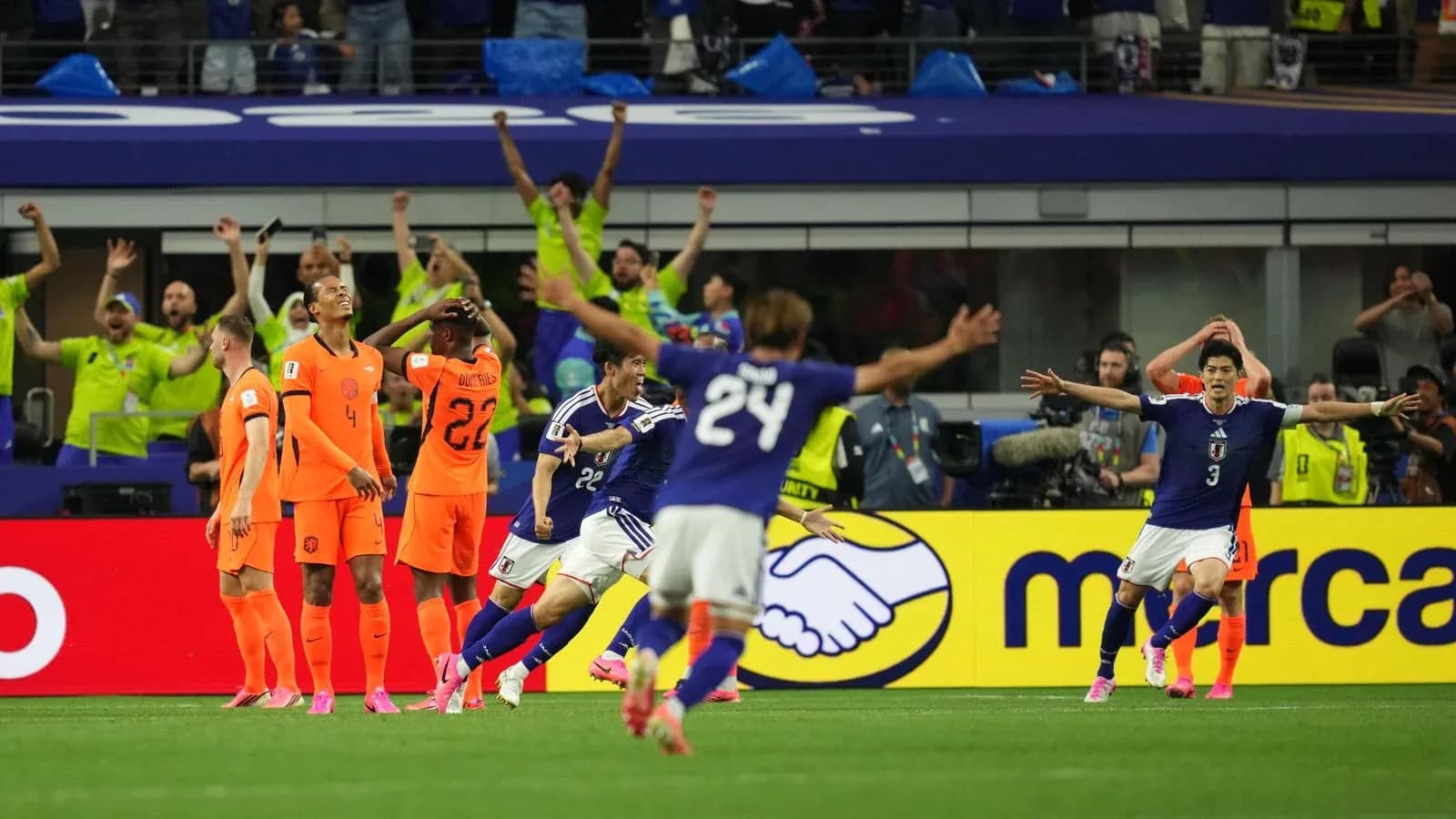
In the vast bowl of AT&T Stadium, Netherlands and Japan opened their World Cup 2026 story with a 2–2 draw that felt less like a settled verdict and more like a prologue. Following this result, both sides sit on 1 point in Group F, the Dutch listed as rank 3 and Japan as rank 2 in their respective tables, each with a goal difference of 0 after scoring and conceding 2 in total. The numbers say parity; the patterns hint at two very different footballing identities.
Netherlands’ seasonal DNA is already clear. Heading into this game they had played 1 fixture in total, at home, drawing it 2–2. Their attacking output at home stands at 2 goals in total with an average of 2.0, mirrored exactly by 2 goals conceded at an average of 2.0. There is no clean sheet yet, no failure to score, and no penalty taken. It is open, expressive football with risk built into the structure.
Japan arrive from the opposite angle: their only match so far has been on their travels, also a 2–2 draw. On their travels they have 2 goals in total with an average of 2.0, and they have conceded 2 with the same 2.0 average. Like the Dutch, there are no clean sheets and no penalties taken, but the way they reach those numbers is different: a compact 3-4-2-1, a reliance on quick combinations, and a willingness to suffer without the ball.
Tactical Overview
Tactically, this fixture showcased a fascinating clash of structures. Ronald Koeman’s 4-3-3 was textbook Dutch: B. Verbruggen behind a back four of D. Dumfries, J. P. van Hecke, V. van Dijk and M. van de Ven, a technically gifted midfield trio of R. Gravenberch, F. de Jong and T. Reijnders, and a mobile front line of C. Summerville, D. Malen and C. Gakpo.
Japan’s 3-4-2-1 under Hajime Moriyasu looked built to disrupt that rhythm. Z. Suzuki anchored a back three of T. Watanabe, S. Taniguchi and H. Ito, shielded by a flexible band of four: R. Doan and K. Nakamura wide, with K. Sano and D. Kamada inside. Ahead of them, T. Kubo and D. Maeda floated around central striker A. Ueda, ready to spring in transition.
There were no confirmed absences in the data, so both coaches had full benches to reshape the narrative. The disciplinary ledger, however, is already tilting. For Netherlands, yellow cards are clustering late: 1 in the 61–75 minute window, 1 between 76–90, and another between 91–105, each band accounting for 33.33% of their total yellows. C. Summerville’s caution and M. Depay’s booking underline a pattern: intensity and perhaps fatigue creeping into the closing stages. Japan, by contrast, have yet to record a yellow or red card in any time band, a sign of controlled aggression but also a potential lack of edge when games become chaotic.
Individual Performances
Within that frame, certain individual arcs stand out. Summerville is already one of the World Cup’s early protagonists. In total this campaign he has 1 goal from 1 appearance, with 1 shot and 1 on target, an 8.3 rating and 29 passes at 86% accuracy. He completed his only dribble and won 5 of 7 duels, drawing 3 fouls. He is both hunter and irritant, a winger who forces defensive lines to bend. Yet his yellow card hints at the emotional cost of playing at that intensity.
Behind him, Gravenberch is emerging as the quiet architect. In total this campaign he has 2 assists from 1 appearance, with 25 passes at 88% accuracy and 2 key passes. His 3 successful dribbles from 3 attempts show how he can break lines on his own, turning a 4-3-3 into a 4-2-4 in an instant. As an “engine room” figure, his duel with Japan’s central block of Kamada and Sano is pivotal: if he finds space between the lines, Netherlands become a wave; if he is crowded out, they become predictable.
Japan’s creative response is twofold. Kubo, with 1 assist and 16 passes at 75% accuracy in total this campaign, is the nominal playmaker, drifting off the right half-space to find Ueda and Maeda. He has already shown defensive discipline too, with 1 interception, hinting at a two-way role in Moriyasu’s plan. Then there is Koki Ogawa, the wildcard from the bench. In total this campaign he has 1 assist from just 15 minutes, 1 shot and 1 key pass. His profile screams impact substitute: direct, vertical, capable of punishing a tiring back line.
Game Dynamics
The “Hunter vs Shield” duel is, for now, collective rather than individual. Netherlands’ attack at home is running at 2.0 goals on average, while Japan’s defence on their travels is conceding 2.0. Flip the pitch and the equation holds: Japan’s attack on their travels is at 2.0 goals on average, against a Dutch defence at home also conceding 2.0. Every number points to a high-event fixture where neither side can truly lock the game down.
Card timing deepens the tactical tension. Netherlands’ late-game yellow-card surge between 61 and 105 minutes suggests that as matches stretch, they become more vulnerable to transitions and individual duels. That is precisely when Moriyasu can release players like Ogawa or J. Ito from the bench, running at defenders already on cautions. Koeman, conversely, must manage that risk through his substitutions: M. De Roon and M. Wieffer offer ballast in midfield, while N. Ake and L. Geertruida provide fresh legs and composure in the back line.
Statistical Overview
In the absence of xG data, the statistical prognosis leans on patterns rather than models. Both teams have identical totals: 1 match played, 0 wins, 1 draw, 0 losses, 2 goals for and 2 against. Both have yet to take a penalty, so there is no edge from the spot. The Dutch have shown more card volatility; Japan have shown more disciplinary control. The formations are stable: Netherlands have used 4-3-3 in their 1 lineup, Japan 3-4-2-1 in theirs.
Projecting forward, expect Netherlands to double down on their front three, with Summerville and Gakpo attacking the half-spaces and Malen stretching depth, while Gravenberch and De Jong dictate tempo. Japan will likely keep their back three and wing-backs compact, trusting Kubo and Doan to carry the counter-attacking threat and Ogawa to change the rhythm late on.
Following this result, the story of Group F feels delicately poised. The numbers say these teams are equals; the eye test says they are opposites. The next time they step into a World Cup night like this, it may be the late-game discipline, the timing of a substitution, or the calm of a playmaker under pressure that finally tips a 2–2 stalemate into something decisive.