.svg&w=384&q=75 "GoalGist logo")
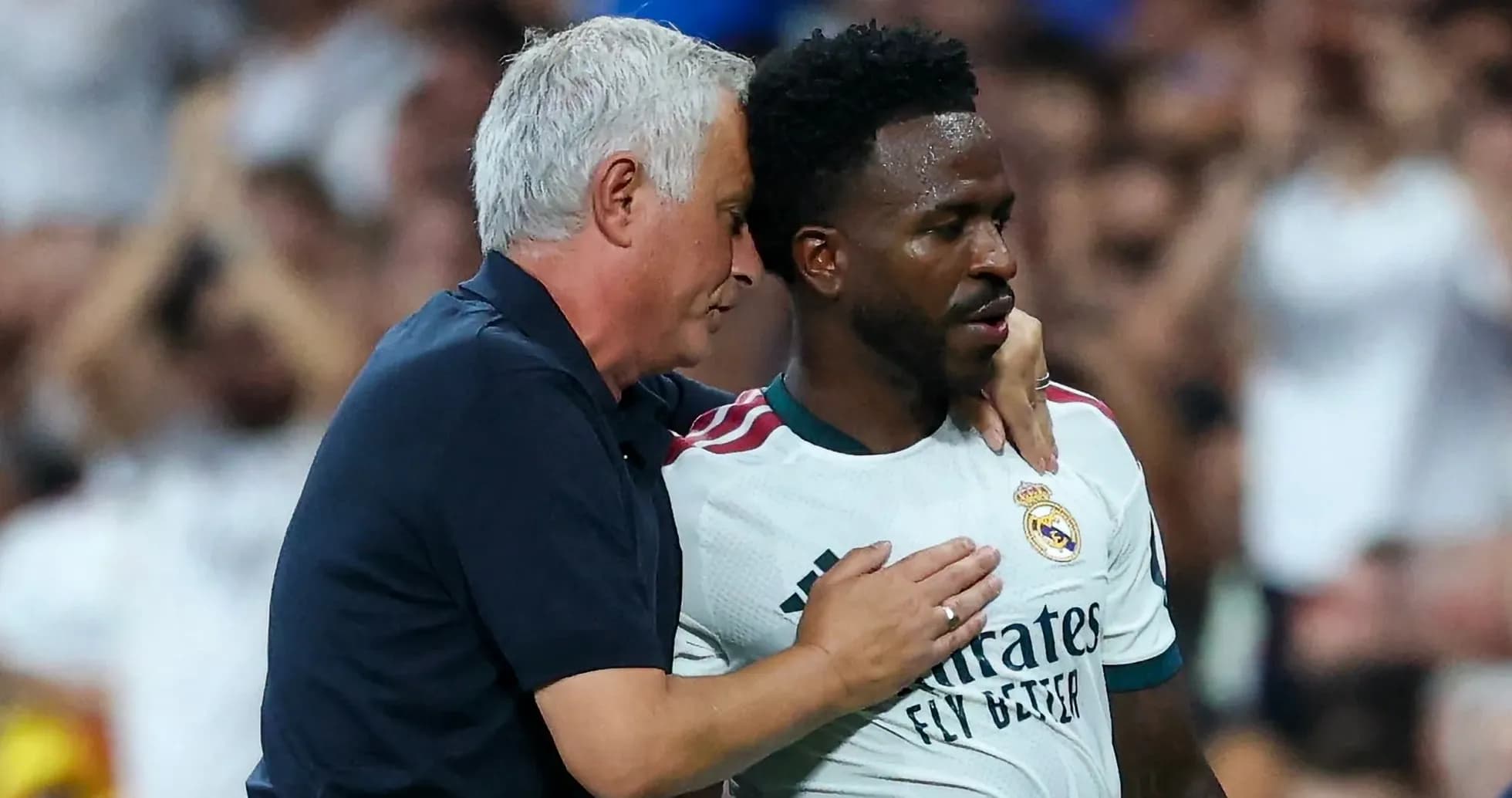
José Mourinho Supports Struggling Vinicius at Real Madrid
José Mourinho did not try to hide the obvious. Vinicius is struggling. But he made it equally clear he will not abandon him.
Speaking after the final whistle, the Real Madrid coach drew a sharp line between form and effort, and placed his Brazilian winger firmly on the right side of it.
“He isn't at his best, and he knows it,” Mourinho admitted in his press conference. “But he's working hard to be the Vinicius who decides games. Without being at his best, he's working harder than ever.”
The performance against Inter fit that description. Vinicius lacked his usual cutting edge in the final third, failed to finish the one-on-ones that once felt routine for him, yet kept chasing, pressing, tracking back. When he didn’t, Mourinho insisted, it was not down to attitude.
“In the moments that he wasn't able to drop back and defend, it was because of fatigue,” he said. “I have to value that a lot. I have a lot of respect for this Vinicius. The time will come when he decides games, and wins us games.”
Out of form, not out of favour
The numbers underline the dip. After a bruising 2025-26 season, when criticism from the Bernabéu stands became a recurring soundtrack, Vinicius chose to commit his long-term future to Madrid in the summer. The reset was supposed to launch a new chapter.
Instead, the opening pages have been slow. Just one goal and two assists in five appearances is a modest return for a player who built his reputation on chaos, acceleration, and decisive moments.
Mourinho, though, framed the Inter display as a tactical and physical grind rather than a crisis of confidence. He pointed to the specific demands of facing a side built on a back three with aggressive wing-backs, a system that can suffocate wide forwards and force them into double duty.
“If he works, he'll always have my support,” Mourinho stressed. “He worked very hard for the team. Playing against a side that plays with three at the back, with wing-backs, it's very hard for the wingers.
“Obviously with the one-on-ones he had on the left wing, with Vini at his best, he'd kill the game. That's what we expect of him. But he gave everything.”
The message was blunt: the ruthless, match-winning Vinicius is the standard, but the exhausted, grafting version still earns protection from his coach.
Makeshift Madrid and Trent’s trial
The context around him did not help. Madrid went into the Inter clash stripped of key creative and controlling pieces. Suspensions to Bernardo Silva, Arda Guler, and Eduardo Camavinga ripped the heart out of Mourinho’s midfield plan and forced an emergency reshuffle.
The most striking adjustment came with Trent Alexander-Arnold, pushed into central midfield in an unfamiliar role. His name on the teamsheet in that position told its own story about the depth issues Mourinho is juggling.
“It’s hard for Trent,” the Portuguese coach acknowledged. “I appreciate the effort he made, but with his characteristics, the specificity needed to play full-back or central midfield, it's completely different physically.”
Alexander-Arnold’s range of passing and vision are not in question. The problem lay in angles, distances, and pressure. He was asked to operate with opponents closing from all sides, not with the game spread in front of him as it is at right-back.
“He had some losses of the ball, because it's not the same playing with the whole field in front of you, and playing with half the field behind you,” Mourinho explained. “He's played there a few times with Liverpool and the national team, but it's completely different. He didn't have more to give.”
It was a telling line. A coach famous for demanding everything from his players openly conceded that, on this night, some simply reached their limit.
A test of endurance and identity
Between an off-colour Vinicius, a patched-up midfield and a physically draining tactical battle with Inter’s wing-backs, Madrid looked like a team wrestling with both fatigue and identity. The structure creaked. The stars laboured. The margins shrank.
Yet Mourinho doubled down on work-rate as his non-negotiable. Those who run, those who suffer for the team, will be shielded. Vinicius sits squarely in that category for now, even as the goals and assists lag behind his reputation.
The question is no longer whether he will keep working. Mourinho has answered that. The real question is when the version of Vinicius who “kills the game” finally reappears—and how long Madrid can wait for him to start deciding nights like this again.