.svg&w=384&q=75 "GoalGist logo")
MLS Capitalizes on World Cup Momentum
“Thanks world, we’ll take it from here.”
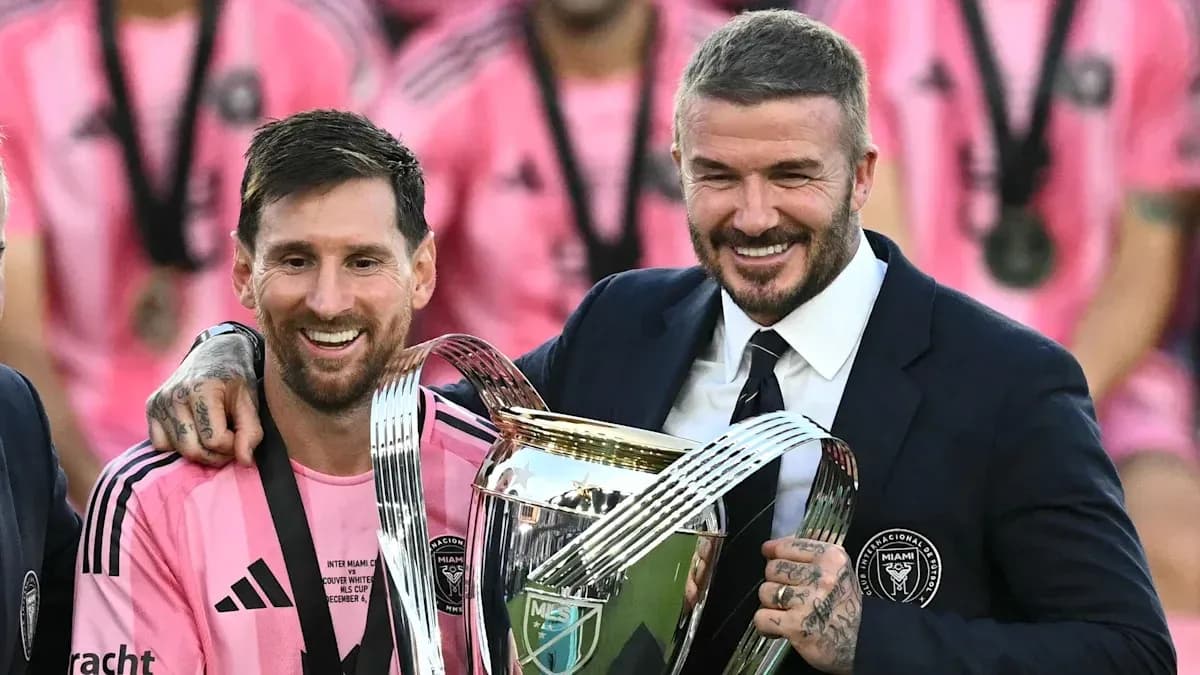
That’s the line MLS has chosen as its calling card, delivered by Lionel Messi, Son Heung-min, David Beckham and a cast of league stars in a glossy new campaign aimed squarely at the millions of fresh eyes the World Cup has brought to football in the United States.
The message is blunt: you’ve fallen for the World Cup. Now come and see what’s happening on your doorstep.
The film stitches together World Cup heroes now plying their trade in North America, beckoning fans back as the regular season kicks in again. To lower the threshold even further, the league is dangling free tickets for new supporters. This is not subtle marketing; it’s a full‑on grab for the moment.
Dan Courtemanche, MLS executive vice-president and a league stalwart since 1995, knows exactly what’s at stake.
“The World Cup has now exposed millions of people to Major League Soccer,” he says. “We’re going to continue to capitalise on that momentum.”
The question hangs over all of it: could this World Cup’s real legacy be MLS stepping decisively into the orbit of the game’s elite leagues?
From 1994 experiment to 30-club beast
MLS itself is a World Cup heirloom. When the United States won hosting rights for 1994, Fifa made a domestic professional league a non‑negotiable condition. Out of that requirement, in 1996, came a 10‑team competition with no football‑specific stadiums and a future that looked fragile at best.
Three decades on, the landscape is unrecognisable. Thirty clubs now stretch across the continent, backed by a growing portfolio of purpose-built stadiums tailored to the sport rather than borrowed from NFL tenants.
The World Cup just staged on American soil has poured petrol on that slow burn. Predictions that high ticket prices would leave empty seats proved misplaced. Stadiums filled. The television numbers, in a saturated sports market, were striking.
The USA’s last‑16 defeat to Belgium drew more than 33 million viewers on Fox, the most‑watched football match on a single US network. England’s last‑16 win over Mexico went even bigger: 45 million people watched in English and Spanish across Fox and Telemundo, the largest football audience in US history.
Those figures live in the same neighbourhood as regular‑season NFL games, even if they still trail the behemoth of American broadcasting. The 2025 Super Bowl, with Kendrick Lamar headlining the half‑time show, pulled in 127.7 million viewers across English and Spanish broadcasts and streaming. That is still the gold standard.
Yet for a league that began as a survival project, MLS now speaks in a very different register.
“I think we’re looked at as the top, one of the top leagues commercially,” commissioner Don Garber said at an event assessing the post‑World Cup landscape. “We’ve cracked that code. Now we’ve got to crack the rest of it.”
Beyond the ‘retirement home’ tag
On some fronts, MLS already sits shoulder to shoulder with the game’s established competitions.
Forty-five MLS players went to the 2026 World Cup, including two who started the final for Argentina: Messi and Rodrigo de Paul. The old caricature of MLS as a soft‑landing for ageing stars has been hard to shake, fuelled by names like Beckham and Messi arriving after glittering European careers.
Courtemanche insists that label no longer fits. The average age of new international signings is now 23.8. These are players at the beginning or middle of their journeys, many of them using MLS as a launchpad with Europe still in their sights.
The league is adjusting its own rhythm to match those ambitions. From 2027, MLS will switch to a summer‑to‑spring calendar, mirroring Europe’s schedule and smoothing transfer moves between continents. Behind that, clubs are pouring resources into youth development, building out academy structures and competition platforms designed to keep talent in the system longer.
On a warm night in Los Angeles, the theory meets reality. As LA Galaxy beam the US national team’s victory over Bosnia-Herzegovina on a giant screen at a viewing party, dozens of children barely glance up. They’re too busy.
Three small‑sided games rage on beside the main event, kids flying into tackles and chasing loose balls, sprinting only briefly to the big screen when the roar of a goal rolls through the crowd. Some wear MLS academy gear. All of them play as if the future is right there under the floodlights.
Among them is eight‑year‑old Landon, named after US legend Landon Donovan. He bounces from goalkeeper to forward, grinning, chasing every touch. His mother, coach Jen Wing, says her children attend MLS camps and travel across New Jersey with competitive teams.
Landon’s ambition is simple, and immediate.
“LAFC,” he says when asked where he wants to play as a professional.
That dream, though, runs headlong into a familiar American problem.
The cost of chasing a dream
For all the progress at the top, critics argue MLS cannot truly compete with Europe until it dismantles the “pay‑to‑play” culture that shapes youth football in the United States.
At academy level, MLS clubs now mirror European models, training and developing their best prospects without charging fees. The barrier comes earlier. To reach the point where an MLS academy even notices a teenager, families often shell out thousands of dollars on private coaching and travel teams. It’s a pattern repeated across US youth sports.
League officials insist the picture is evolving. They point to scholarship programmes in every academy and to a development structure that, they argue, is steadily widening the pathway for talented players who can’t afford the traditional route.
Garber speaks of a league still learning, still building.
The goal, he says, is to produce more players for the men’s national team and to shape athletes who are “better, bigger, stronger, faster, all those things that give you energy to think of a better future”.
The World Cup has shown that the audience is there. Now MLS must prove it can supply the players.
Messi, movie stars and money
If there is one figure who can turn curiosity into obsession, it is Messi. His presence remains the league’s most powerful magnet, a weekly spectacle that draws not just football fans but the casually intrigued.
Yet the celebrity halo around MLS stretches far beyond one No 10.
Hollywood and the wider entertainment industry have bought in with hard cash. Will Ferrell is part of the ownership group at LAFC. Reese Witherspoon has a stake in Nashville SC. Matthew McConaughey beats his drum at Austin FC. Magic Johnson is another high-profile name attached to LAFC.
The numbers behind those investments tell their own story. Drew Carey joined the Seattle Sounders ownership group in 2009, when the expansion fee stood at $30m. Today, the Sounders are valued at more than $900m.
Beckham’s 2007 LA Galaxy contract famously included an option to buy an expansion franchise for $25m. That clause eventually produced Inter Miami CF, now widely valued at more than $1bn.
MLS has become a serious financial play. The question is whether it can now become an equally serious footballing one.
Friday night lights vs Saturday morning touchlines
The league’s surge comes against the backdrop of a country still emotionally wired to a different kind of football.
Brian Udovich watches that tension up close. His 12‑year‑old son, Croil, plays in an MLS Next Level league in Southern California, part of the same development ecosystem MLS is banking on. He sees talented youngsters drift away from soccer as they hit their teens, drawn to American football and everything that comes with it.
On Friday nights, high school gridiron players run out to packed stands, marching bands, cheerleaders, and their names in lights. It is theatre as much as sport, played in cavernous stadiums that dominate local skylines.
Soccer, by contrast, often unfolds on chilly Saturday mornings. Parents sit in folding chairs. There are no bands, no booming PA systems, no floodlit pageantry.
“It just means so much more to other cultures than us,” Udovich says, summing up the cultural gap MLS is fighting against.
Michael Bradley, now coaching the New York Red Bulls after a career that spanned Europe and MLS, has lived that difference. He accepts that the United States does not have the deep, generational football heritage of Europe or South America. For years, he says, that fed an inferiority complex, a nagging doubt over whether the sport would ever truly stick.
The World Cup has shifted that mood. Crowds, viewing figures, and the sheer noise around the tournament have changed how the game feels inside its own borders.
“We don’t have the long, storied football history that other countries do,” Bradley told the BBC. He believes that used to weigh heavily on the sport in the US. Now, he says, many more fans feel pride rather than insecurity.
“I think we can all unequivocally say in 2026, football is not going anywhere.”
The World Cup has passed the ball. MLS insists it is ready to run with it. The real test starts now: can a league born from a Fifa requirement finally force its way into football’s top tier, or will it always be chasing from just outside the elite?