.svg&w=384&q=75 "GoalGist logo")
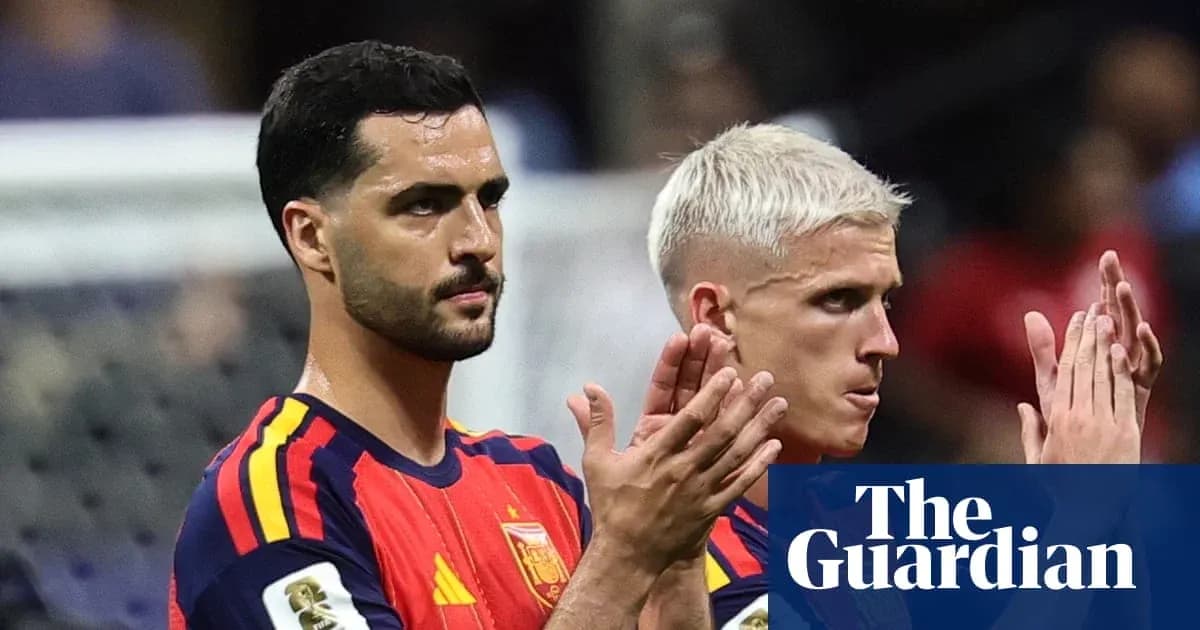
Mikel Merino Reflects on Spain's World Cup Draw and Mourning
The morning after felt heavy in Tennessee. Not defeat, not quite, but something close enough for Mikel Merino to reach for a darker word.
Mourning. With a “u”.
“No one died, it’s not a mourning exactly, but at times defeats can feel like that,” the Arsenal midfielder admitted. Only this wasn’t even a defeat. Spain had drawn 0-0 with Cape Verde in their World Cup opener, and the scoreline sat in the stomach like a loss.
This was not how they had imagined starting a tournament. Not this team. Not against this opponent.
Now they have six long days before they walk back into the light.
A lone voice after a flat night
At 11am the following morning, the Spain squad were back out on the grass at their Tennessee base. All of them, that is, except one. While boots thudded into the turf outside, Merino sat alone under the strip lights of the press room, facing seven desks packed with journalists and a bank of cameras.
He had been chosen to talk. To explain. To absorb.
All part of the job, he shrugged. The noise, the scrutiny, the questions that circle a team when a World Cup begins with a thud instead of a roar.
“If there’s one thing that’s not good for us, it is for there to be panic,” he said. For half an hour he took everything thrown his way, answering with a calm clarity that contrasted with the storm around Spain’s performance.
His mind went back to 2010. Spain lost their first game then, to Switzerland, and ended up lifting the trophy. He remembers it vividly. He had just turned 14.
Living with the ‘mourning’
“Like every game that doesn’t go as you’d like, every player lives with that mourning,” Merino said.
Some players rush to watch the game back. Others switch off completely, burying themselves in anything but football. The pain is the same; the coping mechanisms differ.
“You have to swallow the disappointment. We have to recover as soon as we can. Luis [de la Fuente] always says that it’s about trying to be better tomorrow, even if you’ve won. We’re always self-critical. Personally, I am not one to send messages [to fans]; I think the best message is the next game, turning it around with a win.”
The word he had chosen – mourning – quickly came back at him. Was it too strong? Too dramatic?
“Maybe I didn’t express myself well,” he replied. In truth, he had expressed exactly how it feels for elite players whose lives orbit around winning. He circled back to the same metaphor.
“It was an attempt at a metaphor, a comparison. You’re so competitive that when it doesn’t go well, sometimes you go home and don’t even want to talk to your family. That’s why I say it’s like a mourning. Everyone deals with it differently. I like to face it and watch [games back] as soon as possible but that doesn’t mean it’s the best approach for everyone.”
What players crave after a bad game is the quickest possible chance to put it right. The expanded World Cup, with its gaps and long waits, denies them that instant release.
“The risk is you have lots of time to go over it; it’s a mental challenge to deal with that, evade all that and be as free as you can mentally.”
Family, ego and the ‘circus’
If Spain leaned on one word after Atlanta, it was “family”. Merino knows how easy that sounds when the sun is out and the goals are flowing. The real test comes now.
“It is easy to talk of ‘family’ but when things don’t go well, when they are difficult, is when you truly see that ‘family’ – and I see unity, enthusiasm and a will to play well,” he said.
He talked about ego, too. Not as a dirty word, but as a necessary part of survival.
“It is important to have ego; as a footballer, with all the criticism from outside you need it to feel good on the pitch. But you also need the humility to know that this belongs to everyone. Players come to the national team because they are important [at their clubs] and find a new reality where only a few can play.
“That’s what the word ‘family’ is. We have to be united, support each other in every moment. You can be annoyed, angry, but that energy has to be positive.”
All of this plays out in public. Every gesture, every grimace, every substitution fed into the machine. Merino looked across the room at the reporters and acknowledged the ecosystem he is part of.
“That’s a reality; it’s part of the business, the reason we earn what we earn, why football is so big, so important: because you’re here to cover it, to create stories through which we explain things to fans. There are players who like it more, or like it less, but it’s part of the ‘circus’ and we have to accept it and live with it.”
He knows himself. He doesn’t let go of bad results easily. Over time, though, he has learned to confront them rather than hide.
“I’m one of those that finds it hard to swallow a bad result but with time I’ve realised that it is best to [confront it] and start trying to turn it around as soon as possible. Four, five hours and you realise that this [World Cup] has just started, that there is time to fix it. Then you can focus on the group, on what helps them. Put a hand on the shoulder of whoever is hurt because they didn’t play, or missed a chance. Or know who needs space for that mourning.”
Starting over
Spain’s disappointment eased slightly when results elsewhere fell their way. Saudi Arabia and Uruguay drew, a small twist in the group that felt, to Merino, like a reset button.
He admitted there was relief. “I like to see the positive side,” he said. The maths backed him up: the group had not run away from them.
The history did, too. “The last world champion started by losing to Saudi Arabia. In 2010 Spain lost the first game and there was lots of criticism and they turned it around; that is an example to follow from people who were idols. I often take inspiration from athletes who have lived my dreams before I did. That generation means so much for this one: we want to emulate them.”
So Spain stay in Tennessee with time on their hands and a draw that feels like a bruise. The mourning will pass. The question is what kind of team walks out the other side.