.svg&w=384&q=75 "GoalGist logo")
Mexico Dominates South Africa in World Cup Opener
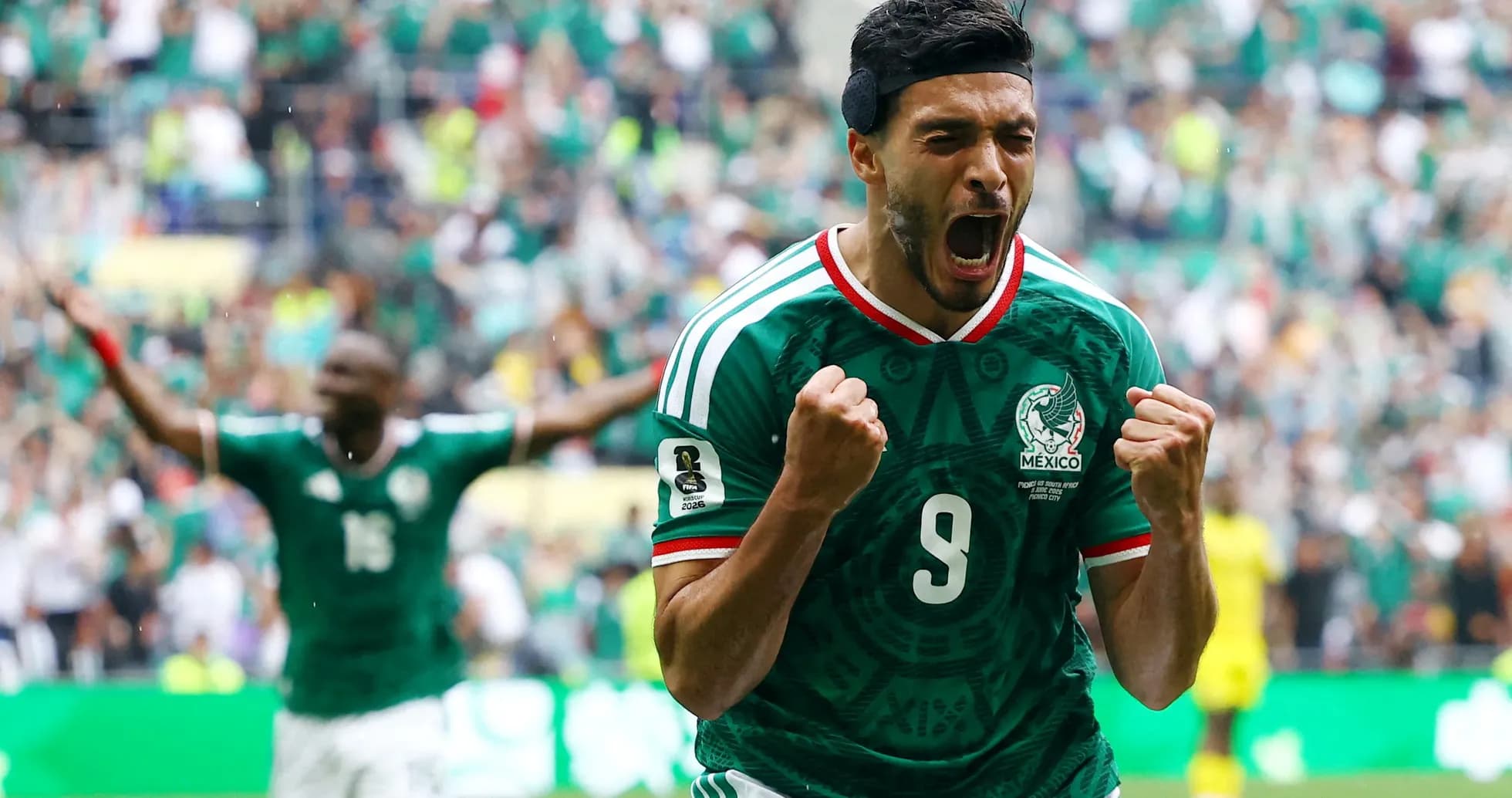
Under the lights of Estadio Azteca, Mexico opened their 2026 World Cup campaign with a performance that felt less like a group-stage opener and more like a statement of intent. The 2-0 win over South Africa did more than secure three points; it revealed the contours of Javier Aguirre’s new‑look side and exposed the structural fragilities in Hugo Broos’ plan.
I. The Big Picture – Mexico’s controlled aggression vs South Africa’s damage limitation
This was Group Stage – 1, but it already carried the weight of a knockout tie. Following this result, Mexico sit 1st in Group A with 3 points and a goal difference of 2, having scored 2 and conceded 0 in total. South Africa, beaten 2-0, are 4th with 0 points and a goal difference of -2, yet to score and already breached twice.
The numbers underline the contrast in approaches. In total this campaign, Mexico have played 1 match, winning it, with an attacking average of 2.0 goals for and 0.0 against. South Africa, on their travels, have also played 1, losing it, failing to score and conceding at an average of 2.0 goals per game. No penalties were awarded to either side; the penalty stats sit at 0 taken, 0 scored, 0 missed for both.
From the first whistle, Mexico’s 4-1-4-1 was designed to own the central lane and stretch the South African back five. R. Rangel in goal sat behind a back four of I. Reyes, C. Montes, J. Vasquez and J. Gallardo. In front of them, É. Lira anchored the structure, allowing a fluid band of four – R. Alvarado, B. Gutiérrez, A. Fidalgo and J. Quiñones – to swarm between the lines behind lone striker R. Jiménez.
South Africa’s 5-3-2, with R. Williams protected by a line of K. Mudau, N. Sibisi, I. Okon, M. Mbokazi and A. Modiba, signalled caution. T. Mokoena, S. Sithole and J. Adams formed a compact midfield trio, leaving I. Rayners and L. Foster to chase shadows up front. It was a plan built to absorb, not to dictate.
II. Tactical Voids – Discipline and depth reshape the contest
There were no pre‑match injury absences flagged, so both managers had their full squads. The real absences came from discipline.
Mexico’s season card profile is surprisingly sharp-edged for a side that kept a clean sheet. Their only yellow so far arrived between minutes 16-30, a 100.00% concentration of yellows in that early second quarter – and it belongs to B. Gutiérrez, who picked up 1 yellow in 66 minutes, committing 2 fouls. Their red-card profile is even more dramatic: 100.00% of their reds so far come in the 91-105 minute window, and that is C. Montes, sent off once despite a solid defensive outing.
South Africa’s discipline is more chaotic and more damaging. Their yellow cards are split 50.00% in 16-30 and 50.00% in 61-75, with N. Sibisi and T. Mokoena each on 1 yellow. But the real tactical voids are the reds: 50.00% of their red cards have come in 46-60 and 50.00% in 76-90, both from midfielders – S. Sithole and T. Zwane. Sithole, who actually blocked 2 shots and made 1 interception, still lost control with 3 fouls committed and a straight red. Zwane, introduced from the bench, lasted only 23 minutes before his own dismissal.
For South Africa, losing two midfielders to red cards across the match fundamentally broke the 5-3-2. The three‑man midfield, already under strain from Mexico’s four‑plus‑one structure, was repeatedly forced into last-ditch interventions. Once Sithole departed, Mokoena’s role as the remaining organiser became impossible; when Zwane followed, the visitors were effectively trying to survive with a fractured block and no stable outlet.
By contrast, Mexico’s bench strengthened their grip. É. Álvarez, L. Chávez, G. Mora, A. Vega and A. González all came in and maintained the technical level. Chávez completed 28 passes at 100% accuracy, Mora added 1 interception and 2 dribble attempts, while Vega and González stretched the pitch and kept South Africa’s tired legs pinned back.
III. Key Matchups – Hunter vs Shield, Engine Room vs Enforcer
Hunter vs Shield centred on R. Jiménez against the South African back five. Jiménez’s 1 goal from 3 shots (2 on target), plus 2 key passes and 6 duels won out of 10, made him the reference point Mexico needed. His movement between Sibisi and Okon dragged the line out of shape and opened lanes for runners like J. Quiñones.
Sibisi, nominally the heart of the shield, had an awkward night: 50 passes at 82% accuracy and 1 interception show composure, but he won none of his 1 recorded duel and still took a yellow. Under sustained pressure, South Africa’s defensive line never stepped out with enough conviction to compress the space around Jiménez.
The true star of the “Hunter” role, though, was J. Quiñones. From the left half-space, he scored 1 goal, took 4 shots (2 on target), attempted 6 dribbles and completed 5, while winning 7 of 10 duels. He repeatedly isolated Mudau and Sibisi, turning South Africa’s back five into a series of exposed one‑v‑ones.
In the Engine Room, É. Lira versus T. Mokoena and S. Sithole defined the tempo. Lira’s 45 passes at 93% accuracy, 1 assist, 1 tackle and 1 interception show a pivot in full control; he also won all 4 of his duels in the top scorers data and all 5 in the top assists data, underlining his dominance in contact. Mokoena, for South Africa, completed 42 passes at 92% with 1 key pass and 4 duels won from 7 – respectable numbers, but they came mostly in a reactive posture, shuttling horizontally rather than advancing.
Sithole’s line is the story of South Africa’s collapse in microcosm: 19 passes at 89%, 2 blocked shots and 1 interception show defensive value, but 3 fouls committed and a red card turned his aggression into a liability. Once he was gone, Lira’s task became simpler: receive, turn, and feed Alvarado and Quiñones into the half-spaces.
On Mexico’s right, R. Alvarado produced a complete wide midfielder’s performance: 35 passes at 91%, 2 key passes, 2 successful dribbles from 2 attempts, 4–5 tackles depending on dataset, and 8–9 duels won from 13–14. He effectively doubled as an auxiliary full‑back, closing transitions before they reached Montes and Vasquez.
For South Africa, the only real sparks came from the bench. E. Makgopa won all 3 of his duels and tried to offer a physical outlet, while O. Appollis completed 6 of 6 passes at 83% accuracy and added 1 tackle. But with nine and then ten men, their influence was limited to brief counterattacking flurries.
IV. Statistical Prognosis – Mexico’s platform, South Africa’s dilemma
With no xG values in the dataset, the prognosis leans on structural and outcomes data. Following this result, Mexico’s overall record is 1 win from 1, 2 goals scored, 0 conceded, 1 clean sheet and 0 failed-to-score matches. Their average of 2.0 goals for and 0.0 against in total suggests a side converting territorial dominance into tangible control.
South Africa’s numbers point the other way: 1 loss from 1, 0 goals for, 2 against, 0 clean sheets and 1 failed-to-score. Their defensive average on their travels of 2.0 goals conceded per match, combined with a disciplinary record that already includes 2 reds and 2 yellows spread across key midfielders and defenders, paints a picture of a team defending too deep, too often, and ultimately too desperately.
Tactically, Mexico emerge from this opener with a clear identity: a 4-1-4-1 built on Lira’s metronome, Alvarado’s two‑way running and the individual incision of Jiménez and Quiñones. The fact that they can bring on technicians like Chávez, Álvarez and Vega without dropping their passing accuracy – all three finished at or above 93% – hints at a squad capable of managing different game states and intensities.
South Africa, by contrast, face an immediate recalibration. The 5-3-2 did slow Mexico at times, but at the cost of any sustained attacking threat. With their disciplinary issues concentrated in central midfield (Sithole and Zwane both seeing red) and key screeners like Mokoena and Sibisi already on yellows, Broos must decide whether to persist with a low‑block survival plan or push his lines higher and trust Makgopa, Appollis and Foster to carry more of the load.
If this match is a template, Mexico have the platform to control Group A through structure and depth. South Africa have heart and isolated bright spots, but unless they resolve the tension between aggression and control in midfield, their World Cup may continue to be defined not by what they create, but by the spaces they are forced to defend.