.svg&w=384&q=75 "GoalGist logo")
Manchester United's Tactical Shift with Benjamin Sesko
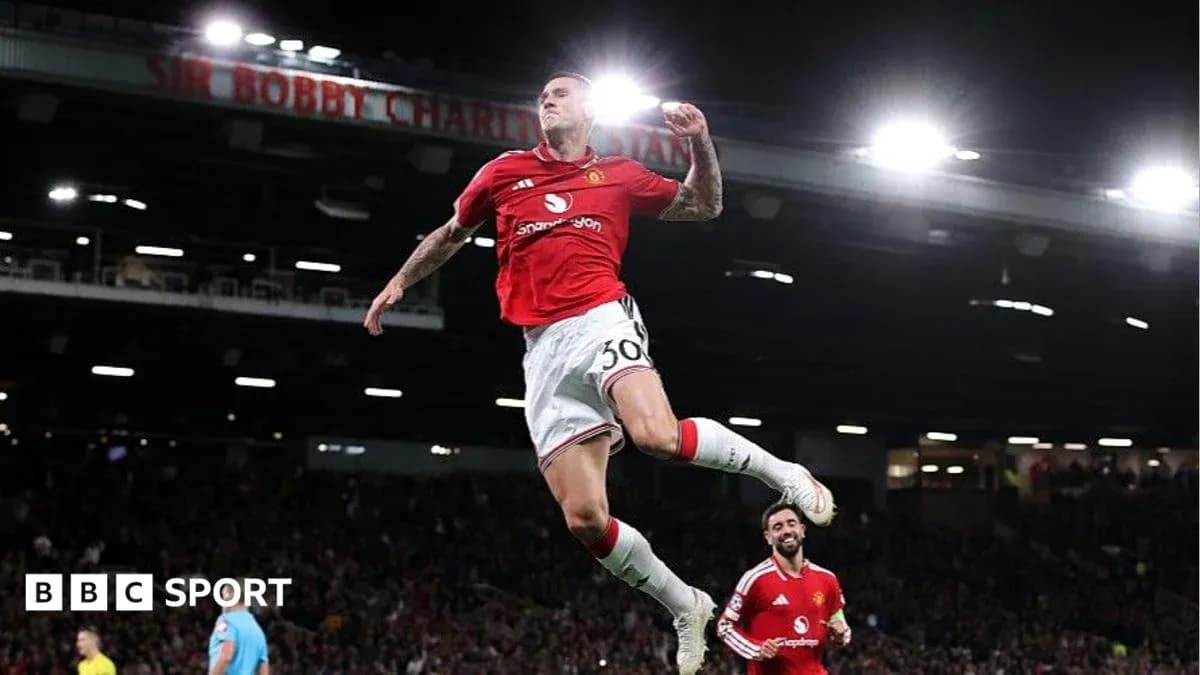
Manchester United will face far tougher examinations of their Champions League ambitions than this, but Sabah FK still handed Michael Carrick one clear takeaway under the Old Trafford lights: his team looks different when Benjamin Sesko leads the line. Sharper. Nastier. More complete.
Sabah, the Azerbaijani champions, were outmatched from the start and may well prove the weakest of United’s eight league-stage opponents. That hardly mattered to Carrick. What mattered was the sight of Sesko, fully involved from kick-off for the first time since March, bullying defenders again.
Sesko changes the picture
The last time Sesko started a game was against Liverpool, before he finally conceded that the shin problem he had been carrying for weeks could no longer be ignored. United hoped he would be ready for the Premier League’s opening weekend. He wasn’t.
Instead, he eased his way back. A second-half substitute at Hull. The same role against Ipswich. Again off the bench versus Everton.
Sabah were not so fortunate. They got the full version.
At 6ft 5in, the 23-year-old brings a presence none of United’s other forwards can match. He pins centre-backs. He occupies them. He forces them to turn and run towards their own goal. United’s attack looks taller, quicker and more ruthless with him in it.
Amad Diallo’s absence has already stripped Carrick of one tactical option, ruling out the pre-season experiment of Bryan Mbeumo as a central striker. Matheus Cunha has stepped into that role and has shown plenty of quality there. The issue is not talent. It is profile.
Cunha likes to roam. He drifts wide, drops into pockets, searches for the ball. When he does, the tip of United’s attack can feel empty, the penalty area lacking a fixed reference point.
Sesko offers the opposite. He stays high. He stretches the pitch. He runs at defenders, not away from them. And crucially, he finishes.
At Everton, it was his sheer size and timing that allowed him to rise and nod home what looked like the winner, only for Ainsley Maitland-Niles to rip up the script with a spectacular late strike. Against Sabah, Sesko again found the decisive moment.
He had already gone close with an audacious back-heel flick in the first half. The warning was there. Then Mbeumo slid him in, and the move showed exactly why Carrick has missed him.
Sesko saw goalkeeper Stas Pokatilov charging out. No panic. One touch to move the ball past him, another to roll it into the empty net. Clean, calm, ruthless.
“Of course, I’m happy with my goal,” he told TNT afterwards. “I saw him rushing out, and it was a great opportunity to take the ball away from him and make the goal a little bit easier.”
United have forwards who can run in behind. They have forwards who can link play. What they do not have, apart from Sesko, is someone who can do all that while also offering a towering, relentless physical threat.
The old cliché about “good control for a big man” barely covers it. When size, skill and pace come in the same package, managers tend to build around it.
“He definitely offers a different kind of threat,” Carrick said. “That’s the beauty of it, really. We know what Ben gives us. There’s not many around that kind of give you what Ben does in terms of his physique, his physicality, playing on the last line and his speed to run in behind. He’s a real threat.
“It’s great to have him back at this level after working to get his fitness back. A couple of goals and good performances, and good minutes in him. I’m really pleased with the way he’s gone.”
A derby dilemma for Carrick
All of which leaves Carrick with the sort of headache every manager claims to enjoy, but few actually do, heading into Sunday’s derby against Manchester City at Old Trafford.
Does he trust Sesko’s body and keep him in from the start again? Or does he step back from the risk, restore Cunha as his central striker and manage Sesko’s minutes more cautiously, especially with Amad still not ready to return?
On this evidence, Sesko has earned the shirt. If Carrick agrees, another decision immediately follows.
Who starts on the left?
Cunha, who opened the scoring against Sabah, has a strong case. Marcus Rashford, who did not get off the bench, has a different kind of argument.
Rashford has yet to score or assist since returning from last season’s loan at Barcelona. The numbers are stark. The performances, less so. His pace, his direct running, his ability to drag defences back towards their own box have made him United’s most persistent threat in wide areas.
Cunha, by contrast, often drifts into the same pockets Bruno Fernandes likes to occupy. It can look fluid. It can also crowd the captain’s space and tilt United’s shape in ways Carrick might not welcome against City’s precision.
Rashford offers cleaner lines. Width. A simple, brutal question for full-backs: can you live with this for 90 minutes?
Carrick kept his cards close when asked about those choices, on a night when Fernandes also found the net.
“It’s not an easy decision, of course it’s not,” he said. “But it’s definitely one I’d prefer: to have goals in the team and for the boys to be playing well.
“The understanding they all have is that sometimes it’s going to be a start, sometimes it’s going to be finishing the game. We need that within the group, from game to game over the season, to be able to call upon slightly different kind of things at different times.
“It’s fantastic they’re all in good form and started so well.”
Sabah FK will not define United’s season. Manchester City might. Carrick now knows what his attack looks like with Sesko at full tilt. The real question is whether he is bold enough to unleash that version in the biggest game of all.