.svg&w=384&q=75 "GoalGist logo")
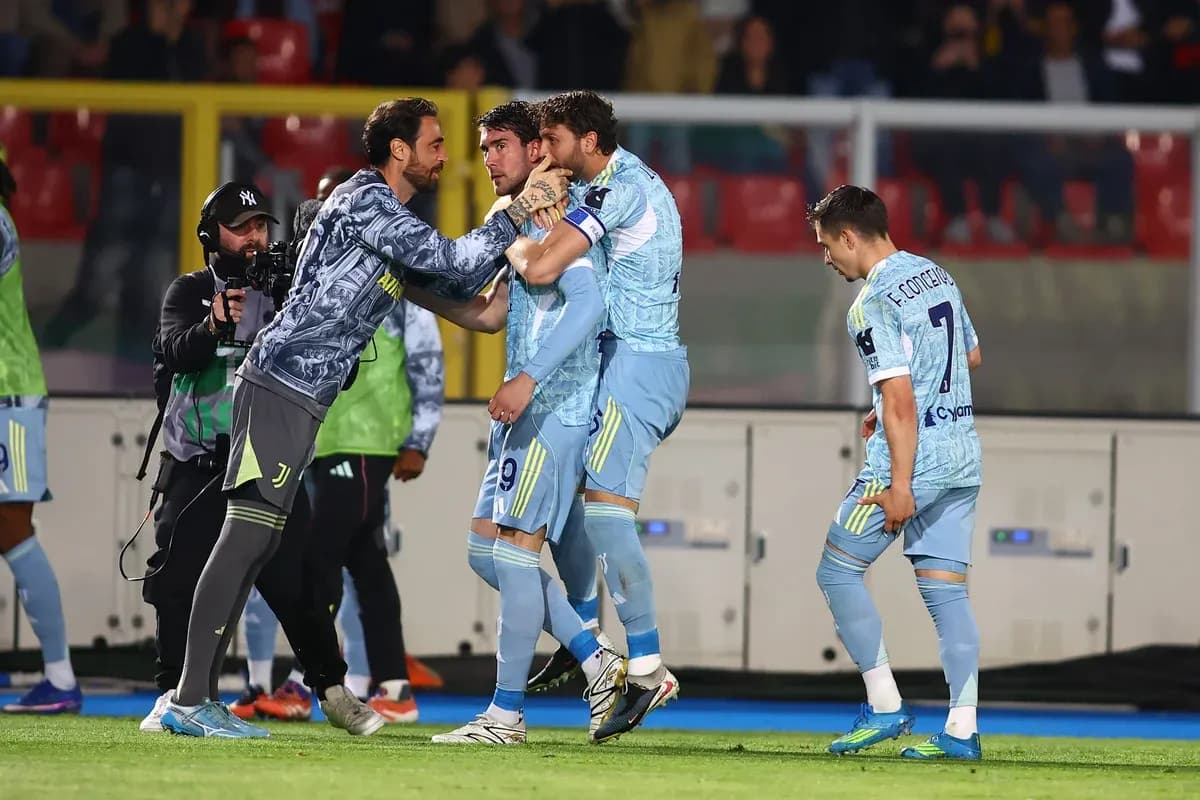
Juventus Dominates Lecce in Serie A Clash
The lights at Via del Mare dimmed on a narrow scoreline but a wide tactical gulf. Following this result, a 1–0 Juventus win in Serie A’s Regular Season - 36, the table tells its own story: Lecce sit 17th on 32 points, clinging to safety with a goal difference of -24, while Juventus consolidate 3rd place on 68 points and a goal difference of 29. Over 36 matches, Lecce’s total return of 24 goals for and 48 against underlines a season of struggle; Juventus, with 59 scored and 30 conceded overall, travel like a side that expects to control outcomes, not chase them.
Both coaches rolled out a mirrored 4-2-3-1, but the systems carried very different identities. Eusebio Di Francesco’s Lecce were built on survival instincts: Wladimiro Falcone behind a back four of Danilo Veiga, J. Siebert, Tiago Gabriel and A. Gallo, with Ylber Ramadani and O. Ngom as the double pivot. Ahead, S. Pierotti, L. Coulibaly and Lameck Banda were tasked with feeding W. Cheddira, a lone forward starved for service in a side that at home averages just 0.7 goals for and 1.3 against.
Luciano Spalletti’s Juventus, by contrast, used the same shape as a platform for dominance. M. Di Gregorio anchored a defence of P. Kalulu, Bremer, L. Kelly and A. Cambiaso. In front of them, M. Locatelli and T. Koopmeiners formed a controlling axis, freeing a line of three — F. Conceicao, Weston McKennie and Kenan Yildiz — to orbit around D. Vlahovic. It was a line-up that blended structure with improvisation, and it showed.
The tactical voids were clear even before kick-off. Lecce’s absentee list stripped away depth and variety: M. Berisha (thigh injury), S. Fofana and Kialonda Gaspar (both knee injuries), plus R. Sottil (back injury) all missed the fixture. Gaspar’s absence in particular removed a defender who, over the season, has combined 21 successful blocks with aerial presence and composure on the ball. Without him, Siebert and Tiago Gabriel had to step into a more aggressive front-foot role against elite movement.
Juventus had their own absences — J. Cabal and A. Milik were both ruled out with muscle injuries — but their squad depth softened the blow. Vlahovic led the line without a natural like-for-like alternative on the bench, yet Spalletti could still call on J. David, J. Boga, L. Openda and E. Zhegrova if he needed to change the profile of his attack.
Disciplinary trends framed the emotional tone of the contest. Lecce’s season-long card distribution shows a late-game tilt: 28.57% of their yellow cards arrive between 76–90 minutes, with another 12.70% in added time (91–105). It paints a picture of a team that often ends matches under siege, forced into desperate interventions. Juventus, too, spike late — 22.45% of their yellows come between 61–75 minutes and 20.41% from 76–90 — but from a position of control rather than panic, often pressing high to kill games.
Key Players
The “Hunter vs Shield” duel revolved around Kenan Yildiz and Lecce’s fragile defensive record. Yildiz has been one of Serie A’s standout attackers this season: 10 total goals, 6 assists, 73 key passes and 77 successful dribbles from 145 attempts. He is not just a finisher, but a constant destabiliser between the lines. Lecce, heading into this game, had conceded 24 goals at home and 48 overall, with only 9 clean sheets in total. Their biggest home defeat, 0–3, and the fact they have failed to score at home 10 times, underline how thin their margin for error is.
Against that backdrop, Veiga and Gallo were always going to be overloaded. Veiga’s season profile — 93 tackles and 13 successful blocks — speaks to a defender who thrives on duels, but the volume of work he faces in a struggling side is punishing. With Yildiz drifting inside from the left, F. Conceicao attacking the opposite half-space and Vlahovic pinning Siebert and Tiago Gabriel, Lecce’s back four were repeatedly forced to compress centrally, leaving Banda and Pierotti chasing back in long, energy-sapping recovery runs.
The Engine Room
In the “Engine Room”, the battle was as much about personality as positioning. Locatelli, one of Serie A’s most complete deep midfielders this season, has 2626 completed passes at an 88% accuracy rate, 95 tackles, 23 successful blocks and 37 interceptions. He is also one of the league’s card magnets with 9 yellows, a marker of his willingness to step into the fire. Opposite him, Ramadani has been Lecce’s heartbeat: 1390 passes at 80% accuracy, 88 tackles, 46 interceptions and 333 duels contested, winning 185. He is the anchor of a side often forced to defend for long stretches.
On the night, Juventus’ double pivot simply had more control points. Locatelli and Koopmeiners could hold a higher line, safe in the knowledge that their team, on their travels, concedes only 0.9 goals per match and keeps 8 away clean sheets. That allowed McKennie to push on and link with Yildiz between the lines, using his 44 key passes and 5 assists this season as a template for third-man runs and cut-backs. Ramadani and Ngom, by contrast, were pinned deep, more concerned with plugging gaps than launching transitions.
Banda's Role
For Lecce, Banda remained the wildcard. Four total goals, three assists and 30 successful dribbles from 77 attempts make him their most direct outlet, but his disciplinary record — 6 yellows and 1 red — mirrors the team’s broader volatility. Against Juventus’ structured block, his bursts often ended in isolation rather than overloads, especially with Cheddira cut off by Juventus’ centre-backs and the full-backs reluctant to over-commit.
From a statistical prognosis standpoint, the outcome fits the season-long patterns almost too neatly. Lecce’s total average of 0.7 goals for against Juventus’ total defensive average of 0.8 conceded always pointed towards a low-scoring night for the hosts. Juventus’ total attacking average of 1.6 goals per game met a Lecce defence allowing 1.3 per match at home, suggesting that a single moment of quality might be enough — and so it proved.
Following this result, the tactical verdict is stark. Lecce’s 4-2-3-1 is structurally sound but starved of vertical punch, over-reliant on Banda’s chaos and Ramadani’s firefighting. Juventus, even away from home, can toggle between control and incision, with Yildiz as the creative spearhead and Locatelli as the metronome-enforcer hybrid. In a league where margins are thin, the blend of defensive solidity and individual quality that Juventus possess continues to separate a side battling for the Champions League from one simply battling to breathe.