.svg&w=384&q=75 "GoalGist logo")
Ivory Coast vs Ecuador: Tactical Analysis of World Cup Opener
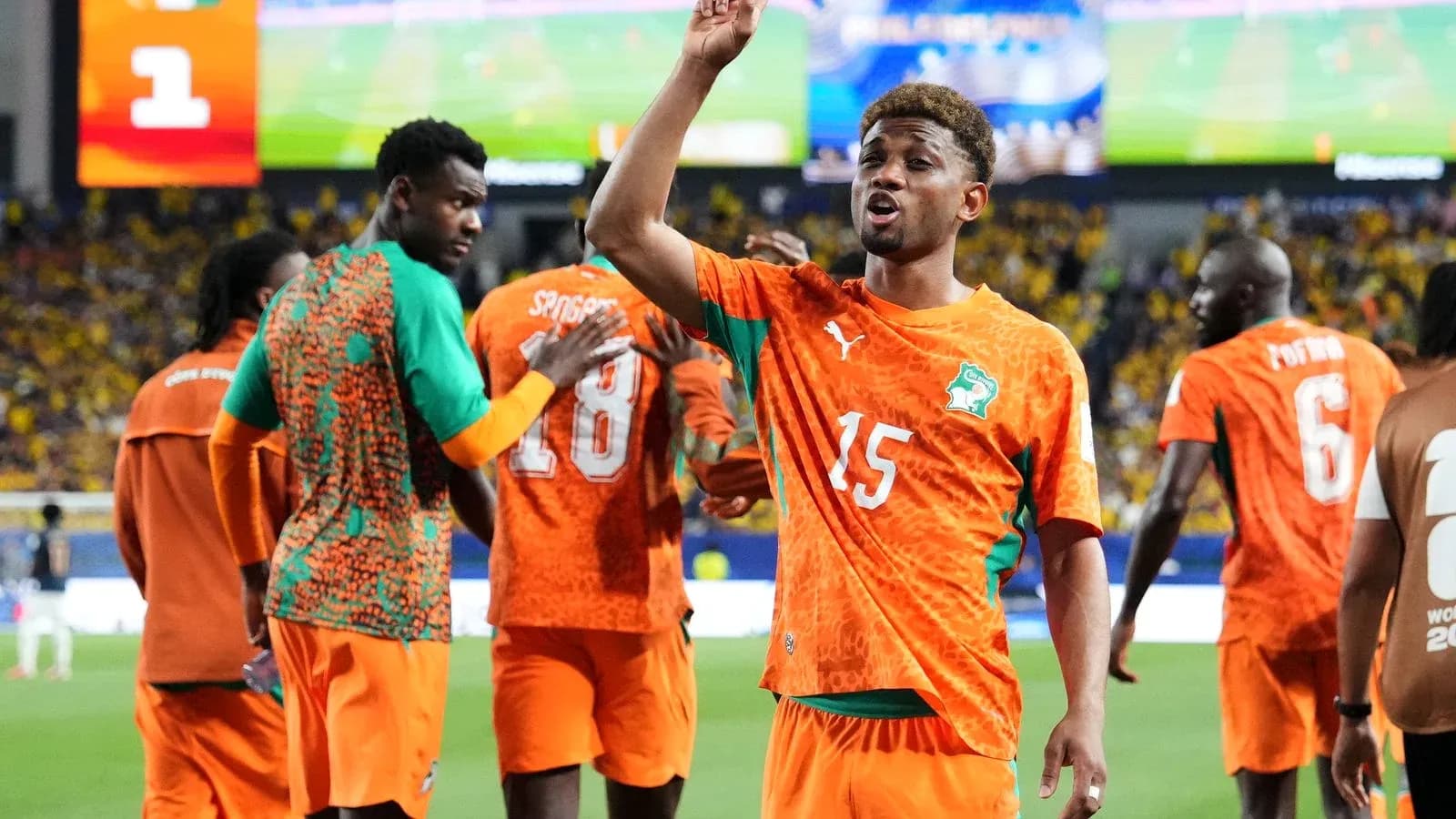
Under the late Philadelphia lights at Lincoln Financial Field, Ivory Coast and Ecuador opened their World Cup campaigns with mirrored 4-4-2s but very different emotional trajectories. Following this result, Ivory Coast sit 2nd in Group E on 3 points, their 1-0 home win and goal difference of +1 (1 scored, 0 conceded) a quiet statement of control. Ecuador, 3rd with 0 points and a goal difference of -1 (0 scored, 1 conceded), leave with more questions than answers about balance and bite in the final third.
I. The Big Picture – Two 4-4-2s, One Clear Identity
Emerse Fae doubled down on structure: a textbook 4-4-2 with Y. Fofana in goal, a back four of G. Konan, E. Agbadou, W. Singo and G. Doue, and a powerful central axis of F. Kessie and S. Fofana. Wide, B. Toure and Y. Diomande were tasked with stretching the pitch, while N. Pepe and E. Wahi formed a mobile, press-ready front two.
Sebastian Beccacece mirrored the shape but not the intent. Ecuador’s 4-4-2 was more hybrid, often collapsing into a 4-4-1-1 with E. Valencia dropping off G. Plata. P. Hincapie and W. Pacho anchored the left side of the back line, with J. Ordonez and A. Franco completing a defence that, on paper, was built to play high and aggressive. In midfield, M. Caicedo and P. Vite tried to orchestrate, with A. Minda and J. Yeboah offering width.
Seasonally, the numbers underline the narratives. Heading into this game, Ivory Coast’s World Cup profile was as clean as their performance: 1 match played at home, 1 win, 0 draws, 0 defeats, 1 goal for and 0 against. Their average at home stands at 1.0 goals scored and 0.0 conceded, backed by a 1-0 home result as their biggest win and a 100% clean-sheet record (1 clean sheet in total). Ecuador’s early story is the inverse: 1 away match, 1 defeat, 0 goals scored, 1 conceded, with a 1-0 away loss their defining line. On their travels they average 0.0 goals for and 1.0 against, and they have failed to score in that single away outing.
II. Tactical Voids and Discipline – Where the Edges Show
There are no explicit injury absences listed, so the voids here are tactical rather than medical. For Ivory Coast, the notable absentee from the starting XI is actually a weapon off the bench: A. Diallo. His World Cup numbers are striking – 1 appearance, 34 minutes, 1 goal, 2 shots on target from 2 attempts, 17 passes at 82% accuracy, 5 successful dribbles from 6 and 6 duels won from 8. He arrived from the bench [IN] replacing an attacker and instantly changed the tempo. His presence means Fae has a game-breaking option who can transform a controlled 4-4-2 into something far more vertical and unpredictable.
Disciplinary trends are already shaping the squad’s risk profile. Ivory Coast’s yellow cards are front-loaded: 1 caution between 16-30 minutes and 2 more in the 31-45 window, meaning 100% of their bookings so far have come before half-time, with a heavy spike between 31-45 (66.67% of their yellows). S. Fofana embodies that edge: 1 yellow card, 1 foul committed, 0 fouls drawn, yet still posting 36 passes at 88% accuracy, 1 key pass, 4 shots and 1 blocked shot. He walks the line between enforcer and liability.
Ecuador’s discipline is quieter but not spotless. Their only recorded yellow card in the tournament so far arrives in the 61-75 minute window (100.00% of their yellows in that phase), a sign that their frustration grows as matches slip away. J. Porozo, who entered from the bench, is central to that story: 28 minutes, 1 yellow, 2 fouls committed, 0 duels won from 2. He is aggressive, sometimes over-eager, and his presence late on can tilt the game toward chaos rather than control.
III. Key Matchups – Hunter vs Shield, Engine Room vs Engine Room
The defining attacking figure in this Ivory Coast side is already A. Diallo. His 8.2 rating, 1 goal and high-volume dribbling profile mark him out as the “hunter” in this squad. He thrives facing defenders like P. Hincapie and W. Pacho, who are comfortable stepping high but can be exposed when drawn into wide, one-v-one duels. If Fae introduces Diallo from the bench again, his ability to attack the channels outside Pacho and isolate full-backs will be decisive, particularly against an Ecuador side that has yet to keep a clean sheet and has already conceded 1 goal on their travels.
In midfield, the “engine room” battle is a compelling clash of styles. For Ivory Coast, F. Kessie and S. Fofana set the rhythm: Kessie as the metronome and breaker of lines, Fofana as the box-to-box disruptor who has already blocked 1 shot and made 2 interceptions. For Ecuador, M. Caicedo and P. Vite bring a more possession-oriented profile, but their problem is progression into dangerous zones. With Ecuador having failed to score in total so far and averaging 0.0 goals for, the onus is on Caicedo to punch passes between the lines into E. Valencia and G. Plata before Ivory Coast’s compact 4-4-2 can settle.
IV. Statistical Prognosis – Ivory Coast’s Structure vs Ecuador’s Search for Spark
With no xG values in the data, the prognosis leans on structural and outcome-based metrics. Ivory Coast’s defensive solidity is already clear: 1 clean sheet from 1 match, 0.0 goals against in total, and no period of sustained concession. Their 4-4-2 has been used in 1 lineup out of 1, signalling tactical continuity rather than experimentation.
Ecuador’s attacking return – 0 goals for in total, 0.0 average goals scored on their travels – suggests that, at least in this early phase of the tournament, their front two are being starved rather than misfiring. Their single goal conceded away, a 1-0 defeat, reflects a defence that is competitive but not impregnable.
Following this result, the tactical forecast is clear: Ivory Coast look like a side whose baseline is control and clean sheets, with the luxury of a high-impact bench weapon in A. Diallo. Ecuador, by contrast, must solve their progression puzzle quickly. Unless Beccacece can find a way to free M. Caicedo and P. Vite between the lines and reduce their late-game disciplinary spikes, the hunter-vs-shield battle will continue to tilt toward Ivory Coast’s organised back four and ruthless substitutes.