.svg&w=384&q=75 "GoalGist logo")
Ivory Coast Triumphs 1-0 Over Ecuador in Tactical World Cup Clash
Ivory Coast’s 1-0 win over Ecuador at Lincoln Financial Field was a controlled, attritional World Cup group-stage performance built on structure more than spectacle. In a match where both sides mirrored each other’s 4-4-2, Emerse Fae’s team accepted a slight deficit in possession (48% to 52%) but generated the clearer threat, outshooting Ecuador 15–12 and winning the xG battle 1.52 to 1.01. The decisive moment came late, but it was rooted in a series of tactical adjustments that gradually tilted the game in Ivory Coast’s favour.
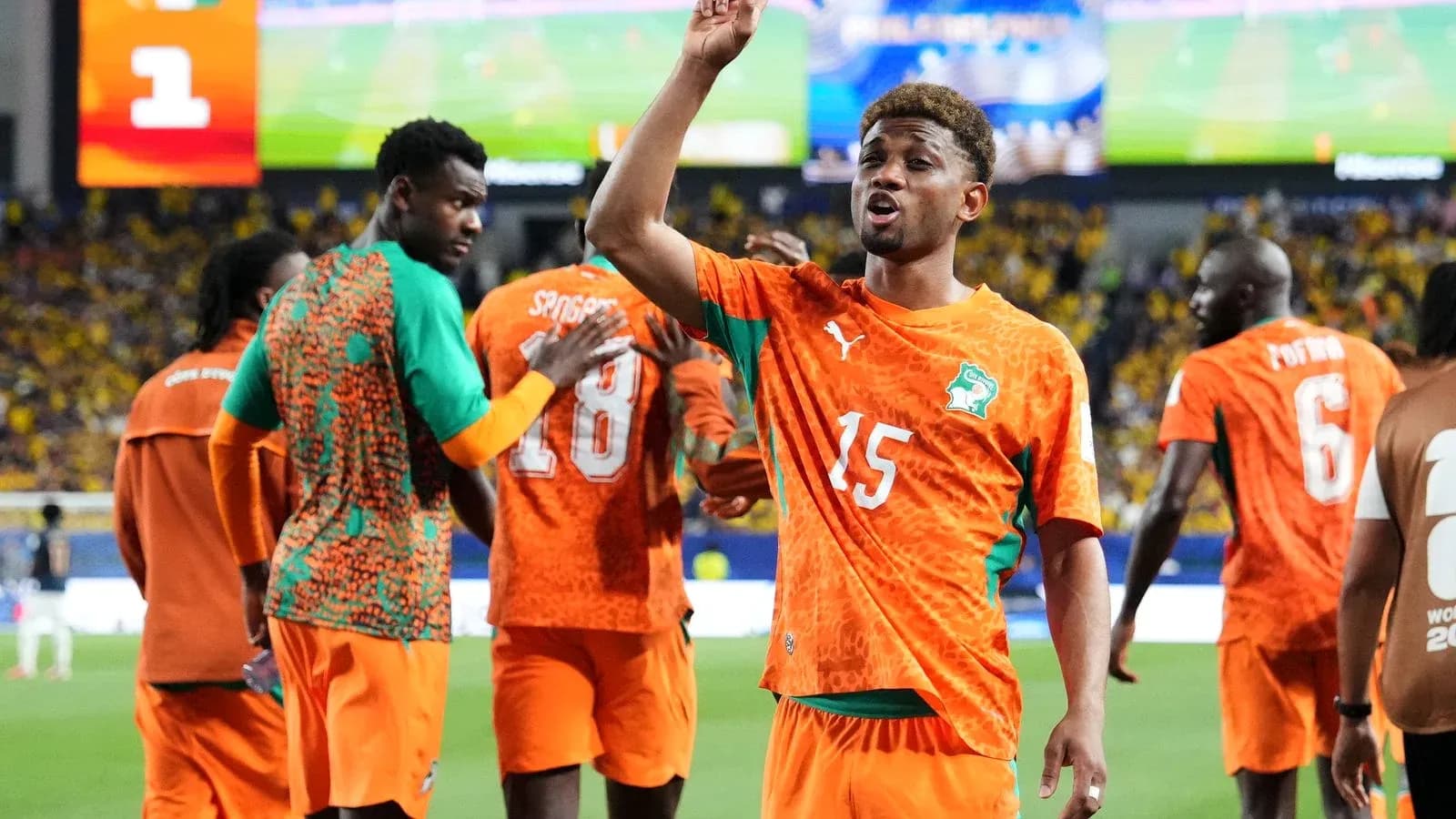
The only goal arrived on 90', when substitute Amad Diallo finished a move created by right-sided defender Wilfried Singo.
Diallo’s impact was the culmination of Ivory Coast’s evolving right-flank strategy. Initially, with Nicolas Pépé and Elye Wahi starting as the front two, Ivory Coast’s 4-4-2 was quite classic: a flat midfield line of Bazoumana Touré, Seko Fofana, Franck Kessié and Yan Diomande, with full-backs Guéla Doué and Ghislain Konan providing width. The structure was compact and vertically disciplined, prioritising control of central zones over high pressing.
Ecuador’s 4-4-2 under Sebastian Beccacece had a similar base shape but different intentions. With Moisés Caicedo and Pedro Vite in central midfield and John Yeboah and Alan Minda wide, Ecuador looked to use their slight possession edge and 492 total passes to move Ivory Coast laterally, then break lines with Enner Valencia and Gonzalo Plata. However, Ivory Coast’s defensive block, anchored by Emmanuel Agbadou and Singo, protected the box well: Ecuador managed only 1 shot on goal despite 12 total attempts and 5 shots inside the box.
First Half
The first half was defined by Ivory Coast’s physical edge and Ecuador’s attempts to play through pressure. Ivory Coast committed 10 fouls to Ecuador’s 13, but their midfield aggression came at a disciplinary cost. The card sequence tells the story of that battle:
- 28' Seko Fofana (Ivory Coast) — Roughing
- 38' Franck Kessié (Ivory Coast) — Tripping
- 40' Guéla Doué (Ivory Coast) — Tripping
- 73' Jackson Porozo (Ecuador) — Holding
Those three first-half cautions for Ivory Coast were all linked to duels in the middle and defensive thirds, underlining how hard they worked to disrupt Ecuador’s combinations between the lines. Fofana in particular played on the edge, tasked with stepping out from the double pivot to confront Vite and prevent clean progression.
In possession, Ivory Coast were more direct and vertical. Their 470 passes with 397 accurate (84%) show a team capable of circulating the ball, but the shot profile – 15 total shots, 8 inside the box, 4 on goal – points to a strategy of getting quickly into advanced zones rather than long, sterile phases. The 3 blocked shots highlight Ecuador’s last-ditch defending, especially from central defenders Willian Pacho and Joel Ordóñez, who were often forced to step out to close down forwards receiving to feet.
Tactical Changes
The game’s tactical hinge came around the 56' mark. Beccacece moved first: Alan Minda (OUT) for Nilson Angulo (IN) at 56' suggested a desire for more direct running from wide. Fae responded immediately with a double change that reconfigured Ivory Coast’s attacking dynamics:
- 56' Ange-Yoan Bonny (IN) came on for Elye Wahi (OUT)
- 56' Amad Diallo (IN) came on for Bazoumana Touré (OUT)
These two moves subtly altered the 4-4-2. With Diallo introduced, Ivory Coast effectively shifted towards a more flexible shape, with Diallo capable of drifting inside from the right and Bonny offering more physical presence and back-to-goal play than Wahi. The midfield line gained more creativity and ball-carrying from wide-right, while Kessié and Fofana remained the central stabilisers.
Ecuador answered with a double substitution at 62':
- 62' Ángelo Preciado (IN) came on for John Yeboah (OUT)
- 62' Jackson Porozo (IN) came on for Alan Franco (OUT)
This had a clear tactical purpose: reinforce the right side and add aerial and physical presence in the back line. Preciado’s introduction at right-back and Porozo’s presence in central defence aimed to cope with Ivory Coast’s growing threat from crosses and diagonal balls. Yet it also meant Ecuador gradually lost some of their earlier fluency in build-up, becoming more direct and reliant on second balls.
The 73' yellow card for Porozo for Holding was symptomatic: Ecuador were increasingly stretched by Ivory Coast’s runners between the lines, resorting to halting transitions with contact rather than clean defensive positioning.
Fae’s next wave of changes further sharpened Ivory Coast’s edge:
- 77' Christ Inao Oulaï (IN) came on for Nicolas Pépé (OUT)
- 77' Ibrahim Sangaré (IN) came on for Seko Fofana (OUT)
- 77' Kevin Rodriguez (IN) came on for Enner Valencia (OUT) for Ecuador
Sangaré’s entry for Fofana was pivotal tactically. It shifted Ivory Coast from a more adventurous double pivot to a slightly more conservative, ball-winning profile, ensuring they could sustain pressure without becoming open in transition. Oulaï’s introduction for Pépé refreshed the right flank, maintaining pace and pressing intensity. For Ecuador, removing Valencia for Kevin Rodriguez reduced their ability to link play; Rodriguez offered depth and running, but Ecuador struggled to get him quality service.
At 89', Emerse Fae made a final defensive adjustment:
- 89' Odilon Kossounou (IN) came on for Guéla Doué (OUT)
This solidified the right side just before the decisive moment. Ironically, it was the earlier structural work on that flank that paid off. On 90', Singo, operating from his right-centre-back position, stepped forward and delivered the assist for Amad Diallo, who had been drifting into pockets and looking for precisely that kind of service. The goal encapsulated Ivory Coast’s second-half plan: use fresher, more mobile attackers to exploit spaces around a reconfigured Ecuador back line.
Between the posts, Yahia Fofana (Ivory Coast) made 1 save, reflecting how well his defence limited Ecuador to low-quality chances despite their 12 shots. Hernán Galíndez (Ecuador) produced 3 saves, and the goals prevented metric at 0.22 for both teams underlines that neither goalkeeper was asked to perform miracles; this was a game of territorial and structural control rather than high-volume shot-stopping.
Statistically, Ecuador’s 52% possession and slightly higher pass completion (492 passes, 419 accurate at 85%) suggest composure on the ball, but Ivory Coast translated their 48% share into more incisive play in the final third. Both sides registered 3 blocked shots and a similar number of shots outside the box (7 each), but Ivory Coast’s 8 efforts inside the area versus Ecuador’s 5 aligned with the xG edge of 1.52 to 1.01 and ultimately with the 1-0 scoreline.
In summary, Ivory Coast won this match not by overwhelming Ecuador, but by managing key phases better: embracing a combative first half, then using well-timed substitutions to increase attacking variety while tightening central control. Ecuador’s structural tweaks made them more solid but dulled their attacking threat, and in a finely balanced tactical contest, that trade-off proved decisive.