.svg&w=384&q=75 "GoalGist logo")
Girona vs Real Sociedad: Tactical Analysis of a 1-1 Draw
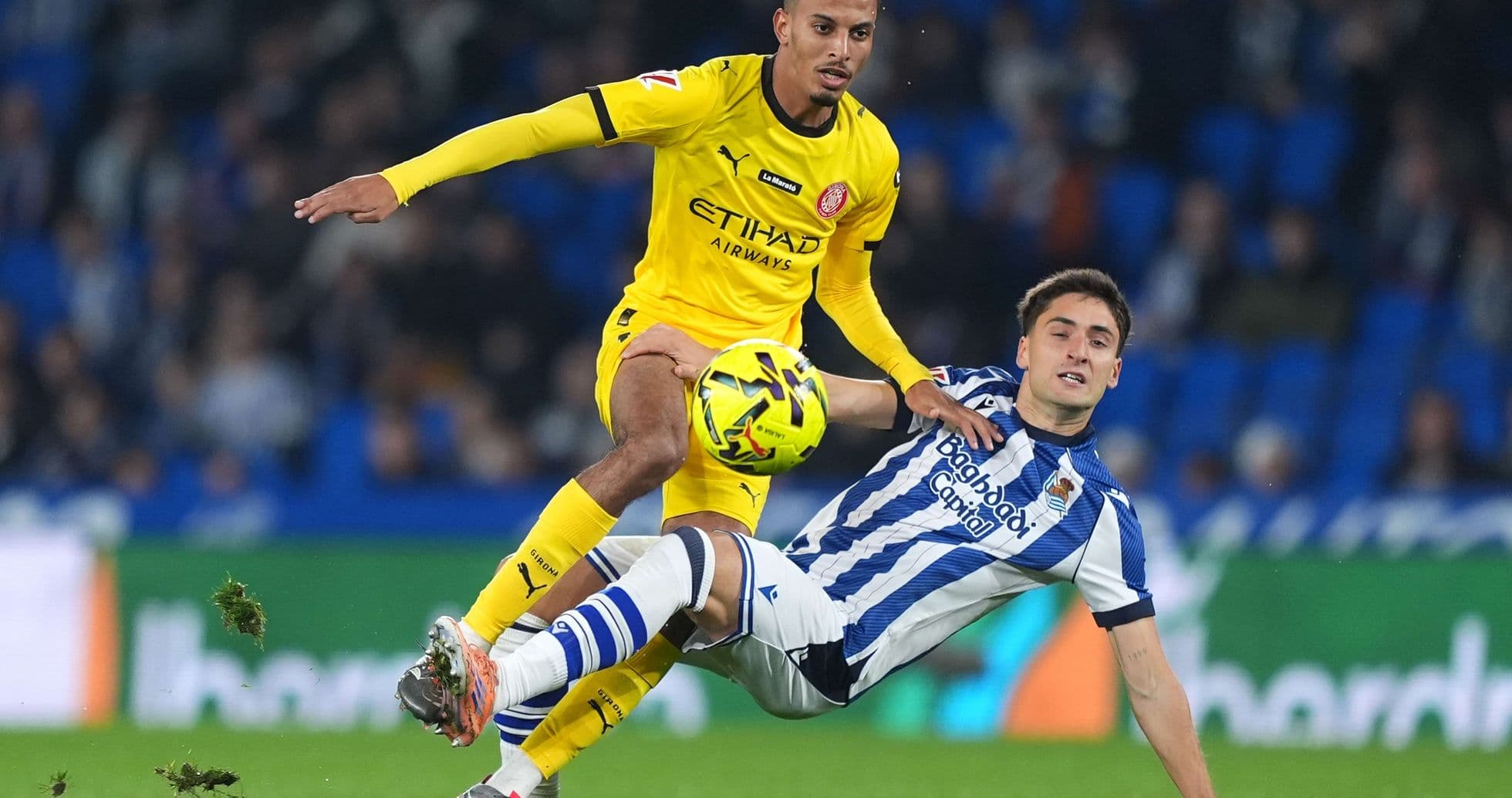
Girona and Real Sociedad produced a tactically rich 1-1 draw at Estadio Municipal de Montilivi, a match where control and territory belonged overwhelmingly to the hosts, but structure and defensive resilience kept the visitors in it. Girona’s 4-3-3 under Michel sought to suffocate the game through possession and volume of shots, while Pellegrino Matarazzo’s 4-2-3-1 for Real Sociedad was built around compactness, selective pressing and transition efficiency.
From the outset, Girona’s plan was clear: a high-possession, positionally disciplined 4-3-3 with P. Gazzaniga as a short build-up outlet and a back four of A. Moreno, Vitor Reis, Alejandro Francés and A. Martinez spreading across the first line. I. Martin, A. Witsel and A. Ounahi formed a technically strong midfield three tasked with circulating the ball quickly and pinning Real Sociedad back. The front line of Joel Roca, V. Tsygankov and B. Gil stretched the pitch horizontally, with Tsygankov and Roca coming inside to overload the half-spaces while full-backs advanced to provide width.
The statistical imprint of that plan is emphatic: Girona finished with 60% possession, 560 passes and 508 accurate (91%), and an xG of 2.22. Their 29 total shots, including 17 inside the box, show how consistently they managed to progress into dangerous zones. However, only 4 of those efforts were on target, underlining an execution problem in the final action rather than a structural or chance-creation issue.
Real Sociedad’s 4-2-3-1 was far more conservative with the ball but highly purposeful without it. A. Remiro’s side completed 401 passes, 330 accurate (82%), and ceded territory by design, defending in a mid-to-low block. The double pivot of J. Gorrotxategi and Y. Herrera shielded a back four of S. Gomez, D. Caleta-Car, J. Martin and J. Aramburu, staying compact between the lines and funnelling Girona wide. Ahead of them, T. Kubo, L. Sucic and Ander Barrenetxea supported M. Oyarzabal in transition, looking to exploit any over-commitment from Girona’s full-backs.
The visitors’ attacking efficiency is perfectly captured by the numbers: just 6 total shots, 5 inside the box, and 2 on target, yet an xG of only 0.33. Their 1-0 lead at half-time, courtesy of J. Martin’s 28th-minute goal assisted by S. Gomez, came from a rare but well-worked situation rather than sustained pressure. It underlines how Real Sociedad relied on set patterns and individual execution rather than volume.
Michel’s in-game management was aggressive. At 46', C. Stuani (IN) came on for B. Gil (OUT), immediately giving Girona a more traditional penalty-box presence. The double switch on 57' — T. Lemar (IN) for I. Martin (OUT) and F. Beltran (IN) for A. Witsel (OUT) — rebalanced the midfield towards more vertical passing and late arrivals into the area. Later, at 80', C. Echeverri (IN) replaced V. Tsygankov (OUT), adding fresh legs and dribbling threat between the lines as Girona chased the equaliser.
On the opposite bench, Matarazzo’s substitutions were mostly defensive and energy-based. At 34', P. Marin (IN) replaced A. Barrenetxea (OUT), an early tactical adjustment that suggested either a physical issue or a desire for different defensive behaviour on the flank. The triple wave at 57' — C. Soler (IN) for J. Gorrotxategi (OUT) and G. Carrera (IN) for T. Kubo (OUT) — refreshed both the midfield screen and the transition outlets. In the closing stages, with Girona pushing, B. Turrientes (IN) came on for J. Aramburu (OUT) and I. Zubeldia (IN) for Y. Herrera (OUT) at 87', reinforcing central areas and helping Real Sociedad see out the draw.
The key tactical turning point was Girona’s equaliser on 66', when C. Stuani finished a move assisted by A. Martinez. It was the logical product of the structural shift: with Stuani occupying both centre-backs, Girona could attack the box with more direct service and second-ball aggression. Martinez’s involvement from full-back underlined how Girona’s wide defenders became auxiliary playmakers once Real Sociedad retreated deeper.
Defensively, Girona’s back line had limited reactive work to do given Real Sociedad’s low xG and shot volume. Gazzaniga registered only 1 save and 0.1 goals prevented, reflecting how little truly dangerous work he faced once the visitors were ahead. Real Sociedad, by contrast, depended heavily on A. Remiro’s positioning and command of his area: 4 saves and 0.1 goals prevented in the context of 29 shots against highlight a goalkeeper who, while not overworked in spectacular fashion, had to be consistently clean and authoritative.
Discipline also tells a tactical story. Girona committed 13 fouls and collected 2 yellow cards (Alejandro Francés and Joel Roca), largely as part of counter-pressing and high defensive engagement. Real Sociedad, under more pressure, committed 19 fouls and received 7 yellow cards, many for Foul and one for Time wasting to D. Caleta-Car. This aligns with a side defending deeper, breaking up rhythm, and running the clock in the final phase.
The statistical verdict reinforces the narrative: Girona’s higher xG (2.22 to 0.33), greater possession, and huge shot volume speak of a side whose overall form in this match was that of a dominant, proactive unit. Their Defensive Index on the day was solid, limiting Real Sociedad to low-quality chances. Real Sociedad’s Defensive Index, however, was arguably the standout: despite being out-shot 29-6, they conceded only 4 shots on target and leaned on a disciplined block plus Remiro’s reliability.
In pure tactical terms, Girona did almost everything right except finish, while Real Sociedad executed a pragmatic, resilient away performance that maximised their structure and minimised risk. The 1-1 scoreline, with Girona’s 1-1 home draw, is less a balance of chances and more a testament to contrasting game models both functioning as designed.