.svg&w=384&q=75 "GoalGist logo")
Germany Dominates Curaçao 7–1 in World Cup Opener
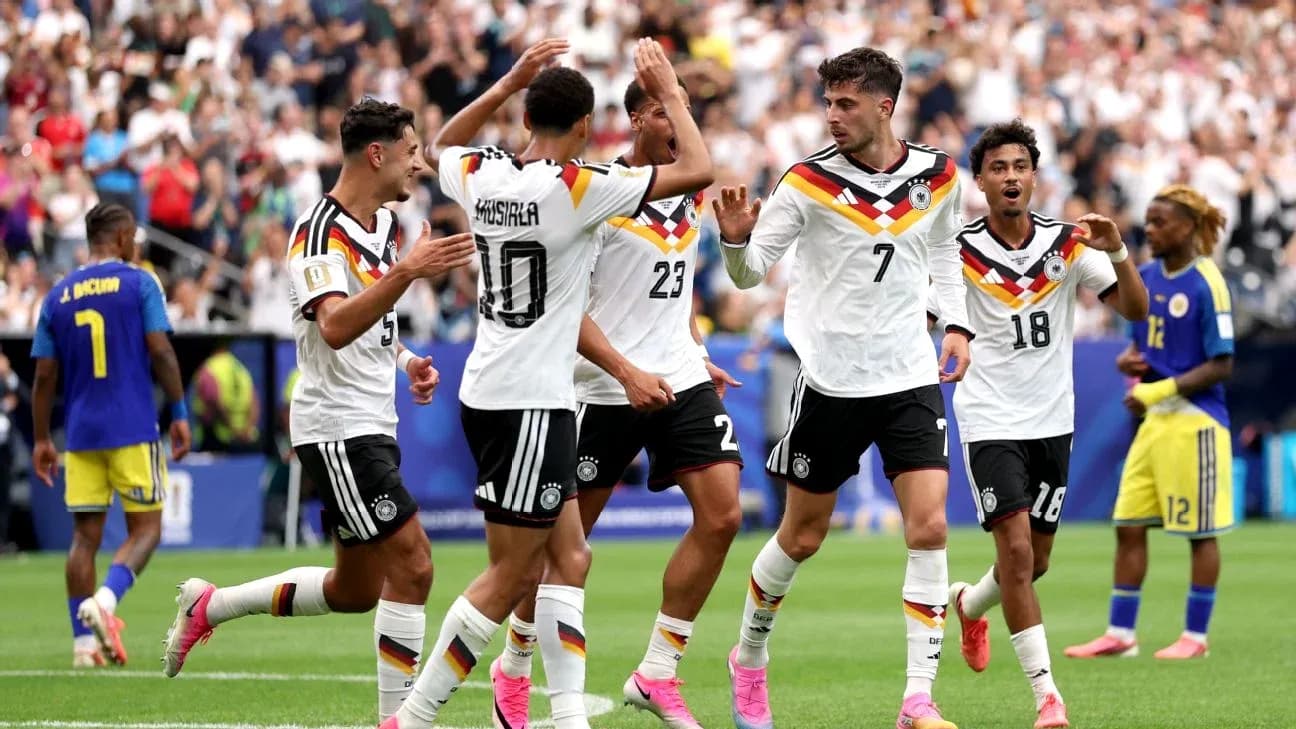
Under the closed roof of NRG Stadium in Houston, Germany opened their 2026 World Cup with a statement win, dismantling Curaçao 7–1 in a Group Stage – 1 clash that felt, at times, like a training-ground exercise in positional play. Heading into this game, Germany arrived as a side in transition under Julian Nagelsmann, yet their seasonal DNA was already clear in the numbers: in total this campaign they have played 1 match, winning it, with 7 goals for and 1 against. That +6 goal difference is reflected directly in the standings, where they sit 1st in Group E on 3 points, their description already reading “Round of 32.”
Curaçao, by contrast, step away from Houston with the scars of their first taste of this level. On their travels this campaign they have played 1 match, losing it 7–1, with 1 goal scored and 7 conceded. Overall, that leaves them 4th in Group E, goal difference -6, form line reading “L” and no safety net in the table.
Tactically, this was a clash of structures as much as of status. Germany lined up in a 4-2-3-1, Nagelsmann’s preferred platform for controlled aggression: double pivot for stability, three creative tens behind a roaming nine. Curaçao’s 4-3-1-2 under Dick Advocaat tried to answer with density in the middle and two forwards to threaten in transition, but the gulf in spacing, tempo and automatisms was exposed early and repeatedly.
Tactical Voids and Discipline
There were no listed absences for either side, which meant both coaches could lean fully into their intended identities. For Germany, that meant Manuel Neuer behind a back four of Joshua Kimmich, Jonathan Tah, Nico Schlotterbeck and Nathaniel Brown, with F. Nmecha and Aleksandar Pavlovic anchoring midfield. Ahead of them, Leroy Sané, Jamal Musiala and Florian Wirtz floated between lines behind Kai Havertz. Every line of Nagelsmann’s blueprint was present.
Curaçao, likewise, were structurally complete: Eloy Room in goal, a back four of Shurandy Floranus, Riechedly Bazoer, Armando Obispo and D. Fonville; a central trio of L. Comenencia, Leandro Bacuna and Juninho Bacuna; Tahith Chong as the nominal 10 behind the front pair of Jürgen Locadia and S. Hansen. On paper, that 4-3-1-2 can compress space centrally and spring forward; on grass, it often became a 6-3-1 pinned deep by German pressure.
Disciplinary data for the campaign is still a blank canvas: the cards tables for both teams show no yellow or red cards across any minute range. That reflects a match and a group opener where the story was more about technical mismatch than physical edge. Germany did not need tactical fouls; Curaçao rarely got close enough to commit them.
Key Matchups
The central duel was always going to be Germany’s attacking line against Curaçao’s defensive block. Heading into this game, Germany’s goals for at home stood at 7 in 1 match, an average of 7.0, with only 1.0 goal against at home. Curaçao’s defensive record on their travels told the opposite story: 7 goals conceded in 1 away match, an away average of 7.0 against. The numbers framed a brutal equation: a free-scoring heavyweight against a defence still learning the rhythms of elite tournament football.
Kai Havertz embodied the “Hunter” role. In total this campaign he has 2 goals from 2 shots, both on target, plus 1 penalty scored from 1 taken. His 41 passes at 92% accuracy underline how Nagelsmann uses him not just as a finisher but as a connective hub, dropping to link with Musiala and Wirtz, then arriving late in the box. Against a Curaçao back line that had to track multiple runners, Havertz constantly attacked the blindside of centre-backs and the half-spaces between full-back and central defender.
On the “Shield” side, Bazoer and Obispo were asked to hold an impossibly high line of responsibility. With the midfield three often dragged horizontally by Germany’s rotations, Curaçao’s centre-backs were left to defend huge zones. The 7–1 scoreline is a blunt verdict on how that matchup tilted: Germany’s home average of 7.0 goals for and Curaçao’s away average of 7.0 against converged exactly on the pitch.
The Engine Room
If Havertz versus Curaçao’s back four was the headline, the true tactical heart of the match lay in midfield. Germany’s double pivot of F. Nmecha and Pavlovic gave the platform; the real engine was the triangle of Musiala, Wirtz and Sané.
Musiala, in particular, set the tone. In total this campaign he has 1 goal, 26 passes (only 50% accuracy, a sign of constant risk-taking), 2 key passes, 5 dribble attempts with 4 successful, and 14 duels contested, winning 9. Those numbers sketch a player who lives in tight spaces, constantly driving at the seams of a block. Against Curaçao’s three-man midfield, he repeatedly received between the lines, turned onto his front foot and forced defenders to step out, ripping holes for runners behind.
On the opposite side, Leandro and Juninho Bacuna had to be both playmakers and enforcers. They were tasked with screening passing lanes into Musiala and Wirtz while also providing the first pass into Locadia and Hansen. The problem was structural: with Germany’s full-backs – especially Kimmich – stepping into midfield, Curaçao were perpetually outnumbered around the ball.
Kimmich’s numbers as a creator from right-back underline that imbalance. In total this campaign he has 2 assists, 73 passes at 89% accuracy and 5 key passes. He effectively functioned as an auxiliary playmaker, stepping into the right half-space to combine with Wirtz and Sané. Every time Curaçao’s narrow midfield shifted towards the ball, Brown on the opposite flank or Musiala centrally found space.
From the bench, Deniz Undav added a different texture to Germany’s attack. In total this campaign he has 1 goal and 2 assists in just 26 minutes, with 1 shot on target and 3 key passes. His movement between the lines and willingness to drop into midfield further overloaded Curaçao’s central trio, turning a tiring defence into static targets.
Statistical Prognosis
Following this result, the statistical arc of Group E is already sharply bent. Germany’s overall record reads: 1 match played, 1 win, 7 goals for, 1 against, average 7.0 goals scored and 1.0 conceded per match, no clean sheets but overwhelming attacking power. Curaçao’s overall line mirrors it from below: 1 match, 1 defeat, 1 goal for, 7 against, averages of 1.0 scored and 7.0 conceded, no clean sheets but at least proof they can find the net.
xG data is not provided, but the shot and chance creation metrics we do have are revealing. Havertz converting both of his shots, Musiala’s high dribble success and duel wins, Kimmich’s 5 key passes and Undav’s 3 key passes in limited minutes all point to a German attack generating repeated high-quality situations rather than relying on low-probability efforts. Given Curaçao’s away average of 7.0 goals conceded in total this campaign, the defensive solidity simply is not there yet to absorb that volume and quality.
From a tactical and statistical standpoint, the prognosis for the group is clear. Germany look built to dominate territory and chance creation, with a 4-2-3-1 that maximises their creative depth and a penalty record of 1 scored from 1 taken that adds another layer of threat. Curaçao, meanwhile, must use this defeat as a tactical laboratory: their 4-3-1-2 needs either deeper defensive spacing or an extra body wide to survive against elite sides.
The story of Houston, written in a 7–1 scoreline and a +6 goal difference swing, is of a tournament heavyweight announcing itself and a debutant discovering, in painful detail, what the highest level demands.