.svg&w=384&q=75 "GoalGist logo")
France vs Senegal: Group I Clash Analysis
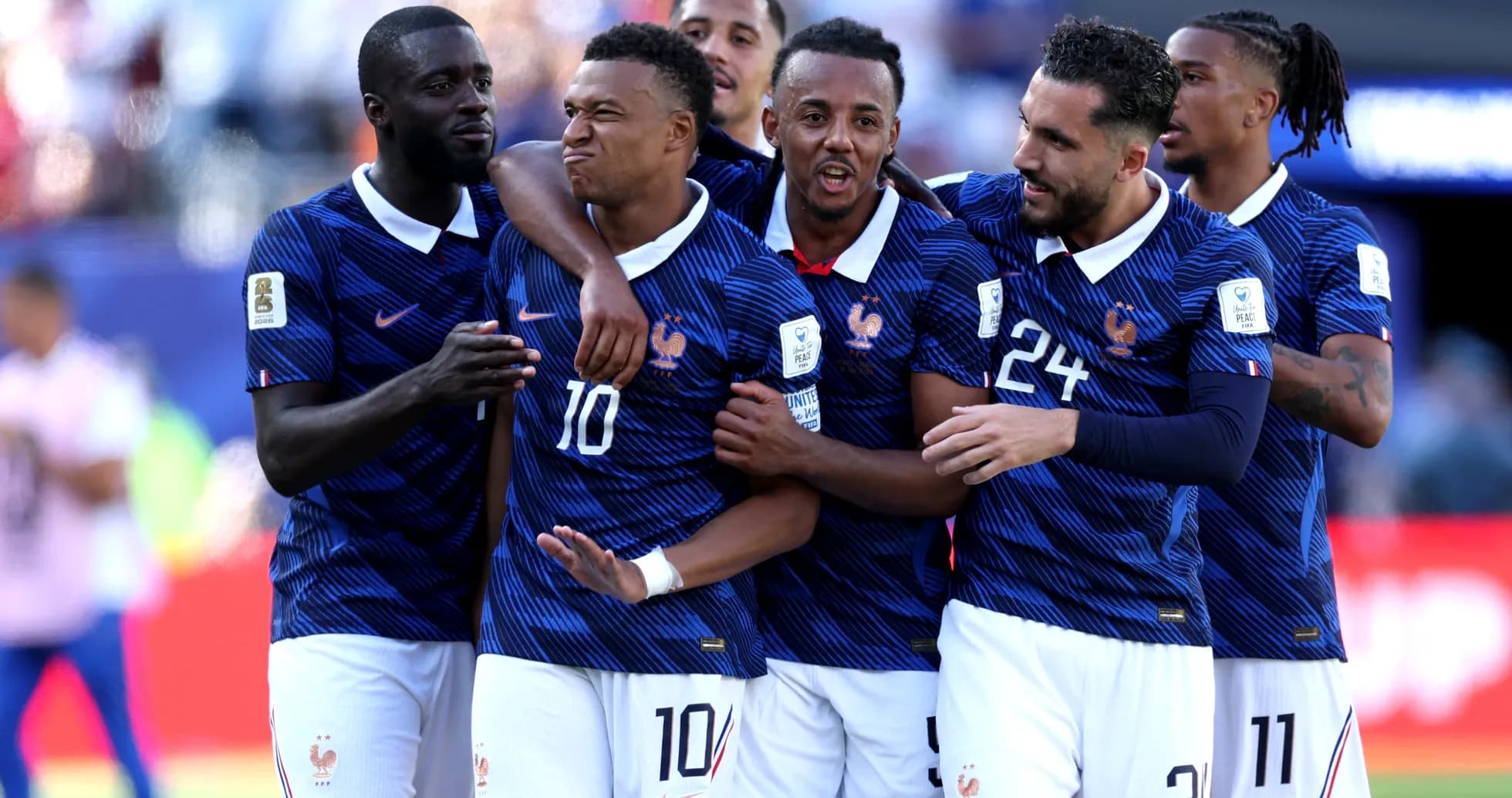
MetLife Stadium, draped in blue, white and a stripe of Senegalese green, watched a heavyweight opening to Group I that felt more like a knockout tie than a curtain-raiser. France and Senegal mirrored each other on the tactical board with matching 4-2-3-1s, but the 3-1 full-time score underlined how differently those shapes lived and breathed over 90 minutes.
Following this result, France sit 2nd in Group I on 3 points with a goal difference of +2, having scored 3 and conceded 1 in total. The numbers fit the story: a side that can overwhelm you in bursts, concede a punch, then reassert control. Senegal, 3rd with 0 points and a total goal difference of -2 (1 for, 3 against), are already playing catch-up, their performance a mix of structural promise and punishing naivety in both boxes.
France's Tactical Setup
Didier Deschamps’ France lined up in a textbook 4-2-3-1, but the nuance lay in the roles. Mike Maignan was the calm base, allowing the back four of Jules Kounde, Dayot Upamecano, William Saliba and Theo Hernandez to hold an aggressive starting position. In front, Aurelien Tchouameni and Adrien Rabiot formed a double pivot that rarely split too far: one stepped to screen, the other held the central lane to protect transitions.
Ahead of them, the trio of Michael Olise, Ousmane Dembele and Desire Doue operated less as “three No. 10s” and more as a rotating band of problem-solvers. Olise drifted into half-spaces to link, Dembele stretched the right flank, and Doue’s inside movements opened corridors for Theo Hernandez to thunder forward. At the tip, Kylian Mbappe was officially the lone striker, but functionally the system was built to give him a runway rather than a platform.
The statistical backdrop only amplifies the impression. In total this campaign, France have played 1 match, won it, and scored 3.0 goals per game overall while conceding 1.0. At home in this World Cup, they have the same 3.0 goals for and 1.0 against from their single outing. It is early, but the pattern is familiar: Deschamps’ side rarely need volume to hurt you; they need moments.
Senegal's Tactical Setup
Senegal, under Bouna Thiaw Pape, matched the 4-2-3-1 but with a different personality. Edouard Mendy’s presence behind a back four of Krepin Diatta, Kalidou Koulibaly, Moussa Niakhate and M. Diouf was meant to provide security for an ambitious front line. Idrissa Gueye and Pape Gueye sat as a double pivot tasked with both screening Mbappe’s channels and feeding the creative trio of Ismaila Sarr, L. Camara and Sadio Mane behind Nicolas Jackson.
On their travels in this World Cup, Senegal’s only match has produced 1 goal for and 3 against, an away average of 1.0 scored and 3.0 conceded. That away fragility is not yet a trend, but it reflects how open they became once they had to chase the game. Clean sheets stand at 0 in total for both sides, but where France’s 3-1 home win (their biggest home result so far) speaks of controlled risk, Senegal’s 3-1 away loss hints at a structure that can be pulled apart if the first press is beaten.
Bench Decisions and Impact Substitutions
The absence data offers no formal list of injuries or suspensions, so both coaches essentially had full decks. That made the bench decisions even more telling. Deschamps’ use of Bradley Barcola, for instance, proved decisive in a different phase of the contest. Barcola’s entry – he has 1 appearance, 10 minutes and 1 goal in total – gave France a fresh vertical runner to exploit a tiring Senegalese back line. On the other side, Ibrahim Mbaye and Iliman Ndiaye came in to good effect for Senegal: Mbaye has 1 goal from 1 shot in 15 minutes, while Ndiaye already leads his side in assists with 1 in just 17 minutes. Their cameos suggest that Senegal’s attacking depth may become a story as the group unfolds.
Disciplinary Context
Disciplinary data at team level is blank by minute range, so we cannot map a precise card pattern. What we can say is that neither side shows a record of yellow or red cards in the season stats so far, and among the highlighted individuals – Mbappe, Barcola, Mbaye, Ndiaye – none have yet picked up a booking. This is important context: both teams are playing on the edge athletically, but not yet living dangerously with the referee.
Individual Matchups
The “Hunter vs Shield” duel is embodied by Mbappe against Koulibaly and Niakhate. Mbappe’s World Cup so far: 1 appearance, 90 minutes, 2 goals from 4 shots (all on target), an 8.2 rating, and a passing accuracy of 93% from 16 passes. He is not just a finisher; he is efficient in his link play, sparing in his touches but devastating in his choices. Senegal’s shield, by contrast, has conceded 3 in its only outing on their travels. Koulibaly and Niakhate defended large spaces once France broke the first line, and with Senegal’s away average of 3.0 goals against, the numbers underline how high the margin for error is when facing Mbappe in transition.
Engine Room Matchup
In the “Engine Room” matchup, Tchouameni and Rabiot’s control of the middle against Idrissa and Pape Gueye decided the game’s rhythm. France’s total record of 0 failed-to-score matches and 0 clean sheets suggests a side that opens itself enough to play, trusting that its midfield will win more battles than it loses. Senegal’s own total of 0 failed-to-score games hints at attacking resilience – they found a goal even in defeat – and Ndiaye’s 1 key pass and 1 interception in just 17 minutes shows he can both create and disrupt between the lines.
Expected Goals Perspective
From an Expected Goals perspective, the raw xG is not provided, but the shot and goal efficiency of the leading forwards is telling. Mbappe converting 2 from 4 shots on target, Barcola scoring with his only effort, and Mbaye netting with his sole shot point to clinical finishing rather than wasteful volume. Combine that with France’s total average of 3.0 goals for and Senegal’s total average of 3.0 goals against, and the statistical prognosis is clear: any open, end-to-end pattern in future group matches will tilt towards France’s ruthless edge and expose Senegal’s still-fragile defensive structure.
Conclusion
Following this result, the narrative is set. France’s squad looks deep, balanced and already in knockout gear, their 4-2-3-1 a flexible canvas for match-winners like Mbappe and impact players like Barcola. Senegal, meanwhile, must tighten the distances between their lines and better shield their centre-backs if they are to turn the promise of Jackson, Sarr, Mane, Mbaye and Ndiaye into points rather than consolations. The story of Group I will likely hinge on whether they can turn that 3.0 away goals-against average into something more sustainable before it is too late.