.svg&w=384&q=75 "GoalGist logo")
FIFA's Hydration Breaks: A Game Changer for World Cup Momentum
Curaçao’s roar had barely finished echoing around the stadium when the whistle went.
In Houston, at 1-1 against four-time world champion Germany, the smallest nation by population ever to reach a World Cup had just authored the moment of its dreams. Livano Comenencia’s strike sent Curaçao’s fans into delirium and left the Germans briefly stunned. For a few precious seconds, a seismic upset felt not just possible, but imminent.
Then came the hydration break.
The players trudged to the touchline. The noise dipped. The chaos calmed. When the game restarted, it belonged to Germany again. Curaçao’s surge vanished, the underdogs conceded twice before the interval, and what had looked like a story for the ages dissolved into a brutal 7-1 reality.
“I actually felt sorry for them,” said former England striker Alan Shearer on The Rest is Football podcast. “They scored and then it was maybe 30 seconds after that it stopped. So it’s killed their momentum.”
That single pause captured the fault line running through this World Cup’s most controversial innovation: FIFA’s mandatory hydration breaks midway through each half.
A World Cup with built‑in timeouts
The breaks were brought in with a clear, logical aim. With matches spread across the summer heat of the United States, Canada and Mexico, and temperatures expected to climb above 90 F (32 C) in the hottest venues, player welfare sits high on the agenda. Referees now stop play at around 22 minutes in each half, giving players three minutes to take on fluids.
On paper, it is a simple health measure. On the pitch, it is something far more disruptive.
“We’re in America, right? So, it’s like it is it’s like it’s a timeout,” Roy Keane said on The Overlap podcast with Gary Neville. “We love football because of the pace of the game ... what it’s doing is stopping the flow of the game, the momentum.”
The numbers from the opening round of fixtures back him up. In eight of the first 16 matches, a goal arrived within 10 minutes of a hydration break. Coaches are not just handing out water; they are calling mini huddles, pushing players into different zones, adjusting presses and triggers that usually require a half-time whiteboard.
“You can use the break to tell the players what they need to improve or what is good or what they should do better,” Netherlands coach Ronald Koeman said. “So you can use it in different ways to your advantage, and this is what we will be doing.”
The evidence is already scattered across the tournament.
Curaçao never regained their grip once Germany had time to reset. In New Jersey, Morocco bossed Brazil early, scored just before the first break, then saw the game tilt. Less than 10 minutes after play resumed, Vinicius Junior had dragged Brazil level. Canada, the US, Australia, Scotland, Sweden and Iran have all struck soon after these enforced pauses.
Momentum maps tracking the flow of matches show clear swings after the new stoppages. The rhythm of the sport is being redrawn.
Fans boo, coaches scheme, TV cuts to ads
Inside the stadiums, the reception has been hostile. When Iraq and Norway stopped for the first hydration break in Foxborough, Massachusetts, the stands answered with boos. The crowd had settled into the match; suddenly, the curtain came down.
The irritation is sharpened by the fact that these breaks are not tied to actual conditions. FIFA has ruled they will be implemented in every match, regardless of temperature, venue or whether the stadium is open-air or under a roof. So Spain’s meeting with Cape Verde in Atlanta was halted for a hydration break despite the game being played indoors in air-conditioned comfort.
The governing body’s explanation is “equal conditions for all teams, in all matches.” Many coaches accept the principle. They do not all buy the execution.
Spain coach Luis de la Fuente called the breaks logical in “extreme” heat but questioned the need to apply them universally. “Tomorrow, when the temperature that we’ll have in this stadium is chill, maybe these breaks are not so needed, but we need to abide by the rules,” he said.
Norway’s Staale Solbakken echoed the concern. “I can understand it when it’s like it’s been in Greensboro, when it’s been 35 degrees (95 Fahrenheit) and a really hot climate and there’s a bit of vibration in the air – then I think it’s fine. But I don’t like it otherwise. I think it’s unnecessary,” he said.
Then there is the other, less subtle force at work: television.
In the United States, broadcaster Fox cuts straight to commercials as soon as the referee signals a hydration break. Telemundo, the Spanish-language broadcaster, does not. For a sport that has long prided itself on 45 minutes of uninterrupted action, the intrusion jars.
“Every time going to a commercial is a bit ... not really (something) that I like,” said Netherlands captain Virgil van Dijk, who watched early World Cup games on TV before his side opened with a 2-2 draw against Japan. “I think for the neutral watchers on TV it’s also not great.”
Football has always stood apart from American sports like baseball, basketball and gridiron, where the game is segmented around advertising windows. That firewall is now under pressure.
France coach Didier Deschamps framed it bluntly. “It’s not two half times, it is four quarter times basically that we’ve got. This is what’s been decided and so the players and the coaches adapt to this new reality,” he said.
Whether this “new reality” survives beyond this World Cup is unclear. FIFA has not committed to using hydration breaks at future tournaments, and the English Football Association has already indicated it is unlikely to adopt them for Euro 2028 in the UK and Ireland.
For now, the game lives with the pause: three minutes that can cool legs, reset tactics, break hearts and, as Curaçao discovered, turn a dream into a rout.
Ronaldo’s sixth World Cup: same hunger, different stakes
While the sport wrestles with structural change, one constant looms into view: Cristiano Ronaldo, back for a sixth World Cup.
At 41, he walks into this tournament as both living monument and active weapon. Portugal coach Roberto Martinez insists the veteran forward is attacking this campaign with the hunger of a debutant.
“He is an example and a reference for football. For all those children on the street who begin to feel the love for sport, following the example of Cristiano Ronaldo is wonderful,” Martinez said before Portugal’s opener against DR Congo.
“It is his sixth World Cup, but I can say that internally it seems to be his first World Cup in terms of intensity, in terms of emotional output, of how important it is for him to be prepared to lead the group.
“Within the team he is a vital player because he is the finisher, he is the player in the penalty area, he is the player who has those movements that can open spaces for other players. Within our attacking game, his numbers reflect the importance he has.”
Those numbers are staggering. No one in the history of the men’s game can match his 143 international goals. Yet his recent major-tournament record is stark: nine matches without a goal, and a diminishing role when his team does not have the ball.
That contrast has fuelled a familiar debate in Portugal. Does Ronaldo still elevate this side, or does the team now bend too far around him?
Inside the camp, the message is unwavering. This is still Ronaldo’s stage.
Bruno Fernandes, arriving at the World Cup as the Premier League’s player of the year and the heartbeat of one of the strongest midfields in the tournament, grew up under Ronaldo’s shadow.
“All of us in this national team we have grown up watching Cristiano Ronaldo play and for us it's such an honor to play next to him now in the same team,” said the Manchester United captain. “We're all here to support him and to support Portugal to go as far as possible.”
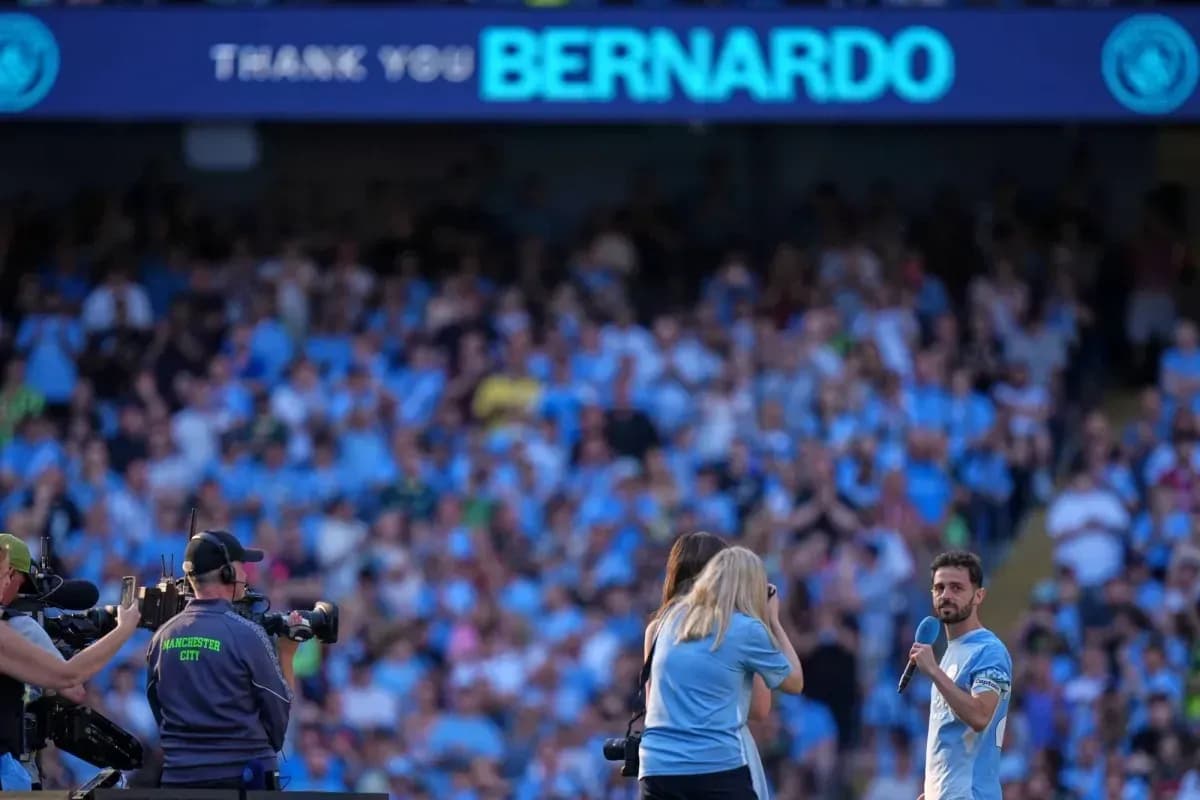
Behind Ronaldo, the supporting cast is formidable. Vitinha and Joao Neves come in as back-to-back Champions League winners with Paris Saint-Germain. Bernardo Silva, after a trophy-laden nine years at Manchester City, is set to join Real Madrid. The talent pool is as deep as Portugal has ever had.
“We have a very strong team, great individual quality, and beyond the individual quality and the strengths that we have as individual players, I think we are a very cohesive team, a very united team,” Fernandes said. “Obviously our dream is to be there (winning the World Cup) and I think that dreaming is not forbidden.”
No easy games, no long future
Portugal’s Group K assignment looks manageable on paper: DR Congo, Uzbekistan and Colombia. Martinez, though, has watched enough of this World Cup to know that paper counts for little.
Spain’s goalless stumble against Cape Verde in their opener sits fresh in his mind.
“We've got very little to win tomorrow from the outside. If you win against Congo, it's expected. If you win by one, it's a big problem. If you draw, it's a catastrophe. If you lose, this is the end of the world,” he said. “They come with no expectations, they are enjoying being here. We've seen incredible performances from teams like Qatar, Cape Verde, exemplary performances, that shows you that there are no easy games in a World Cup.”
There is another layer to Martinez’s stance. He knows his own clock is ticking.
“My contract ends after the World Cup. This is not news, this is just a fact,” he said. “We're now focused on finishing the work that we've begun three-and-a-half years ago.
“When I came to Portugal the focus was to try to win everything, but most importantly to prepare for the World Cup.”
So the picture sharpens. A World Cup played in four quarters, with hydration breaks carving into momentum and television edging into the gaps. A tiny island nation feeling the full force of a pause. A 41-year-old icon chasing one last shot at the only trophy that has eluded him, led by a coach who knows this is his final act.
If Ronaldo lifts the World Cup at the end of it, will anyone in Portugal care how many times the clock stopped along the way?