.svg&w=384&q=75 "GoalGist logo")
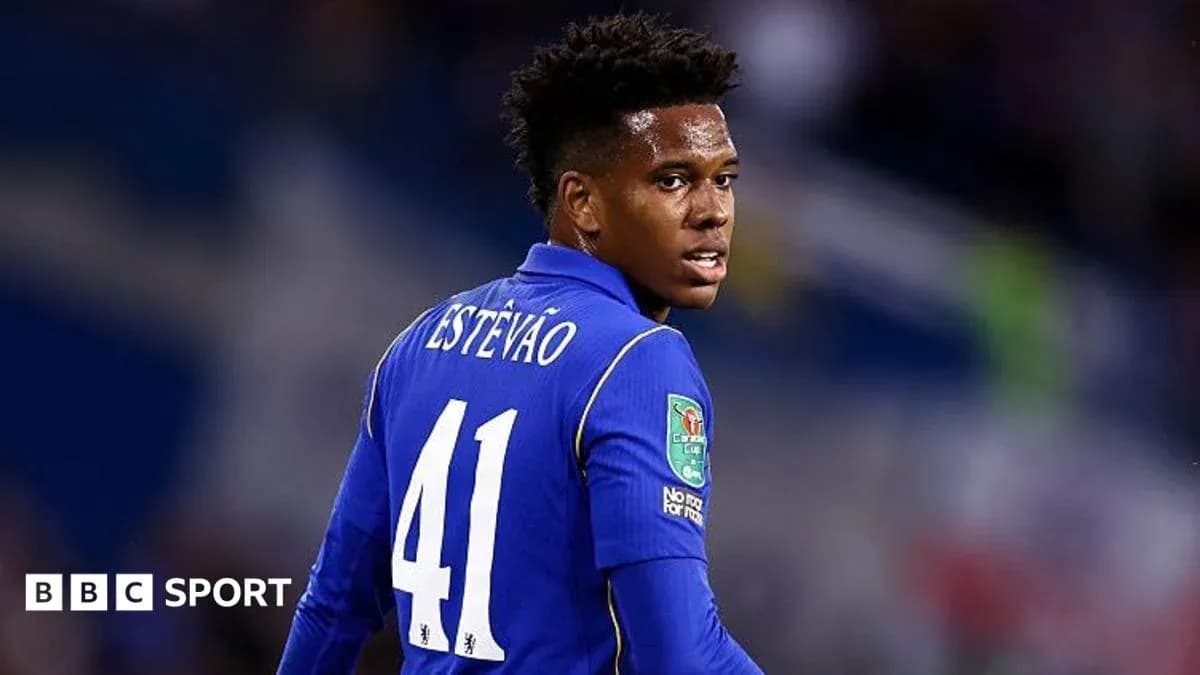
Estevao: The £51m Talent Waiting for His Chance at Chelsea
The ball seemed to be bending towards the far corner, the away end already half-rising. Estevao Willian had cut inside, opened his body and let fly.
David Raya’s glove killed the moment.
Arsenal kept their lead. Chelsea left with nothing. But that brief, curling strike from a 19-year-old Brazil winger told its own story: there is a serious footballer waiting for a bigger stage in Xabi Alonso’s squad.
A £51m talent stuck on the fringes
Chelsea did not bring Estevao from Palmeiras for him to watch from the bench. £51m is not development-squad money. Yet, four games into the season, his minutes tell a different tale.
- Ninety-six in total.
- Eighty of those in one Carabao Cup tie against League One Luton Town.
- Sixteen more, scattered across late cameos against Fulham and Arsenal.
He did not get on the pitch at all in the narrow win over Brighton, watching as Chelsea clung on without turning to him. For a player who arrived with heavy expectation and a reputation from Brazil, that is a thin slice of action.
Reports back home have already painted a picture of frustration, suggesting Estevao is unhappy with his role. Inside Stamford Bridge, the response has been blunt: not true. People close to the player and within the club insist he is content, excited even, by the scale of Chelsea’s summer rebuild and the competition that comes with it — including the arrival of Morgan Rogers.
Rogers, the £117m signing from Aston Villa, has walked straight into the team. Cole Palmer and Joao Pedro have started the season sharply. That trio has blocked off Estevao’s preferred territory in the final third.
“I count on Este 100%”
Alonso is not shying away from the question. Asked directly whether Estevao’s limited involvement reflects any unhappiness, the head coach pushed back.
“No, Este is ready, training well. The other day he had a great impact,” he said. “He is fully involved with a very good attitude every day. I count on Este 100% because of his potential. He is so young but he is learning and adapting quickly. The season is long.”
Inside the club, Estevao sits in rarefied company. Chelsea see him as one of a small group of “untouchables” alongside Palmer, Joao Pedro and Moises Caicedo. There is no intention to sell. Quite the opposite: he is central to their long-term plan.
Early talks have already taken place over a new contract, with Chelsea keen to lock down key pieces on improved terms. Joao Pedro has been rewarded; others are expected to follow.
The context matters too. Estevao is building back from a serious grade-four hamstring tear suffered late last season, an injury that cost him a World Cup appearance. Chelsea always expected his involvement to grow gradually rather than explode from day one.
System, stars and a blocked pathway
At the Emirates, Estevao’s role underlined the current dilemma. He came on for Pedro Neto, who has been asked to operate as a wing-back in Alonso’s new shape. It is hard to imagine many other situations where Estevao would be used there, given the defensive running and physical duels that come with the position.
His natural home is further up, inside-right, as a number 10 cutting in and combining. That space belongs to Palmer.
Palmer is not just a tactical fit. Alonso sees him as a dressing-room leader and one of his primary attacking threats. Dropping him for league games would be a major call, and Alonso has shown no appetite for that so far.
On the rare occasion Alonso has used a back four, Estevao and Palmer have dovetailed well, hinting at a partnership that could define Chelsea’s attack in time. But that shape has appeared only once: against Luton in the Carabao Cup.
Without European football, Alonso has also been picking close to his strongest side in the domestic cups. He wants his tactical ideas to bed in quickly. Rotation, for now, is limited.
A crowded, restless squad
Estevao is not the only one staring at the clock. Chelsea’s squad stands at 27 players, and a number of young attackers are feeling the squeeze.
Palmer and Rogers have started every game. Joao Pedro has begun all three league matches. Danny Welbeck, the most experienced striker in the group, led the line against Luton. That has left Emmanuel Emegha, signed from Strasbourg in the summer, with just one appearance on the bench.
At the back, Aaron Anselmino is still waiting for his first minute, included in only one matchday squad so far, while managing fitness issues. The same theme runs through the forward line. Geovany Quenda and Jamie Gittens have featured for just eight and 10 minutes respectively across four matches, with Quenda — signed despite firm interest from Manchester United in 2024 — left out of two squads altogether.
Even with injuries, opportunities are tight. Caicedo and Jordan Henderson have both had fitness problems, which has occasionally left Chelsea light in midfield. Yet summer signing Valentin Barco has only one start and one substitute outing to show for it, with right-back Malo Gusto preferred in midfield. Wing-back Marco Palestra is still out injured.
If everyone were fit, Chelsea would have to leave six outfield players out of each matchday squad. Eleven starters, nine substitutes, and the rest in the stands. That is the hard arithmetic of a big squad without midweek European fixtures.
History says the core stays small
There is another cold reality at play. Successful teams without European football rarely spread the minutes around.
Leicester City’s title-winning run in 2015-16 came with just 14 players making more than 15 appearances in all competitions under Claudio Ranieri. When Antonio Conte led Chelsea to the league the following season, again without Europe, only 13 players passed the 1,500-minute mark.
Even in the era of five substitutions, the pattern holds. Newcastle United, in their 2022-23 campaign that ended with Champions League qualification, saw only 14 players exceed 1,500 minutes.
The closest modern comparison for Chelsea might be last season’s Manchester United, who finished third without European football after early exits in both domestic cups. Only 13 players reached 1,500 minutes there as well.
Managers in that situation lean on a trusted core. The rest wait, hope, and pounce when the door opens.
Leeds, the cups and a chance Estevao cannot waste
All of which quietly cranks up the importance of Wednesday night. Chelsea host Leeds United in the Carabao Cup. Lose, and there will be no more cup football until the FA Cup in January.
For a 27-man squad, that is a long time to keep everyone satisfied on league minutes alone.
For Estevao and the others on the fringes, a deep cup run is more than a nice-to-have. It is the clearest path to real playing time, the stage on which cameos become arguments, and arguments become starts.
Estevao has already shown, in one late, curling effort at Arsenal, what his left foot can do. Now the question is simple: when the next chance comes, will he be on the pitch long enough to change more than just the mood?