.svg&w=384&q=75 "GoalGist logo")
English Football's Premier League Glory and Hidden Challenges
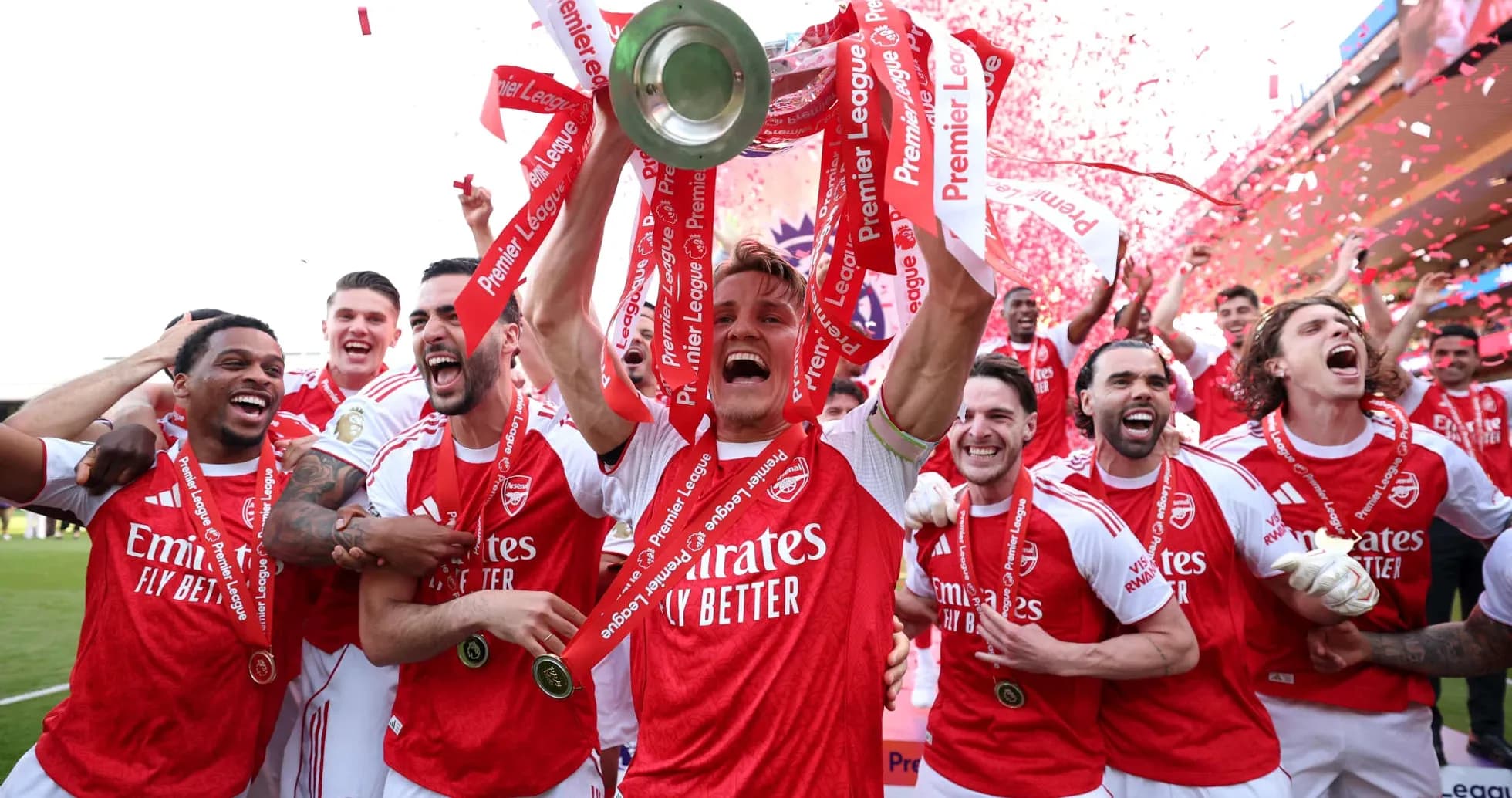
Martin Odegaard raised the Premier League trophy into the south London sky and, for a moment, English football looked untouchable.
Arsenal, champions again after 22 long years, crowned at Selhurst Park on May 24. A 14th league title, a new generation, a different name on the silverware for the third straight season after Liverpool in 2024-25 and Manchester City in 2023-24. To the casual eye, the Premier League has never looked healthier.
Scratch the gloss, though, and the picture shifts.
England’s dominance – and its warning signs
On the pitch, the numbers scream supremacy. England’s top flight has become the benchmark Europe cannot quite match. Spain, the continent’s next richest league, remains a private feud between Barcelona and Real Madrid, who have hoarded 20 of the last 22 titles. In Germany, Bayern Munich’s grip has stretched over 13 of the last 14 seasons. In France, Paris Saint-Germain have claimed eight of the last nine.
Only Serie A offers anything like the same churn at the top as England, with Juventus, Inter Milan, AC Milan and Napoli all taking turns as champions over the last seven years. The Premier League, by contrast, keeps rotating its winners while maintaining a ferocious level of competition beneath them.
That strength has spilled into Europe. Only a penalty shootout defeat for Arsenal against PSG in the Champions League final denied English clubs a clean sweep of UEFA’s major trophies, after Aston Villa and Crystal Palace took the Europa League and Europa Conference League respectively. Chelsea still hold FIFA’s Club World Cup. The English game, at elite level, is everywhere.
Money explains much of it. The Premier League sells its domestic and overseas TV rights for more than any other football competition. English clubs occupy half the places in Deloitte’s latest list of the world’s 30 richest sides by revenue. Even AFC Bournemouth, Brentford and Brighton & Hove Albion — clubs once miles from the limelight — now sit among global heavyweights.
Yet the wealth and the trophies mask a set of problems that run deeper than the confetti.
Talent flowing out, not just in
For years, English football judged itself by who it could attract. Now, a growing number of its best are leaving.
Harry Kane, the England captain, leads that exodus. Anthony Gordon’s sale from Newcastle United to Barcelona last week underlined the trend. Six members of England’s squad for the forthcoming World Cup now play for foreign clubs.
Martin Samuel of The Times, never one to miss a shift in the game’s weather, framed it starkly. Once, English football swelled with pride when Real Madrid or AC Milan came calling for a homegrown star. That was a compliment. Now, with almost a quarter of the national squad based abroad, it feels different. A talent drain. And, as Samuel pointed out, it would sting less if players of similar calibre were flowing the other way.
The Premier League still draws outstanding foreign talent, but the balance of power in individual careers is tilting. Top English players no longer see staying at home as the automatic pinnacle. For a league that has built its brand on being the destination, not the departure lounge, that shift matters.
The illusion of endless money
Then there is the balance sheet.
Despite those huge broadcasting deals and commercial contracts, only four Premier League clubs — Newcastle, Aston Villa, Bournemouth and Liverpool — turned a profit in the most recent season with available figures. The rest are either losing money or relying on creative accounting to stay within the rules.
Outside the top flight, the picture is harsher. Administration has claimed a series of historic names, with Derby County and Sheffield Wednesday among those dragged to the brink. These are not minnows with no support; they are clubs with deep roots and long histories, forced into crisis by the modern game’s financial gravity.
To keep pace, some owners have resorted to sale-and-leaseback deals on stadiums and training grounds, shifting assets off the books to comply with financial fair play regulations. Those rules were designed to stop a handful of mega-wealthy backers — including sovereign wealth funds — from inflating wages and transfer fees to unsustainable levels. Instead, they have encouraged a different kind of financial engineering.
The irony is sharp. In trying to protect the sport from runaway spending, the system has pushed clubs towards short-term fixes that may store up long-term risk.
Relegation bites the investors
Another assumption is under threat too: that there will always be another rich buyer waiting in the wings.
Tottenham Hotspur, one of the six Premier League clubs that flirted with the doomed European Super League in 2021, only just avoided relegation this season. West Ham United, the league’s eighth-longest serving club and 20th in Deloitte’s Money League, did not. They went down.
Those two stories echo far beyond north London and east London. They cut straight into the mindset of potential investors, especially Americans used to closed leagues with no relegation. In their world, a franchise’s value rarely faces the existential threat of dropping into a lower division. In England, it can vanish in a single bad season.
Samuel noted that Liverpool, Manchester United, Crystal Palace, Chelsea and Newcastle are all, in one way or another, on the market or open to new investment. Prospective owners will look at West Ham’s fall, Tottenham’s brush with disaster, and think twice. The risk profile has changed.
And in the corridors of the Premier League’s headquarters, they will have noticed that too.
Odegaard’s trophy lift told one story: a league at the peak of its powers, with drama, variety and global reach. The numbers, the transfers and the balance sheets tell another. How long can English football keep winning on the pitch while walking such a fine line off it?