.svg&w=384&q=75 "GoalGist logo")
Egypt's Tactical Mastery Over Australia in Round of 32
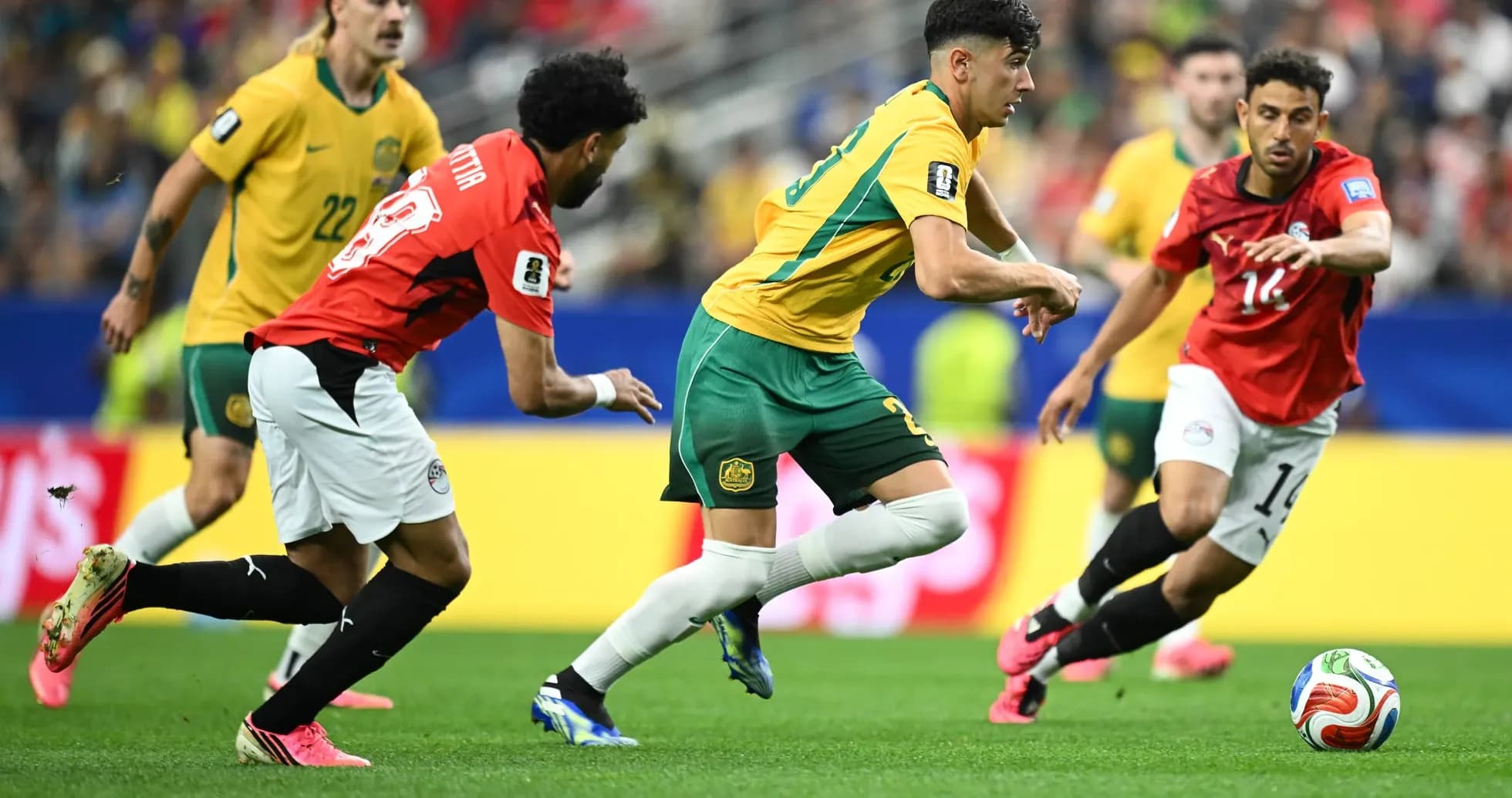
Australia’s Round of 32 exit on penalties to Egypt at AT&T Stadium was defined by a clash of structures and possession philosophies. Across 120 minutes, Egypt’s 4-4-2, built on controlled circulation and half-space occupation, consistently imposed itself on the ball, while Australia’s 3-4-2-1 sought to compress space, counter through vertical runs, and attack wide-to-central. The 1-1 draw in open play, followed by a 4-2 defeat in the shootout, reflected a contest where Egypt dictated tempo but Australia engineered enough chaotic moments to stay alive.
Egypt’s 58% share of possession was not sterile; it was the platform for a clear territorial strategy. With Karim Hafez and Mohamed Hany providing width from full-back and Omar Marmoush stepping inside from the left midfield line, Hossam Hassan’s side created natural overloads in the outside channels before playing into the front pairing of Mohamed Salah and Mostafa Ziko. The opening goal on 13 minutes, finished by Emam Ashour and assisted by Hafez, was the purest expression of that plan: progression down the flank, a well-timed underlapping run from midfield, and a clean final action from central areas.
Australia’s 3-4-2-1 under Tony Popovic was structurally reactive but not passive. The back three of Lucas Herrington, Harry Souttar and Alessandro Circati stayed narrow to protect the box, while wing-backs Jordan Bos and Aziz Behich were tasked with aggressive jumps onto Egypt’s wide midfielders. Jackson Irvine and Aiden O’Neill formed a double pivot aimed at screening Salah’s dropping movements and Ashour’s surges. Ahead of them, Cristian Volpato and Connor Metcalfe floated between Egypt’s lines to connect with lone forward Nestory Irankunda. The shape produced volume rather than clarity: 16 total shots but only 1 on target, with 9 efforts blocked, underlining how often Egypt managed to get bodies in the line of fire.
The own goal at 55 minutes, when Mohamed Hany diverted into his own net to level for Australia, emerged from this pressure-through-volume approach. By then, Australia had begun to pin Egypt deeper with more direct entries and second-ball aggression. The structural tweak was subtle but important: the wing-backs held higher starting positions, while one of the two attacking midfielders consistently attacked the far post. This forced Egypt’s back line to defend facing their own goal more frequently, increasing the risk of defensive errors such as Hany’s misfortune.
In midfield, Egypt’s technical superiority was clear. They completed 614 of 723 passes (85%), using Hamdy Fathy and Marwan Attia as stable circulation points. This allowed Ashour to operate higher, often joining Salah between the lines to create a quasi-4-2-3-1 in possession. The result was more efficient chance creation: 14 total shots, 4 on goal, and a higher xG of 1.36. Australia, despite a respectable 507 passes with 404 accurate (80%), struggled to progress cleanly through central zones and leaned heavily on wide deliveries and second-phase chaos to generate their 0.87 xG.
Substitutions reflected divergent priorities as the match evolved. At 46 minutes, Kai Trewin (IN) came on for Jordan Bos (OUT), a move that slightly rebalanced Australia’s left side toward defensive stability and aerial presence. At 67 minutes, Egypt freshened both midfield and attack: Hossam Abdelmaguid (IN) came on for Hamdy Fathy (OUT), and Haissem Hassan (IN) replaced Mostafa Ziko (OUT), maintaining vertical threat while injecting energy. Australia’s double change on 74 minutes — Mohamed Touré (IN) for Nestory Irankunda (OUT) and Ajdin Hrustić (IN) for Cristian Volpato (OUT) — was more overtly attacking, adding a ball-carrying forward and a creative midfielder to improve link play and set-piece quality.
Egypt’s later substitutions were about sustaining intensity and adding direct running. Mahmoud Trézéguét (IN) replaced Karim Hafez (OUT) at 80 minutes, effectively turning the left flank into a more aggressive outlet, while Hamza Abdelkarim (IN) came on for Omar Marmoush (OUT) at 106 minutes, keeping the threat of transition alive in extra time. On the Australian side, Awer Mabil (IN) for Connor Metcalfe (OUT) and Paul Okon-Engstler (IN) for Aiden O’Neill (OUT) at 91 minutes signalled a push for more dribbling and late box arrivals from midfield. The 119th-minute goalkeeper switch — Mathew Ryan (IN) for Patrick Beach (OUT) — was a pure penalty-shootout decision, prioritising Ryan’s experience.
Defensively, both teams showed contrasting methods. Australia’s 12 fouls, largely the product of their compact mid-block and aggressive duels when Egypt tried to play through the inside channels, contrasted with Egypt’s 14 fouls, many of which came as they tried to disrupt Australian counters and wide overloads. The two Egyptian bookings — 105 minutes Haissem Hassan (Egypt) — Foul; 120 minutes Yasser Ibrahim (Egypt) — Foul — highlighted the growing strain on Egypt’s back line as Australia chased late transitions and set-pieces.
In goal, Patrick Beach (Australia) made 3 saves, reflecting Egypt’s superior shot quality and their ability to reach true finishing zones despite Australia’s congestion in front of goal. At the other end, Mostafa Shobeir (Egypt) was called upon for just 1 save, a direct consequence of Australia’s inaccuracy and Egypt’s effective shot-blocking unit. The goals prevented metric underlines that both defences underperformed slightly against the chances they allowed, but within the tactical balance, Egypt’s structure did a better job of forcing low-probability attempts.
Statistically, Egypt’s control was decisive. More possession, higher pass completion, more shots on goal, and a superior xG all point to a side whose 4-4-2 morphed intelligently in possession and consistently found Salah, Ashour and the wide runners between and behind Australia’s lines. Australia’s 3-4-2-1 delivered volume and set-piece threat, and the own goal they forced was a logical outcome of sustained territorial pressure. But their inability to convert 16 shots into more than 1 on target, combined with Egypt’s superior passing network and more efficient shot profile, meant the match tilted subtly but persistently towards Egypt.
By the time penalties arrived, the underlying numbers and tactical patterns had already framed the outcome. Egypt had controlled where and how the game was played; Australia had fought the game more than shaped it. The 4-2 shootout scoreline simply confirmed the edge that Egypt’s structure, ball circulation, and attacking balance had suggested over 120 minutes.