.svg&w=384&q=75 "GoalGist logo")
Crystal Palace and Everton Draw 2-2: Tactical Insights and Season Dynamics
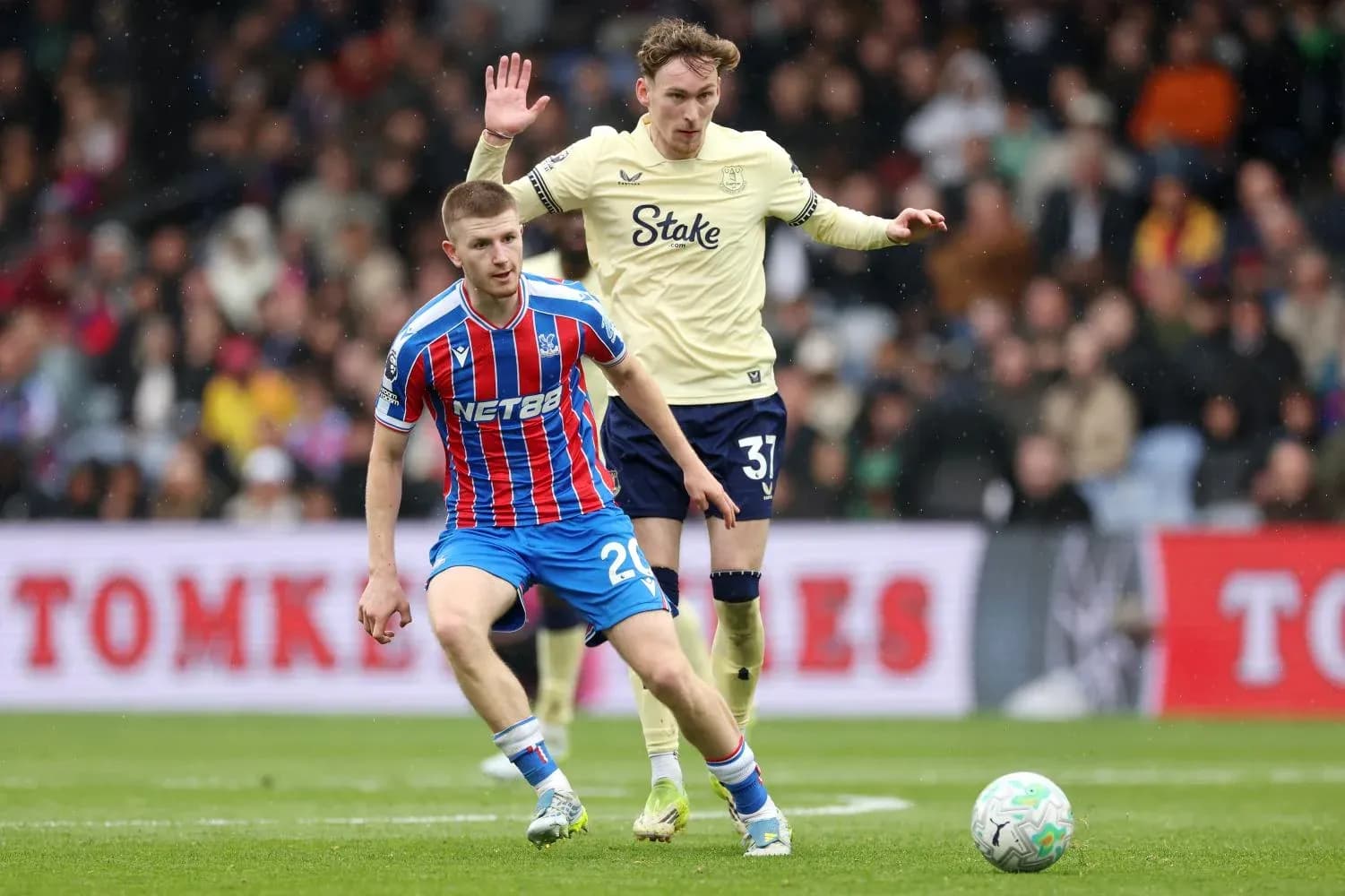
Selhurst Park had the feel of a late‑season crossroads as Crystal Palace and Everton played out a 2-2 draw that said as much about their tactical identities as it did about the Premier League table. Following this result, Palace’s campaign-long struggle for control met Everton’s uneasy balance between structure and risk, and neither side quite found the extra layer of authority to claim all three points.
I. The Big Picture – Shapes, Context, and Season DNA
Palace arrived as a team still searching for complete security, sitting 15th with 44 points and a goal difference of -6, built from 38 goals for and 44 against in total. Their season has been defined by tight margins: at home they had played 18 league matches heading into this game, winning 4, drawing 9, and losing 5, with only 18 goals scored and 21 conceded. An average of 1.0 goals for and 1.2 against at Selhurst Park underlined a cautious, attritional home profile.
Everton, 10th with 49 points and a total goal difference of 0 (46 scored, 46 conceded), came in as the more balanced side overall. On their travels they had played 18, winning 7, drawing 5, and losing 6, with 21 away goals for and 22 against. Their away averages of 1.2 goals scored and 1.2 conceded suggested a team comfortable in tight, tactical contests, but not always ruthless.
The formations told their own story. Palace once again leaned into Oliver Glasner’s 3-4-2-1, a structure they had used 31 times this league season. Daniel Henderson was protected by a back three of Chris Richards, Maxence Lacroix, and J. Canvot. The wing-backs, Daniel Muñoz on the right and Tyrick Mitchell on the left, flanked a central pair of Adam Wharton and Daichi Kamada. Ahead of them, Ismaïla Sarr and Brennan Johnson worked as dual 10s behind the lone striker, J. S. Larsen.
Everton, by contrast, lined up without a declared formation in the data, but the personnel suggested a back four in front of Jordan Pickford: Jake O’Brien, James Tarkowski, Michael Keane, and Vitaliy Mykolenko. The midfield core of Tim Iroegbunam, James Garner, and M. Rohl was supported by Kiernan Dewsbury-Hall and Iliman Ndiaye behind centre-forward Beto. It was a spine built for work rate and vertical thrust rather than pure control.
II. Tactical Voids – Absences and Discipline
Both managers were forced to navigate significant absences that reshaped their tactical options.
For Palace, Cheick Doucouré (knee injury), E. Guessand (knee injury), Eddie Nketiah (thigh injury), and B. Sosa (injury) were all ruled out. Doucouré’s absence removed a natural ball-winner at the base of midfield, placing more defensive burden on Wharton and Kamada. Nketiah’s injury reduced Glasner’s ability to change the profile of the attack from the bench, making J. Mateta’s role as the primary alternative centre-forward even more pronounced.
Everton were without Jarrad Branthwaite (hamstring injury), Jack Grealish (foot injury), and Idrissa Gueye (injury). Branthwaite’s absence forced a more conservative reading of the back line, with Tarkowski and Keane asked to hold a deeper line against Palace’s transitions. Grealish’s creativity and ball-carrying were missing between the lines, shifting creative responsibility onto Dewsbury-Hall and Garner. Without Gueye, Everton lost a natural screening midfielder, which subtly encouraged Palace’s inside forwards to test the half-spaces.
From a disciplinary perspective, the season-long data framed the risk zones. Palace’s yellow-card distribution peaked between 31-45 minutes at 19.72%, with notable spikes again in the 46-60 (18.31%) and 61-75 (15.49%) windows. Everton, meanwhile, showed a pronounced late-game edge: 21.74% of their yellows arrived between 76-90 minutes, with another 20.29% in the 46-60 period. The red-card profiles were equally telling. Palace’s single-season red cards were concentrated between 46-75 minutes, while Everton’s were heavily back-loaded, with 50.00% of their reds in the 76-90 window. It mapped onto what we saw: both sides were combative as the game wore on, but wary of tipping over the edge.
III. Key Matchups – Hunter vs Shield, Engine Room
The clearest attacking “Hunter” in this fixture, even from the bench, was Jean-Philippe Mateta. With 11 league goals in total, 55 shots (31 on target), and 4 penalties scored from 4 attempts, he is Palace’s reference point in the box. His physical profile and duel volume (279 total duels, 105 won) make him a battering ram who thrives when crosses and cutbacks are supplied by wing-backs and inside forwards.
Everton’s “Shield” against that threat was built around Tarkowski and Keane, but also structurally around O’Brien and Garner. O’Brien’s season numbers – 16 blocked shots, 55 tackles, and 14 interceptions – speak to a defender who steps out aggressively to meet danger. Garner, nominally listed as a defender in the data but deployed here as a midfielder, is the true engine of Everton’s structure: 1,665 passes with 52 key passes, 115 tackles, and 9 blocked shots. His 11 yellow cards underline the edge to his game, but also his willingness to sit in the fire.
The “Engine Room” duel centred on Wharton and Kamada versus Garner and Iroegbunam. Palace’s double pivot had to compensate for Doucouré’s absence, shuttling laterally to protect the back three while still feeding Sarr and Johnson. Everton’s pair, by contrast, were tasked with compressing space on Kamada, whose role as a connective 8/10 is crucial in Glasner’s system.
Wide, the battle between Muñoz and Mitchell against Mykolenko and Dewsbury-Hall shaped the rhythm. Palace’s wing-backs are essential for stretching the pitch in a 3-4-2-1 that otherwise crowds central lanes. Everton’s full-backs, especially Mykolenko, had to judge when to engage high and when to stay home against Sarr’s pace.
IV. Statistical Prognosis – xG Logic and Defensive Solidity
Even with a 2-2 final score, the underlying season profiles suggest a contest that lived on a knife-edge rather than a wild shootout. Palace’s total averages of 1.1 goals scored and 1.3 conceded, combined with 12 clean sheets and 11 matches where they failed to score, paint a side that often relies on moments rather than sustained pressure. Everton’s symmetry – 1.3 goals for and 1.3 against overall, 11 clean sheets and 9 failures to score – reinforces the idea of a team comfortable in games decided by a single big chance.
Penalty data adds nuance to the xG picture. Palace had taken 7 penalties in total and scored all 7, with 0 missed; Everton had taken 2 and scored 2, also with 0 missed. In a match where marginal decisions in the box can swing the outcome, both sides carried a reliable edge from the spot.
Defensively, the individual numbers hint at why neither side could fully shut the other down. Lacroix’s 17 blocked shots and 42 interceptions, plus his 88% passing accuracy, make him a high-level organiser in Palace’s back three, but his single red card this season underlines how fine his line of aggression can be. For Everton, O’Brien’s 16 blocks and 301 duels (186 won) show a defender who engages often and early; combined with Garner’s 115 tackles and 54 interceptions, they usually form a robust central screen, but the absence of Branthwaite and Gueye inevitably thinned the shield.
In xG terms, this was always likely to be a game where both sides generated moderate but not overwhelming volumes: Palace leaning on structured wide attacks and set plays, Everton on vertical counters and second phases around Beto. The 2-2 scoreline fits the statistical fabric: two teams with middling goal outputs, solid but not elite defences, and enough individual quality – from Mateta’s penalty prowess to Garner’s delivery – to ensure that when the game opened up, it did so decisively.
Following this result, Palace remain a side whose 3-4-2-1 brings organisation but not yet full control, while Everton continue to walk the line between stability and ambition. The numbers suggest that on another day, with slightly different finishing or a single penalty call, this fixture could easily have tilted 2-1 either way. Instead, the draw feels like the most accurate reflection of two mid-table teams still searching for a definitive late-season statement.