.svg&w=384&q=75 "GoalGist logo")
Colombia Dominates Ghana 1-0 in World Cup Match
Colombia’s 1-0 win over Ghana at Arrowhead Stadium in this World Cup Round of 32 tie was a textbook example of territorial dominance and structure controlling a knockout game. Nestor Lorenzo’s side translated a 61% share of possession, 20 total shots and 2.18 xG into a narrow but largely secure victory, while Carlos Queiroz’s Ghana never managed a shot on target and generated only 0.26 xG. The scoreline stayed tight, yet the tactical balance was heavily tilted towards Colombia, whose 4-3-3 positional play consistently pinned Ghana’s 4-1-4-1 deep and limited them to sporadic transitions.
Decisive Phase
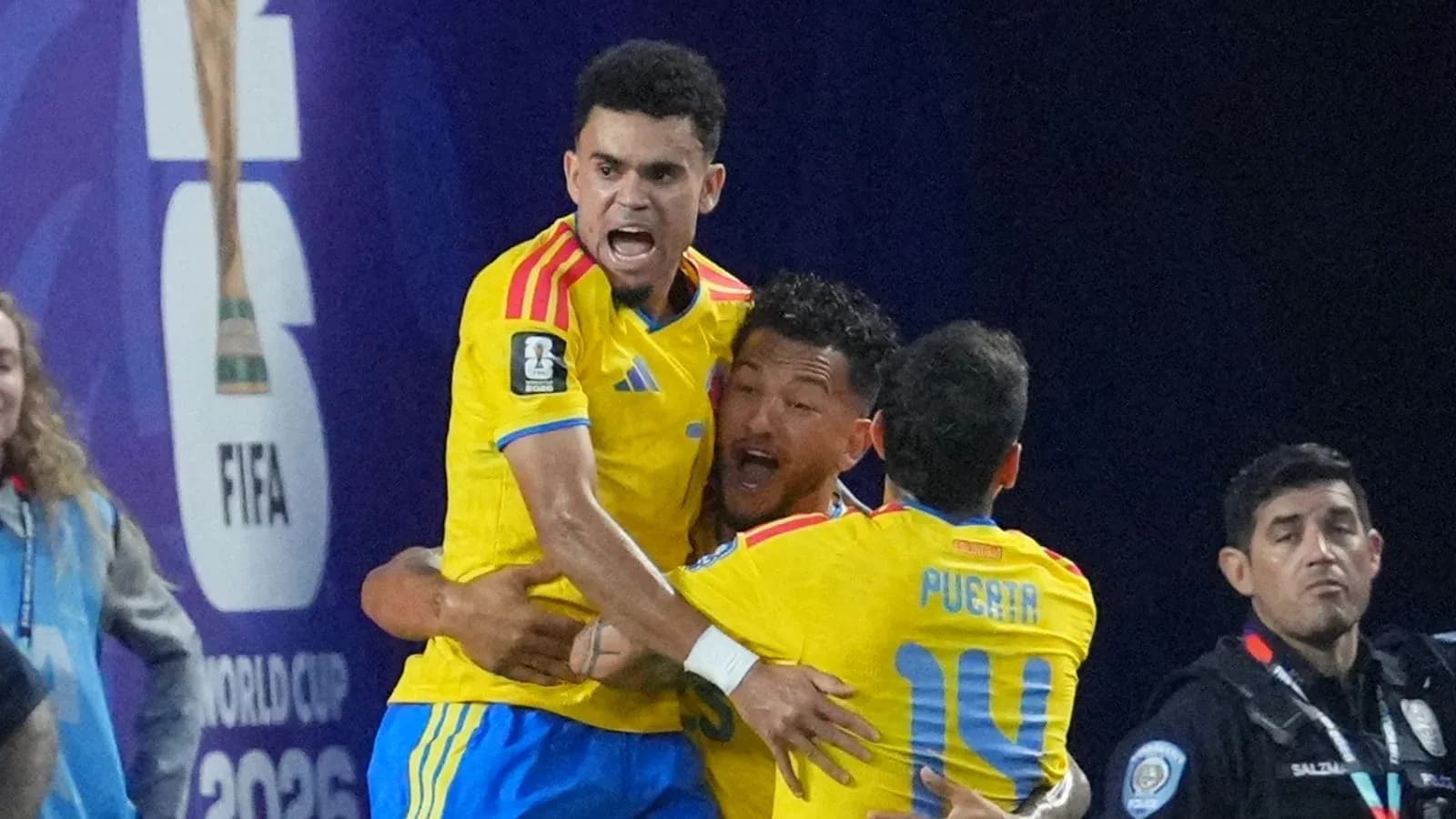
The decisive phase came early. Lorenzo made an aggressive in-game adjustment in the eighth minute, with Luis Javier Suárez (IN) coming on for Jhon Córdoba (OUT). This shifted Colombia’s front line profile: Suárez offered more mobility into channels and between lines, complementing Luis Díaz’s wide threat and James Rodríguez’s playmaking from the right half-space. Within six minutes the tweak paid off. In the 14th minute, Jhon Arias timed a forward run from midfield to perfection, finishing a move assisted by Suárez for the game’s only goal. It was emblematic of Colombia’s plan: midfielders breaking beyond the forwards against Ghana’s back line, exploiting gaps either side of Thomas Partey.
Colombia’s Structure
Structurally, Colombia’s 4-3-3 was very stable. Gustavo Puerta held a deeper role to connect the centre-backs Davinson Sánchez and Jhon Lucumí with midfield, allowing Jefferson Lerma and Arias to operate as advanced eights. With Johan Mojica and Daniel Muñoz pushing high from full-back, Colombia often morphed into a 2-3-5 in possession, pinning Ghana’s wide midfielders and full-backs into a low block. The passing numbers underline this control: 586 total passes, 532 accurate at 91% completion. That volume and precision allowed Colombia to recycle attacks, maintain pressure, and prevent Ghana from stringing together meaningful counters.
Ghana’s Formation
Ghana’s 4-1-4-1 under Queiroz was designed for compactness and counter-attacks, but it rarely translated into threat. Partey anchored in front of the back four, with Caleb Yirenkyi and Kwasi Sibo as central midfielders ahead of him, and Iñaki Williams and Antoine Semenyo nominally wide behind Jordan Ayew. However, Colombia’s sustained possession forced Ghana’s wide men into deep defensive positions, often leaving Ayew isolated against Sánchez and Lucumí. With only 39% possession and 376 passes (312 accurate, 83%), Ghana struggled to progress the ball centrally and were pushed into longer, lower-percentage passes that Colombia’s centre-backs and Puerta handled comfortably.
Shot Profile
The shot profile is revealing. Colombia produced 20 total shots, 12 inside the box and 4 blocked, reflecting repeated entries into dangerous central zones. Ghana, by contrast, managed just 8 shots overall, only 2 inside the box, and none on target. This speaks both to Colombia’s counter-press and rest-defence: when they lost the ball, Lerma and Puerta were quick to close down Ghana’s first pass, while the back four held an aggressive line to compress space. Ghana’s inability to work even a single effort on target meant Camilo Vargas (Colombia) did not have to make a save; the defensive unit protected him so effectively that his “goals prevented” value of 1.92 stems from the modelled danger of Ghana’s few situations rather than actual shots to stop.
Goalkeeping Performance
At the other end, Lawrence Ati Zigi (Ghana) was central to keeping the game alive. Colombia recorded 8 shots on goal, yet only one found the net, with Ati Zigi credited with 7 saves. His 1.92 goals prevented figure matches Colombia’s xG, underlining how often he bailed out a stretched defensive line. Ghana also blocked 5 shots, indicating a last-ditch, box-protecting posture once Colombia broke through the midfield screen. Without that combination of goalkeeping and emergency defending, the scoreline could have reflected Colombia’s territorial and statistical dominance more emphatically.
In-Game Management
Lorenzo’s in-game management continued to reinforce control rather than chase more goals recklessly. At 46', James Rodríguez (OUT) made way for Richard Ríos (IN), a move that added fresh legs and defensive balance in midfield to protect the lead and sustain Colombia’s press. Later, at 73', Arias (OUT) was replaced by Juan Fernando Quintero (IN), shifting the emphasis slightly more towards ball retention and tempo management through Quintero’s passing. Finally, at 90', Díaz (OUT) was substituted for Jaminton Campaz (IN), a late adjustment to add energy and secure the left flank as Ghana pushed bodies forward.
Ghana's Substitutions
Queiroz’s substitutions for Ghana were aimed at injecting pace and direct threat into a blunt attack. At 13', Marvin Senaya (OUT) was replaced by Alidu Seidu (IN), an early defensive adjustment on the right. At 62', Williams (OUT) made way for Abdul Fatawu Issahaku (IN), and Sibo (OUT) was replaced by Elisha Owusu (IN), an attempt to refresh both the right flank and central midfield. Later, at 79', Ayew (OUT) was substituted by Ernest Nuamah (IN), and Yirenkyi (OUT) by Prince Kwabena Adu (IN), further emphasizing speed and verticality. Yet Colombia’s structure and compactness meant these changes yielded little in terms of clear chances.
Discipline and Cards
Discipline also shaped the rhythm. The match produced five yellow cards: Colombia 2, Ghana 3, total 5. Chronologically, the bookings were:
- 12' Jhon Arias (Colombia) — Tripping
- 49' Caleb Yirenkyi (Ghana) — Holding
- 66' Abdul Fatawu Issahaku (Ghana) — Unsportsmanlike conduct
- 76' Alidu Seidu (Ghana) — Tripping
- 78' Richard Ríos (Colombia) — Tripping
These cards, particularly Ghana’s trio, reflected a side increasingly forced into reactive defending and tactical fouls to break Colombia’s flow or stop transitions.
Key Moment
A key moment in the second half came at 56', when a potential goal by Luis Díaz for Colombia was disallowed by VAR for offside. Tactically, it highlighted once more how Colombia were able to get runners in behind Ghana’s back line, even if the timing was marginal. The disallowed strike served as a warning rather than a turning point; Colombia continued to control territory and tempo without overexposing themselves.
Statistical Verdict
Statistically, the verdict is clear. Colombia’s 2.18 xG to Ghana’s 0.26, combined with an 8–0 advantage in shots on target and a 586–376 edge in total passes, paints the picture of a knockout match managed on Colombian terms from start to finish. The single goal margin owed much to Ati Zigi’s (Ghana) 7 saves and Ghana’s 5 blocked shots, but the underlying performance metrics and tactical patterns point to Colombia as the more coherent, proactive, and structurally superior side throughout the 90 minutes.