.svg&w=384&q=75 "GoalGist logo")
Celtic's European Nightmare: McGregor's Scathing Reaction
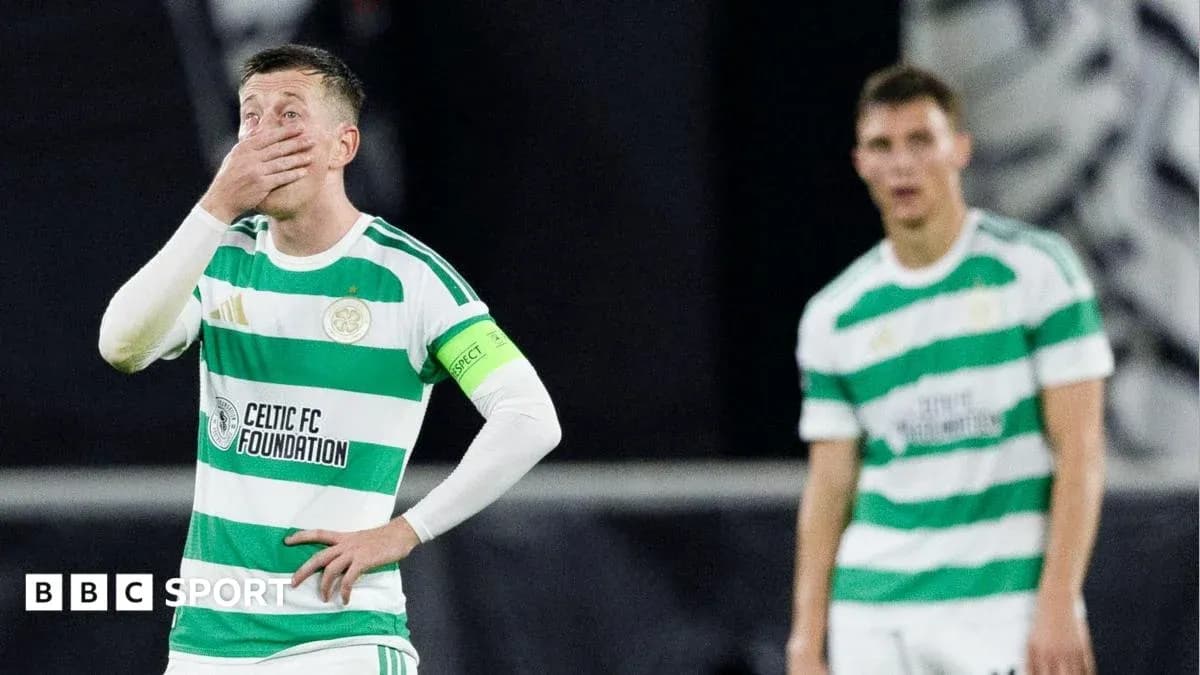
Callum McGregor has lived through most of Celtic’s modern European nightmares, but rarely has he sounded as scathing as he did in Linz.
In the aftermath of a 5-1 defeat to LASK that shredded a 4-0 first-leg advantage and dumped Celtic out of the Champions League, the captain did not reach for excuses or clichés. He went for the jugular.
“Passive.” “Scared.”
Words no pundit could sharpen more brutally than McGregor did himself. Words aimed squarely at his own dressing room.
A captain at boiling point
McGregor has been Celtic’s constant for close to a decade. Trophies, titles, domestic dominance – all of it. But he has also been there for the humiliation tour of Europe.
He played when Celtic failed to score in 210 minutes against Kairat Almaty and then contrived to miss three of five penalties in the shootout. He was on the pitch for the 7-1 against Borussia Dortmund, the 6-0 against Atletico Madrid, the 7-1 against PSG, the 7-0 against Barcelona. He lived through Champions League exits to Midtjylland, Ferencvaros, AEK Athens, Cluj, and the 4-1 double dose from Sparta Prague.
He carries medals. He carries scars.
But this? Losing a 4-0 lead? This was a different kind of wound.
McGregor did not rant. That is not his way. He spoke calmly, which only made the anger more cutting. He talked about fear. About players panicking when the heat rose. About professional pride being trampled in front of Europe.
“Now we’ll see what people are made of,” he said. A challenge, and an accusation.
From cruise control to collapse
The collapse is even more staggering when you retrace the opening act in Austria.
McGregor himself scored the first goal of the night, his shot deflecting in to make it 1-0 on the evening and 4-0 on aggregate. LASK had started brightly, just as they had in Glasgow, but that goal looked like a punch to the gut. Two games, countless chances, and they were four down.
How many blows can a team absorb before they fold? As it turned out, LASK were nowhere near finished. Celtic helped them back to their feet.
A week earlier, Celtic’s attacking verve and slick finishing had been hailed. There was an assumption – wildly optimistic, as it proved – that there was steel behind the swagger. Once Benjamin Nygren rolled a hopelessly loose pass straight into trouble and LASK seized on it for the equaliser on the night, the first tremors appeared.
Thirty-two minutes played. Celtic 4-1 up on aggregate. And yet they did not look remotely settled. That, in itself, was alarming.
Three minutes into the second half, the legs began to wobble properly. Auston Trusty was muscled off the ball, brushed aside far too easily, and LASK made it 4-2. The Americans’ struggles became a flashing target for the Austrians. They went after him, and Celtic could not protect him.
Ten minutes later, the third LASK goal arrived. Panic was now coursing through too many areas of the Celtic team. This was no longer a slow bleed. It was a quickening collapse.
Rabbits in headlights
Players who had sparkled in Glasgow simply disappeared in Linz. Camilo Duran, so influential in the first leg, was reduced to a spectator. Kasper Hogh ran and chased but left no imprint on the game. Passes went astray. Attacks broke down. Celtic lost their shape and, with it, their nerve.
They looked lost. Not just under pressure, but overwhelmed by it.
McGregor tried to drag some composure out of the chaos, but even he could not cut through the tension. LASK sensed the fear and kept coming.
On the touchline, Martin O’Neill looked as if the night was ageing him in real time. He would later call it one of the worst evenings of his football life and accept responsibility. He was right to do so, but he was not alone in failure.
He emptied his bench, making five substitutions in 12 frantic minutes, an attempt to stop the bleeding. Nothing changed. The tide did not turn. Celtic did not muster a single shot on target in the second half of normal time or in extra-time.
They were not competing. They were clinging on.
The numbers of a rout
LASK’s fourth goal, which dragged the tie level on aggregate in the 90th minute, had been coming for a long time. By then, the Austrians had racked up 33 shots on Celtic’s goal, and would finish on 40 across the night, to add to the 20 they had in Glasgow.
That is not a contest. That is a siege.
Cameron Carter-Vickers hobbled through the closing stages. Hogh did the same. Celtic were trying to repel wave after wave with a makeshift back four of Anthony Ralston, Dane Murray, Trusty and Liam Scales in a match worth around £40m.
It looked exactly like what it was: a club under-resourced for this level, exposed under the harshest lights.
The fifth LASK goal felt almost merciful in its inevitability, another Celtic error at the worst possible moment. This time it was Luke McCowan caught out, joining Nygren and Trusty on a grim roll call of decisive mistakes. Hapless, helpless – and out.
The game drifted to a conclusion that felt both shocking and entirely predictable. LASK even missed a penalty that would have made it 6-1 before Miguel Freckleton, once of St Mirren, slalomed through a shredded Celtic defence and briefly threatened to deepen the humiliation.
Freckleton deserves credit for grasping his moment in Austria. But the fact that he looked, in flashes, like a major attacking force in his short cameo told its own story about Celtic’s disintegration.
Old failings, new scars
By the end, Celtic were not just beaten. They were spooked, overpowered, outfought, outplayed.
The slick, ruthless side that cut LASK apart in Glasgow now looked like a mirage, a trick of the light that concealed a soft underbelly. Nobody could reasonably have forecast a 4-0 advantage turning to dust in this way, but the pattern of previous European failures meant the warning signs were always there.
The squad issues are not a secret. Celtic need a back-up left-back to Kieran Tierney. They do not have one. They need a physical presence in the middle of the pitch, a midfielder with stature and bite who will not be bullied as they were in Austria. They do not have that either.
Deals have been done this summer, some of them smart, but not nearly enough. The club sits in net profit in the transfer market while fielding a patched-up defence in a season-defining Champions League qualifier.
Ambition, that awkward word, will dominate the inquest again. When a club of Celtic’s size finishes a tie of this magnitude with Ralston, Murray, Trusty and Scales as its back four, something has gone badly wrong in planning as well as performance.
The cost is not only financial, though the loss of Champions League money is vast. It cuts into self-worth, into belief, into the sense that the club is learning from its past.
They thought they had moved on from the days when Kairat, Midtjylland, Ferencvaros, Cluj and AEK Athens handed out European bruises. They believed those nights belonged to a previous era.
Now another name is etched onto that list. LASK join the gallery of ghosts. The question for Celtic is how many more it will take before something truly changes.