.svg&w=384&q=75 "GoalGist logo")
Canada and Bosnia & Herzegovina Draw 1-1: Tactical Analysis
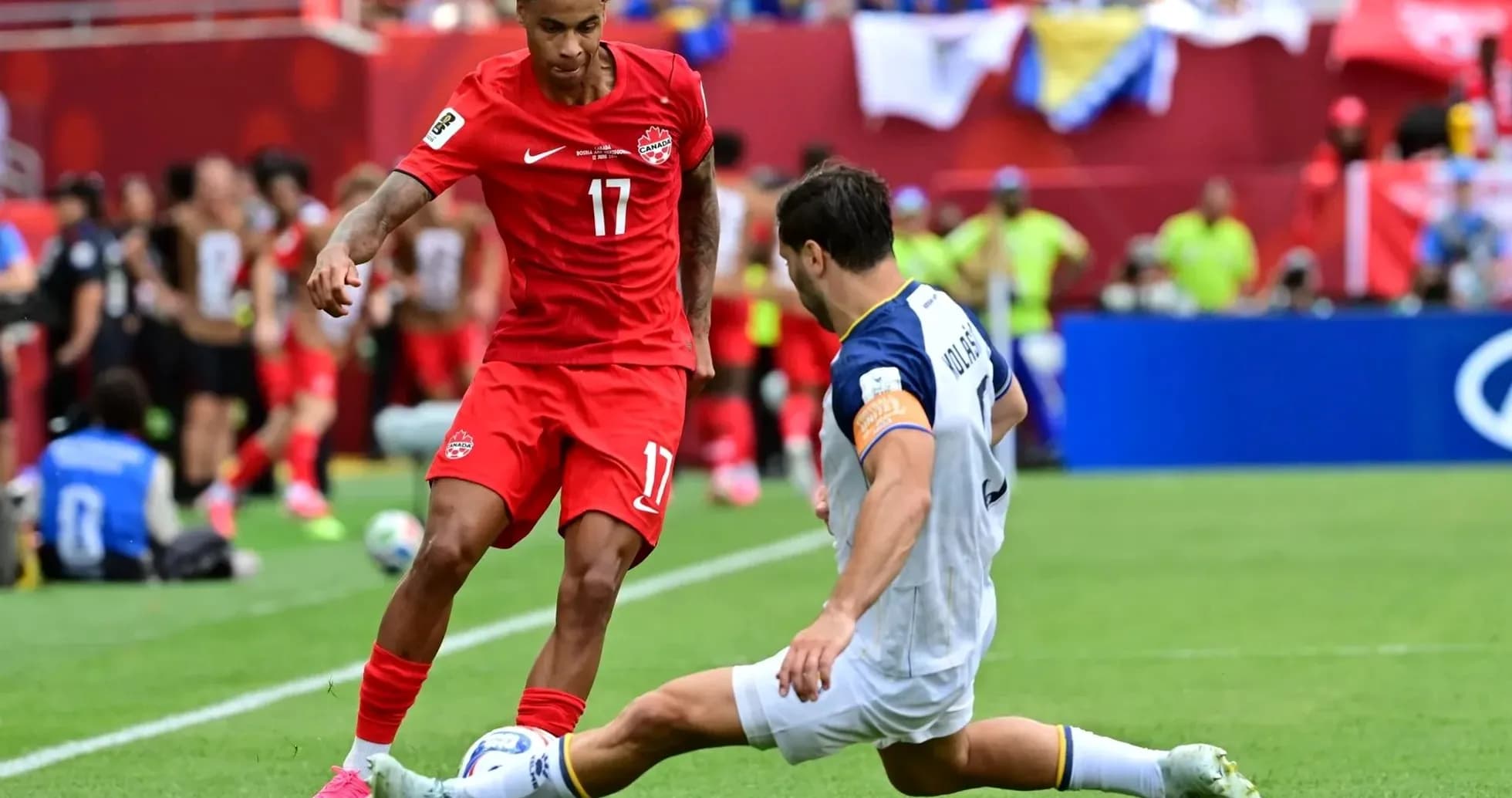
Canada’s 1-1 draw with Bosnia & Herzegovina at BMO Field unfolded as a tactical arm-wrestle between two nominal 4-4-2s that behaved very differently with and without the ball. Canada, under Jesse Marsch, imposed a proactive, front-foot structure built on width and high volume crossing, while Sergej Barbarez’s Bosnia & Herzegovina leaned into a compact, foul-heavy low-to-mid block and direct transitions.
Out of possession, Canada’s 4-4-2 morphed into an aggressive 4-2-4 press. The front pair, Jonathan David and Tani Oluwaseyi, worked to lock play to one side, with the ball-near wide midfielder jumping high to Bosnia & Herzegovina’s full-back. Behind them, Stephen Eustaquio and Ismael Koné held a relatively high double pivot line to compress space and sustain pressure after turnovers. This approach is reflected in the territorial dominance: 61% possession, 415 passes with 310 accurate (75%), and 9 corners to 4.
The trade-off was transitional vulnerability, and Bosnia & Herzegovina’s opener at 21’ captured that. From a deeper base, the visitors looked to play early into the front two, Ermedin Demirović and Jovo Lukić, or into the channels for wide midfielders Esmir Bajraktarević and Amar Memić. Sead Kolašinac’s advanced involvement in the assist for Lukić’s goal underlined Bosnia & Herzegovina’s willingness to let a full-back break the line when the opportunity arose, even from a generally conservative shape.
With the ball, Canada’s full-backs, Richie Laryea and Alistair Johnston, provided the primary width. The midfield four often narrowed, with Liam Millar and Tajon Buchanan stepping into half-spaces, allowing overlapping runs outside. Canada’s shot profile supports this: 13 total shots, 10 from inside the box, and 4 blocked. They were able to reach the penalty area frequently, but Bosnia & Herzegovina’s central block, led by Nikola Katić and Tarik Muharemović, forced many efforts under pressure.
Bosnia & Herzegovina’s 4-4-2 was far more rigid. The wide midfielders dropped to form a clear second line of four, and the front two were tasked more with screening passes into Eustaquio than with high pressing. Their 270 passes (172 accurate, 64%) and only 8 total shots show a side content to cede the ball and defend deep. The foul count – 20 to Canada’s 10 – was a tactical tool as much as a disciplinary issue, repeatedly breaking Canada’s rhythm and slowing transitions.
Substitutions and Tactical Shifts
The match’s inflection point came with Canada’s triple substitution on 61’. Promise David (IN) came on for Jonathan David (OUT), Ali Ahmed (IN) came on for Tajon Buchanan (OUT), and Jacob Shaffelburg (IN) came on for Liam Millar (OUT). Marsch effectively refreshed all three attacking lanes behind and alongside Oluwaseyi, injecting pace, directness, and fresh pressing energy. Bosnia & Herzegovina responded with their own double change at 62’, Samed Baždar (IN) for Jovo Lukić (OUT) and Armin Gigović (IN) for Ivan Bašić (OUT), aiming to add legs in midfield and a different profile up front, but the initiative had already tilted.
From that moment, Canada’s 4-4-2 almost resembled a 4-2-4 siege. The new wide players, Shaffelburg and Ahmed, held very high starting positions, effectively pinning Bosnia & Herzegovina’s full-backs. This created repeated 2v1s on the flanks with Laryea and Johnston overlapping. The outcome was a sustained wave of entries into the box, captured by the xG figures: Canada at 1.25 versus Bosnia & Herzegovina’s 0.98. The volume and quality of Canada’s chances were finally rewarded at 78’, when Cyle Larin, introduced at 76’ as Tani Oluwaseyi (OUT) made way, finished from a Promise David assist. That goal was the direct product of the substitution pattern: fresh striker, fresh wide runner, and a tiring Bosnian back line forced to defend deeper and narrower.
Defensively, Canada’s back four held a relatively high line, trusting Derek Cornelius and Luc De Fougerolles to manage Bosnia & Herzegovina’s forwards in duels. The two Canadian yellow cards – Alistair Johnston at 11’ and De Fougerolles at 53’, both for “Foul” – underline the cost of that aggressive posture: stepping in late when pressing traps were broken. Bosnia & Herzegovina’s three yellows (Demirović 44’, Lukić 45+1’, Katić 90+3’, all “Foul”) map neatly onto their strategy of repeated contact defending, especially as Canada increased the tempo in the second half.
In goal, Maxime Crépeau (Canada) was asked to do relatively little in pure shot-stopping terms, recording 2 saves, consistent with Bosnia & Herzegovina’s 3 shots on goal and 8 total shots. His main contribution was in build-up, providing an extra passing option to help Canada circulate under limited Bosnian pressure. At the other end, Nikola Vasilj (Bosnia & Herzegovina) made 1 save despite Canada’s 4 shots on goal. The discrepancy between Canada’s shot volume and Vasilj’s save count highlights how many efforts were blocked by defenders rather than reaching the goalkeeper, reinforcing the picture of a compact, last-ditch block in front of him.
Statistically, the draw feels slightly underwhelming for Canada given their control. Their 61% possession, superior passing accuracy, and higher xG underline a game-state where they dictated terms for long stretches, especially after the hour mark. Bosnia & Herzegovina, by contrast, maximized a lower-volume approach: fewer shots, fewer passes, but a clinical early strike and disciplined, if foul-heavy, defensive organization.
From a broader tactical lens, this match showcased a clear identity for both sides. Canada demonstrated a high-tempo, wing-driven 4-4-2 capable of generating box entries and sustained pressure, but still searching for sharper final-third efficiency. Bosnia & Herzegovina showed they can be structurally resilient in a low-possession game, using tactical fouls and compact spacing to frustrate more proactive opponents and extract value from limited attacking phases. The 1-1 scoreline at BMO Field ultimately reflects Canada’s territorial and chance superiority balanced against Bosnia & Herzegovina’s early incision and defensive stubbornness.