.svg&w=384&q=75 "GoalGist logo")
Burnley vs Aston Villa: Tactical Insights from a 2-2 Draw
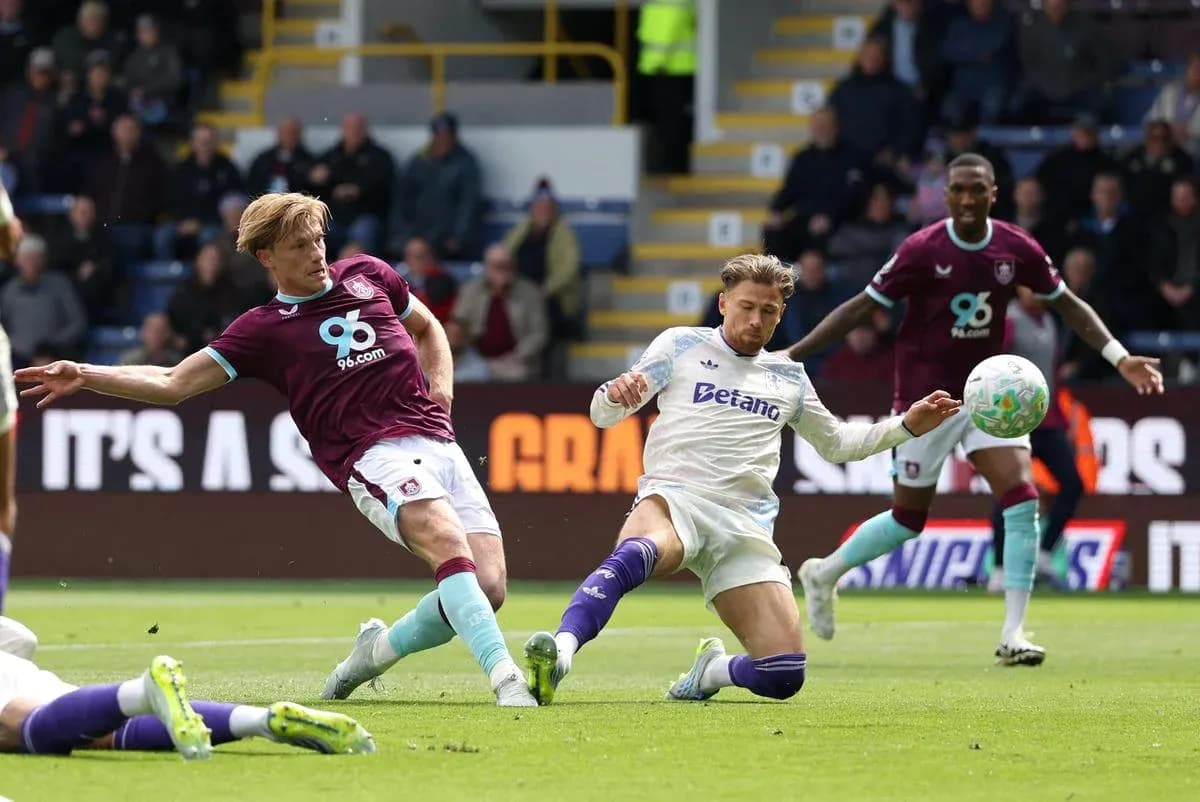
On a grey May afternoon at Turf Moor, Burnley and Aston Villa produced a 2-2 draw that felt like a snapshot of their entire Premier League seasons: one side clawing for survival, the other straining for European certainty, both revealing their structural strengths and flaws over 90 tense minutes.
I. The Big Picture – Context and Seasonal DNA
Following this result, Burnley remain 19th in the Premier League table on 21 points, deep in the relegation places. Their overall numbers frame the scale of the task: across 36 league matches they have won 4, drawn 9 and lost 23, scoring 37 and conceding 73. That goal difference of -36 is exactly the product of a fragile defensive structure leaking 2.0 goals per game overall, while only scoring 1.0.
At home, the picture is only marginally better. Across 18 league fixtures at Turf Moor they have 2 wins, 6 draws and 10 defeats, with 17 goals for and 28 against. The averages are stark: 0.9 goals scored at home per game, 1.6 conceded. Turf Moor has not become the fortress they needed; it has been a place of resistance rather than dominance.
Aston Villa, by contrast, arrive at this stage of the season with a very different profile. They sit 5th with 59 points, chasing Champions League qualification. Overall they have 17 wins, 8 draws and 11 defeats from 36 games, with 50 goals scored and 46 conceded. Their overall goal difference of +4 is modest for a top-five side, but it underlines a team that can outscore opponents without being defensively watertight.
On their travels, Villa’s record is balanced: 6 wins, 6 draws and 6 defeats away from home, with 22 goals for and 26 against. The away averages — 1.2 goals scored and 1.4 conceded per game — describe a side that tends to be involved in tight contests, often decided by the sharpness of their attacking stars.
Both teams set up here in a 4-2-3-1, a mirror that turned the afternoon into a tactical duel of double pivots and roaming No.10s.
II. Tactical Voids – Absences and Discipline
Burnley’s squad was stretched by key absences. J. Beyer (hamstring injury), J. Cullen (knee injury) and C. Roberts (muscle injury) were all ruled out. In structural terms, that removed a natural centre-back option, a metronomic midfielder, and a full-back with energy and delivery. It forced Mike Jackson to lean heavily on A. Tuanzebe and M. Esteve at the heart of defence, with K. Walker and Lucas Pires as the full-backs, and to entrust central control to Florentino and L. Ugochukwu.
For Aston Villa, Unai Emery had to navigate without Alysson (muscle injury), B. Kamara (knee injury) and A. Onana (calf injury). The loss of Kamara, in particular, stripped Villa of a natural screening midfielder, pushing V. Lindelof into a holding role alongside Y. Tielemans. That adjustment subtly shifted Villa’s balance: more passing from deep, less pure ball-winning.
Season-long disciplinary trends added another layer. Burnley’s yellow cards show notable spikes in the 16-30 and 76-90 minute ranges, both at 19.67%. This is a team that often starts edgy once the game settles and then finishes under pressure, with late-game tackles and recovery runs leading to bookings. Their red card profile is spread almost evenly across 31-45, 76-90 and 91-105 minutes (each 33.33%), reinforcing the sense of a side that can lose control in key phases, especially as fatigue and desperation bite.
Villa’s yellows cluster heavily between 46-60 minutes, where 29.09% of their bookings arrive, and they also show a significant 18.18% in 91-105. This hints at a team that raises intensity immediately after half-time and then again in closing stages. Their single red card has come in the 61-75 window (100.00% of their reds), a warning that mid-second-half surges can sometimes tip over into rashness.
III. Key Matchups – Hunter vs Shield, Engine Room Battles
The headline attacking duel was between two of the league’s more influential forwards: O. Watkins for Villa and Z. Flemming for Burnley.
Watkins, with 12 league goals and 2 assists in 35 appearances, is Villa’s cutting edge. His 51 shots, 31 on target, speak to a striker who consistently finds good positions. Against a Burnley defence that has conceded 73 goals overall — including 28 at home — his movement between the lines and down the channels was always going to be pivotal. With Burnley allowing 2.0 goals per game overall, the “Hunter vs Shield” equation tilted towards Villa’s No.11.
Flemming, though listed as a midfielder, plays like Burnley’s talismanic second striker. With 10 league goals from 27 appearances and 2 penalties scored from 2 attempts, he carries a ruthless streak in a side that otherwise struggles for goals. His 37 shots (20 on target) and 251 duels, with 102 won, show a player who both initiates attacks and fights to sustain them. Up against E. Konsa and T. Mings, Flemming’s ability to find pockets behind Y. Tielemans and around Lindelof’s zone was central to Burnley’s plan.
In the engine room, the duel was defined by contrasting profiles. For Burnley, Florentino and L. Ugochukwu offered screening and simple progression, tasked with protecting a defence that has kept only 4 clean sheets overall, all at home. For Villa, Tielemans and Lindelof brought more technical security, setting the platform for M. Rogers and J. McGinn to roam.
Rogers, in particular, is Villa’s creative hub: 9 goals and 5 assists across 36 appearances, with 1033 passes and 43 key passes. He dribbles aggressively — 117 attempts, 41 successes — and draws 49 fouls. His duel with Burnley’s deeper block, and with Walker’s aggressive defending on the flank, was a constant tactical thread. Walker himself is a defensive pillar for Burnley: 53 tackles, 10 blocked shots and 43 interceptions, plus 9 yellow cards that underline his willingness to operate on the edge.
From the bench, both sides had game-changers. Burnley could turn to J. Ward-Prowse for set-piece precision, A. Broja or L. Foster for direct running, and J. Bruun Larsen or Z. Amdouni for more fluid attacking shapes. Villa’s substitutes — L. Bailey, T. Abraham, E. Buendia and J. Sancho — offered Emery a complete reshaping of the front line if needed, from pace in behind to creative overloads between the lines.
IV. Statistical Prognosis – xG Logic and Defensive Solidity
Even without explicit xG values, the underlying numbers point towards a clear pre-match expectation. Heading into this game, Villa’s attack, averaging 1.4 goals per game overall and 1.2 on their travels, faced a Burnley defence conceding 2.0 overall and 1.6 at home. That gap strongly suggested Villa would generate the higher quality chances, particularly through Watkins and Rogers attacking a back line that has already suffered heavy defeats both home and away.
Burnley’s path to a result was always going to be narrow but defined: compress space in their own third, lean on the shot-stopping of M. Weiss, and rely on Flemming’s penalty-box instincts and the creative flashes of L. Tchaouna, H. Mejbri and J. Anthony behind him. Their 13 matches failing to score overall, including 9 at home, show how often that attacking plan has broken down; yet when it clicks, as here in a 2-2 draw, it hints at a side capable of punching above their weight in single games even if not across a season.
For Villa, the structural concern remains defensive looseness. Conceding 46 goals overall — 1.3 per game — and 26 away (1.4 per game) leaves them vulnerable to exactly the kind of chaotic exchanges Burnley thrive on when the game becomes stretched. Their reliance on a high-intensity 4-2-3-1, with full-backs like M. Cash and I. Maatsen pushing high, can leave gaps that a well-timed Flemming run or a Ward-Prowse set piece can exploit.
Following this result, the numbers and the narrative align: Villa are still the side with the clearer upward trajectory, their top-end quality embodied by Watkins and Rogers. Burnley, however, showed that even with a -36 goal difference and a season of struggle, a disciplined 4-2-3-1 and a defiant core — Walker’s edge, Flemming’s finishing, Weiss’s presence — can still bend the script on any given afternoon at Turf Moor.