.svg&w=384&q=75 "GoalGist logo")
Australia Dominates Türkiye in World Cup Opener
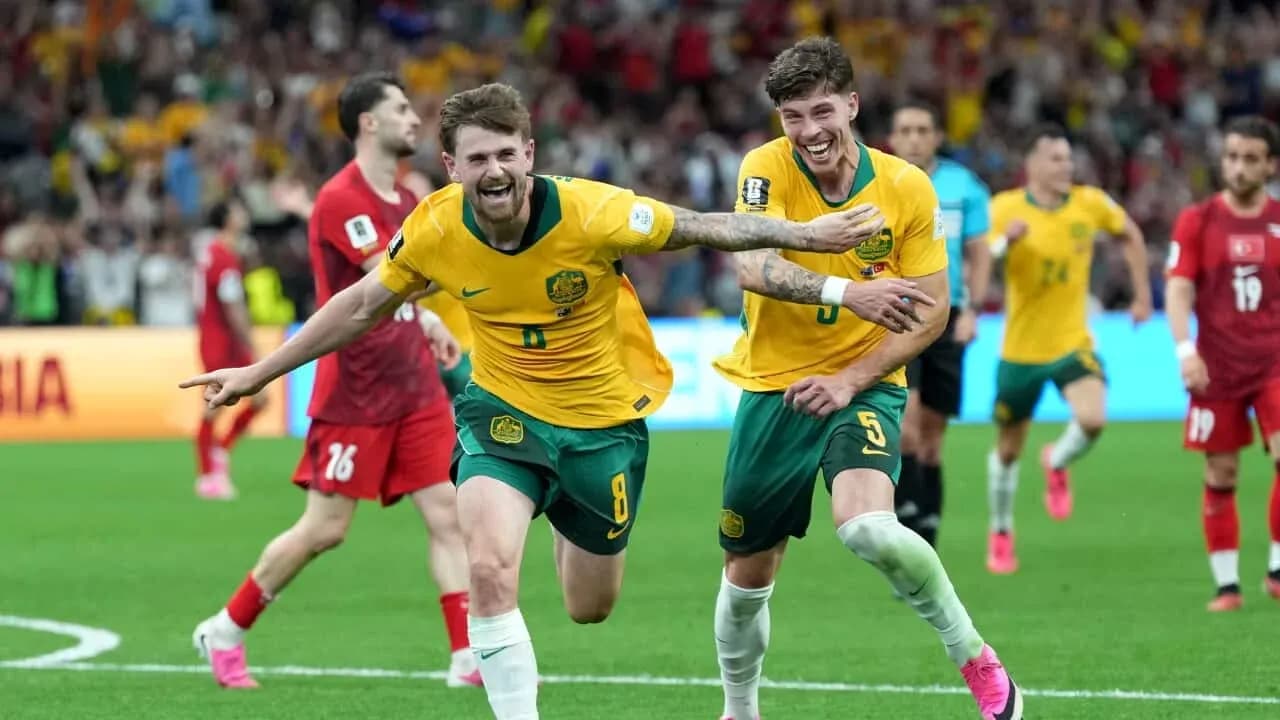
BC Place in Vancouver hosted a quietly defining World Cup night as Australia’s new‑look generation opened Group D with a controlled 2-0 win over Türkiye. Following this result, the standings snapshot is stark: Australia sit 2nd in Group D on 3 points with a goal difference of +2 (2 scored, 0 conceded), while Türkiye are 3rd with 0 points and a goal difference of -2 (0 scored, 2 conceded). It is early, but the seasonal DNA of both sides is already visible.
Australia’s campaign so far is built on clarity. Overall they have played 1 match, won 1, drawn 0, lost 0, scoring 2 and conceding 0. At home in this World Cup data frame, they have played 1, won 1, with 2 goals for and 0 against, an average of 2.0 goals for and 0.0 against at home. The clean sheet total is 1, and they have yet to fail to score. Türkiye, by contrast, have begun on their travels: 1 match away, 1 defeat, 0 goals scored and 2 conceded, averaging 0.0 goals for and 2.0 against away, with no clean sheets and 1 match where they failed to score.
I. The Big Picture: Structures and Intent
Tony Popovic’s Australia lined up in a 5-4-1 that was anything but passive. Patrick Beach anchored the side in goal, shielded by a back five of Jordan Bos, Cameron Burgess, Harry Souttar, Alessandro Circati and Jacob Italiano. In front, a narrow but industrious midfield band of Nestory Irankunda, Paul Okon-Engstler, Aiden O’Neill and Connor Metcalfe supported lone forward Mohamed Touré.
The shape told its story: three centre-backs to dominate aerially and protect central zones, wing-backs Bos and Italiano ready to explode into the wide channels, and a front five in possession when Irankunda stepped high alongside Touré. Australia’s season data underlines the plan: one match, one use of 5-4-1, a 2-0 home win as their biggest result. The system is not an experiment; it is the blueprint.
Vincenzo Montella’s Türkiye answered with a 4-2-3-1, nominally more progressive. Uğurcan Çakır started in goal behind a back four of Ferdi Kadıoğlu, Abdülkerim Bardakcı, Merih Demiral and Zeki Çelik. İsmail Yüksek and Hakan Çalhanoğlu formed the double pivot, with an attacking line of Barış Alper Yılmaz, Orkun Kökçü and Arda Güler behind striker Kerem Aktürkoğlu. On paper, this is a side built to dominate the ball and attack between the lines. In practice, the structure ran repeatedly into Australia’s compact 5-4-1 wall.
II. Tactical Voids and Discipline
There is no explicit injury or suspension list in the data, so the voids are structural rather than personnel-based. For Australia, the risk in a 5-4-1 is obvious: if Bos and Italiano are pinned back, Touré can become isolated and the midfield four can be outnumbered centrally. Yet Popovic mitigated this by trusting Okon-Engstler and O’Neill to slide laterally and compress half-spaces, turning the midfield into a shifting box.
Türkiye’s tactical void was more damaging. The 4-2-3-1 demands a stable platform from the double pivot, but with Australia defending deep and narrow, Çalhanoğlu and Yüksek were often forced to receive with their backs to goal, facing a dense midfield line. The lack of a true holding destroyer to break Australian transitions left the back four repeatedly exposed when Irankunda and Bos surged forward.
Disciplinary patterns underline the frustration. Türkiye’s season card data shows 1 yellow card, and crucially, a late spike: 100.00% of their yellow cards have arrived in the 76-90 minute window. Yunus Akgün embodies that edge. Off the bench, he logged 35 minutes, committed 1 foul, and was booked once. He is simultaneously Türkiye’s top yellow-card holder and listed among the top red-card profiles, but the match data confirms: 1 yellow, 0 reds. There is no red card; any red-card label is statistical noise, not reality. For Australia, card distributions are blank across all time ranges, reinforcing a picture of controlled aggression and composure.
III. Key Matchups
Hunter vs Shield
The emerging “hunter” in this Australian side is Nestory Irankunda. Heading into this game he already stood out in the World Cup scoring charts: 1 appearance, 1 goal, 2 shots, both on target, and a rating of 7.5. He is not just a finisher but a direct carrier, with 1 successful dribble from 1 attempt and 7 total duels, of which he won 2. In this fixture, he repeatedly targeted the space behind Türkiye’s full-backs, especially when Ferdi Kadıoğlu pushed high.
Türkiye’s “shield” is collective rather than individual. Overall this campaign they have conceded 2 goals on their travels, with an average of 2.0 away goals against and no clean sheets. Demiral and Bardakcı are aggressive front-foot defenders, but the numbers and the eye test combine to show a unit that can be dragged wide and exposed by quick switches. Against a wing-back system that naturally stretches the pitch, that vulnerability was decisive.
Engine Room
If Irankunda is the spear, Paul Okon-Engstler is the engine. In his 84 minutes, he completed 32 passes with 81% accuracy, created 2 key passes and delivered 1 assist. Defensively he was outstanding: 3 tackles, 3 interceptions and 2 successful blocks. Those 2 blocks are not near-misses; they are fully successful interventions that broke up Turkish attacks at source. He is listed among the top assist providers in the competition, and his dual role as playmaker and ball-winner is the hinge of Popovic’s 5-4-1.
Across from him, Türkiye’s creative axis of Çalhanoğlu, Kökçü and Güler struggled to impose itself between the lines. Without season-long passing or xG data in the snapshot, the evidence is structural: a 4-2-3-1 that wants to play through the middle met a 5-4-1 designed to suffocate that very zone, with Okon-Engstler and O’Neill stepping out to press the receiving No.10 and wide creators.
IV. Statistical Prognosis and Tactical Verdict
In total this campaign, Australia’s metrics are clean and ruthless: 1 win from 1, 2 goals scored, 0 conceded, 1 clean sheet, 0 failed-to-score matches, and no penalties taken or missed. Türkiye’s overall picture is inverted: 1 defeat, 0 goals for, 2 against, no clean sheets, and 1 match where they failed to score. Penalties are a non-factor for both: 0 taken, 0 scored, 0 missed, so there is no hidden edge from the spot.
Without explicit xG numbers, the shape of the game and the existing data still support a clear tactical prognosis. Australia’s defensive solidity is not an accident; it is system-backed. A three-centre-back base, disciplined wing-backs and an engine room led by Okon-Engstler and O’Neill form a platform that, so far, has produced an average of 0.0 goals conceded in total and at home. Their attacking output of 2.0 goals per home game, driven by Irankunda’s vertical threat and Touré’s presence, suggests a side capable of striking efficiently rather than in volume.
Türkiye’s 4-2-3-1 has the names to hurt opponents, but the early campaign data exposes fragility: 2.0 away goals conceded on average, 0.0 scored, and a late-game disciplinary spike at 76-90 minutes that hints at frustration rather than controlled pressure. Yunus Akgün’s cameo — 21 passes at 90% accuracy, 2 key passes, 1 successful dribble, but also 1 foul and 1 yellow — is emblematic: talent, but channelled through a chasing-game scenario.
Following this result, the tactical balance of Group D tilts toward Australia. Their 5-4-1 is not just conservative; it is a launchpad for a young, aggressive front line, with Irankunda as the hunter and Okon-Engstler as the metronomic shield. Türkiye, for all their attacking midfield quality, must now re-engineer the protection in front of their back four if they are to turn possession into points and halt a defensive trend that, even at this early stage, is running against them.