.svg&w=384&q=75 "GoalGist logo")
Alaves Upset Barcelona 1-0 with Tactical Masterclass at Estadio Mendizorrotza
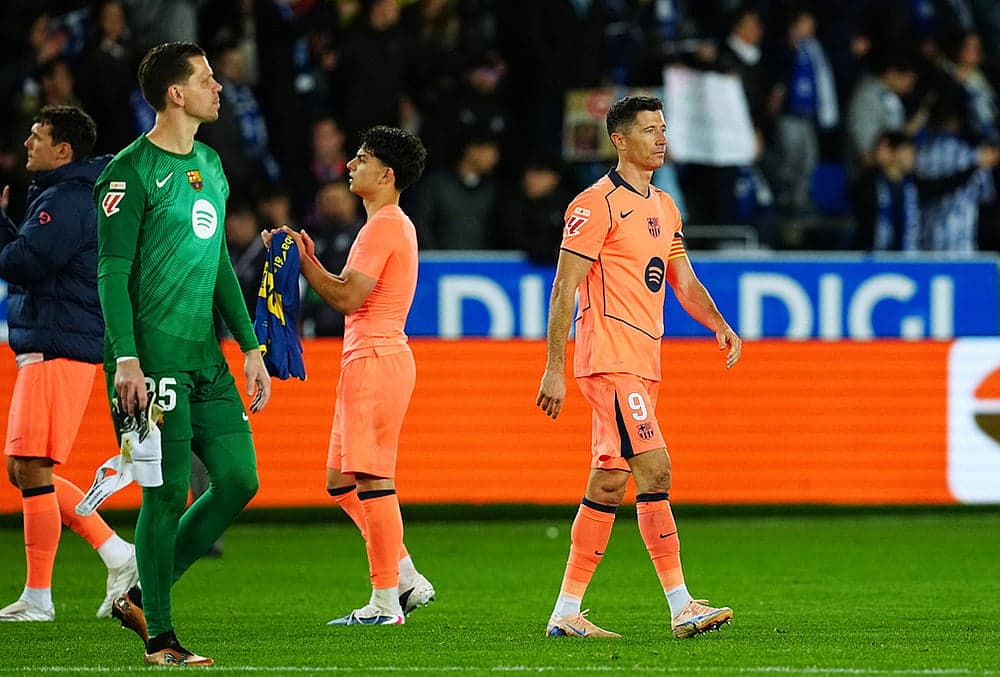
Alaves delivered a textbook low-block upset at Estadio Mendizorrotza, beating Barcelona 1-0 in La Liga’s Regular Season - 36 despite having just 23% of the ball. Quique Sanchez Flores’ 5-3-2 absorbed pressure, restricted box entries, and maximized transitions, while Hansi Flick’s 4-2-3-1 dominated territory but never translated 77% possession into a single shot on target. The decisive moment came on the stroke of half-time, when I. Diabate finished a rare but well-constructed attack. From there, Alaves managed the game with compact spacing and disciplined line management, forcing Barcelona into sterile circulation and speculative efforts from distance.
I. Scoring Sequence & Disciplinary Log
The match’s only goal arrived at 45'. A. Blanco broke Barcelona’s midfield line with a forward action, and I. Diabate (Alaves) converted — officially recorded as a Normal Goal assisted by A. Blanco. That strike set the half-time score at 1-0 to Alaves and ultimately decided the contest, with no further goals in the second period.
Discipline unfolded immediately after the interval. At 46', Marcus Rashford (Barcelona) received a Yellow Card — Foul, signalling early Barcelona frustration as they tried to chase the game. Alaves’ own caution came later: at 81', Abderrahman Rebbach (Alaves) was booked with a Yellow Card — Persistent fouling, reflecting his repeated defensive interventions on the flank in a system that required aggressive stepping out from the back five.
Barcelona’s final card arrived in the closing stages. At 89', João Cancelo (Barcelona) was shown a Yellow Card — Foul, underlining the away side’s increasing urgency and tactical fouling as they tried to recover possession quickly after losing the ball in advanced areas. In total, Alaves collected 1 yellow card, Barcelona 2, for a match total of 3 cautions and no reds.
II. Tactical Breakdown & Personnel
Flores set Alaves up in a 5-3-2 that was unapologetically space-oriented rather than ball-oriented. The back five of A. Rebbach, V. Parada, V. Koski, N. Tenaglia and A. Perez stayed narrow, protecting the central lane and the edge of the box. With Barcelona’s 4-2-3-1 built around R. Lewandowski as a reference and a line of three in R. Bardghji, D. Olmo and Marcus Rashford, Alaves’ priority was to deny between-the-lines reception.
The midfield trio of D. Suarez, A. Blanco and J. Guridi formed a tight triangle in front of the centre-backs. Their job was to screen passes into Lewandowski’s feet and to jump out selectively on Barcelona’s double pivot of M. Casado and M. Bernal. Alaves’ 190 passes, 112 accurate (59%), underline how little they cared for sustained possession; their structure was about compressing space, winning second balls, and then attacking quickly into the channels.
Up front, T. Martinez and I. Diabate worked as vertical runners rather than traditional target men. Diabate’s goal at 45' was emblematic: a direct exploitation of the space behind Barcelona’s high line once the first line of pressure was broken. With only 9 total shots (7 inside the box) and an xG of 0.66, Alaves were highly selective; when they did progress, they committed numbers to the box and attacked with purpose rather than volume.
Barcelona’s 4-2-3-1, under Hansi Flick, produced 676 passes, 605 accurate (89%), and 77% possession. Structurally, they had control: J. Kounde and A. Balde provided width from full-back, while P. Cubarsi and A. Cortes held a high rest-defence line to keep Alaves pinned. The double pivot tried to circulate quickly and draw out Alaves’ midfield three, creating pockets for D. Olmo and Rashford to receive between lines.
However, Alaves’ compactness meant Barcelona often recycled side-to-side without penetration. The key failure was in the final third: 8 total shots, 0 on target, and an xG of 0.59 show that most efforts were either from poor angles or well-contested zones. Lewandowski was frequently isolated, with crosses either blocked (3 blocked shots) or forced into crowded central areas.
The substitutions around 62' were a clear tactical adjustment. F. Torres (IN) came on for R. Bardghji (OUT), Pedri (IN) came on for M. Casado (OUT), and X. Espart (IN) came on for P. Cubarsi (OUT). Flick sought more creativity and line-breaking from Pedri and more direct threat from F. Torres, while X. Espart’s introduction rebalanced the back line. Later, J. Cancelo (IN) came on for A. Balde (OUT) at 79', adding an inverted full-back profile to overload central zones, and T. Marques (IN) replaced M. Bernal (OUT) at 87' for fresh legs in midfield.
Flores’ response was equally calculated. A. Manas (IN) replaced I. Diabate (OUT) at 64', trading a vertical runner for fresh defensive work and counter outlets. P. Ibanez (IN) for D. Suarez (OUT) at 64' and C. Protesoni (IN) for V. Parada (OUT) at 80' refreshed the midfield and back line to sustain the block’s intensity. The single yellow for Abderrahman Rebbach — Persistent fouling — reflects the strain placed on Alaves’ wide defenders, who repeatedly had to step out to confront Barcelona’s wide overloads.
In goal, A. Sivera’s statistical line is unusual: 0 Goalkeeper Saves but 0.12 goals prevented. This indicates that Barcelona’s few threatening actions were either off target or neutralized before requiring a formal save, with defensive interventions and pressure affecting shot quality. At the other end, W. Szczesny made 3 Goalkeeper Saves and also posted 0.12 goals prevented, keeping Barcelona in the game despite the decisive concession just before the break.
III. The Statistical Verdict
The xG battle — Alaves 0.66 vs Barcelona 0.59 — confirms how effectively Alaves translated limited possession into comparable, and slightly better, chance quality. Barcelona’s 77% possession and 676 passes, 605 accurate (89%), produced control but not incision; they failed to register a single shot on goal despite 8 attempts, underlining how Alaves’ deep block pushed them into low-probability shooting zones.
Alaves, with only 190 passes, 112 accurate (59%), and 9 total shots (7 inside the box), optimized their few attacking moments. Their 14 Fouls and 1 yellow card contrasted with Barcelona’s 8 Fouls and 2 yellows, reflecting a defensive game plan that accepted physicality and risk in specific zones. Corner Kicks (6 for Alaves, 4 for Barcelona) show that the hosts also leveraged set pieces as an attacking platform.
Overall, the numbers reinforce the tactical story: Alaves’ defensive index on the day outstripped Barcelona’s overall form with the ball. A compact 5-3-2, disciplined wide defending, and efficient counter-attacking sequences allowed Flores’ side to turn a low-possession game into a high-value 1-0 win at Estadio Mendizorrotza.