.svg&w=384&q=75 "GoalGist logo")
World Cup Highlights: Messi, Mbappe, and the Underdogs
The World Cup has finally caught fire.
The expanded 48‑team format arrived wrapped in scepticism, but the football has blown most of that away. Cape Verde trading punches with giants, Japan and Egypt refusing to bow, lower‑ranked sides turning group stages into ambush zones – the undercard has refused to behave like an undercard.
And then the headliners walked in.
Lionel Messi, Kylian Mbappe, Erling Haaland. Now Cristiano Ronaldo. The marquee names have not just turned up, they’ve taken over the storylines.
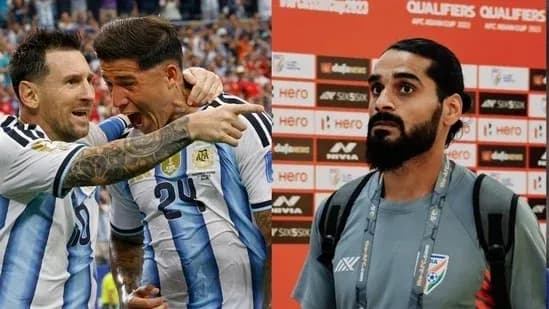
Amid it all, India defender Sandesh Jhingan, on duty as part of Zee5’s expert panel, has been watching closely. Speaking to Hindustan Times Digital, he cut through the noise around the tournament’s biggest characters and the teams driving this World Cup.
Messi at 39: “He makes you feel like a kid”
Five goals in two games. Braces, hat-tricks, and the same old No. 10 walking through defences as if time doesn’t apply to him.
For Jhingan, Messi’s genius at 39 starts with something that rarely makes the highlight reels: sheer, relentless consistency.
“The hardest thing to do, or the greatest talent you can have, is to have that consistency,” he said. Longevity at the very top, not for a year or two, but across a career that has spanned generations of teammates and opponents.
Jhingan spoke of watching Messi’s entire journey, from teenage prodigy to World Cup‑winning captain, and of a moment that summed up the emotional pull the Argentine still has. In the Zee studio, he saw a clip of a 100‑year‑old woman watching Messi play.
That image stuck.
When people watch Messi, Jhingan said, they feel like children again. If a centenarian is glued to the screen, he imagines she must feel like a 10‑year‑old when Messi gets the ball. That, for him, is the essence of the No. 10’s appeal: he doesn’t just score, he taps into something pure, something joyful.
“He gives you that kind of joy,” Jhingan reflected. “Just a joy to watch him.”
The armour behind the artist
Messi’s numbers dominate the headlines, but Argentina’s title defence has been built on something far more rugged: they have not conceded a goal yet.
Jhingan’s defender’s eye went straight to the structure behind the stardust.
“The reason Messi is doing so well is because the team’s shape and compactness are so good,” he said, quick to credit Lionel Scaloni and his staff. The best coaches, in his view, don’t impose a rigid system; they bend their ideas to the players they have.
Argentina, he argued, are a case study. Sometimes they sit deep, sometimes they hold a mid‑block, but they almost never lose their organisation. That order is what buys Messi his freedom.
The message to the rest of the side is simple: win it, give it to him.
Defenders and midfielders know their role – recover the ball, feed the No. 10, trust that something will happen. That trust, Jhingan believes, is a weapon in itself. It spreads confidence through the group, allows them to suffer without the ball because they believe one pass can flip the match.
Bodies on the line at one end, magic at the other. It’s not a new formula, but Argentina are executing it with ruthless clarity.
“Reliant on Messi”? Jhingan’s blunt answer
The criticism has still come. Lautaro Martinez runs himself into the ground, presses, tracks back, drags defenders away, yet the narrative persists: Argentina’s strikers aren’t scoring enough, the team leans too heavily on Messi.
Jhingan doesn’t buy the panic.
“If I’m an Argentine player or a fan, I wouldn’t mind being called reliant on Messi as long as the team is winning,” he said. The label, to him, misses the point. Argentina are not a one‑man show; they are a well‑drilled system that happens to be built around the best player on the pitch.
Their defensive discipline, compactness and timing – knowing when to drop, when to press, when to hunt in packs – are as central to their success as any left‑footed finish from the edge of the box.
They are already through to the next phase. The plan is working. For Jhingan, that’s the only metric that matters.
Mbappe and the weight of history
On the other side of the draw, another phenomenon is building his own World Cup mythology.
Mbappe, still only in his late 20s, has already stacked up goals and records that would define most careers. Jhingan called his numbers “incredible” and “mind‑blowing”, but he also knows how unforgiving the comparison game can be in this era.
Any discussion about greatness, he pointed out, now gets dragged into the Messi‑Ronaldo frame. They are the standard, the pillars everyone else is measured against.
To stand alongside them, Mbappe must do what they did: sustain this level for a decade and more.
The French forward, in Jhingan’s eyes, has every tool to do it. Pace, finishing, big‑game temperament. What will decide his place in history is how long he can stay motivated, how fit he can remain, how often he can summon that extra gear on the biggest stage.
And that, Jhingan said, is where Mbappe already looks special. When the World Cup comes around – 2018, 2022, and now 2026 – “that guy just brings an extra level.” The stage gets bigger, his game sharpens. That, to a fellow professional, is the mark of a truly elite player.
Lamine Yamal and the defender’s nightmare
The new generation is not just Mbappe’s. Lamine Yamal has arrived as one of the tournament’s most exciting young talents, even without starting every match or playing 90 minutes.
From a defender’s standpoint, Jhingan’s assessment was brutally honest.
“If you’re in a one‑on‑one situation with Lamine, most of the time he’s going to get past you,” he said. That’s the reality when you face a winger whose first instinct is to take you on, every time. He’s the type of player, Jhingan added, that people “pay to watch” because he plays with joy and daring.
So how do you deal with that?
Not by pretending you’ll win every duel. That’s the trap. A defender can be perfect for 90 minutes, then one shot, one deflection, and the story flips: the attacker “won” the battle.
For Jhingan, the real job is to shrink the number of those moments. Keep the team compact. Deny him space to receive. Cut the supply line at source. That requires collective work – midfielders pressing, forwards joining the press, the back line holding high and brave.
Lamine will get chances. The task is to make sure they’re rare, not to chase the impossible clean sheet in every individual contest.
Ronaldo, the critics and a “bold statement”
No World Cup can escape the Ronaldo debate. At 41, his every touch is analysed, every off day treated as evidence that he should step aside.
Jhingan didn’t sit on the fence.
Calling his view a “bold statement”, he argued that most of the noise about whether Ronaldo should be benched comes from people who have never played professional football, or not at a significant level. Opinions are free, he acknowledged, but one opinion matters more than the rest: Roberto Martinez’s.
“He’s the head coach. If he thinks he’s good enough, he will play.” That, for Jhingan, is the bottom line.
Ronaldo, like Messi, lives under a harsher spotlight. Every time the other scores and he doesn’t, the age questions resurface. His legs, his movement, his role – all dissected.
Context gets lost. At club level, Jhingan pointed out, Ronaldo finished as top scorer in the Saudi league. He hit plenty in the qualifiers as well. People, he said, “tend to forget that and just pinpoint” the negatives.
The scrutiny will not ease. But history suggests that when doubt circles Ronaldo, he often responds. Jhingan expects him to “open his account in a big way” and, once again, silence a few voices.
Golden Boot race: giants at full stride
If the group stage has been a showcase, the Golden Boot race has become a private contest among the sport’s biggest names.
Jhingan sees it that way too. For him, the award is likely to come down to Messi and Mbappe, with Haaland looming just behind. Messi already has a “very healthy lead” with five goals after only two games, but the margins at this level can evaporate in one explosive night.
And Ronaldo? Jhingan firmly keeps him in the conversation. The Portuguese forward, he believes, will burst into life and force his way into the numbers battle.
Messi, Mbappe, Haaland, Ronaldo. Four global superstars chasing one prize. For the neutral, Jhingan summed it up simply: more goals, more fun, more chaos.
Backing Japan to shock the world
Asked to pick a champion, Jhingan didn’t hide his bias.
“I’m going to root for Japan,” he admitted, happily. Argentina, of course, sit among the favourites, but his heart is with an Asian side pushing deep into the latter stages.
He wants Japan to “go as high as they can”, to carry the flag for a continent that has spent this World Cup refusing to stick to the script.
In a tournament where the old kings are still ruling and the new heirs are circling, that wish captures the mood perfectly: the giants are still here, still scoring, still defining the biggest nights – but the door, at last, feels slightly open.