.svg&w=384&q=75 "GoalGist logo")
World Cup 2026: Socceroos Injury Blow and Tactical Challenges Ahead
World Cup 2026 has finally caught fire. Goals, controversy, a tactical arm-wrestle in Foxborough, a Ronaldo response for the ages, and a brutal injury blow for Australia – all before the knockout rounds have even begun.
This is where the tournament starts to harden around its contenders and expose its hopefuls.
Socceroos rocked by injury as Paraguay decider looms
Australia’s World Cup campaign has taken a sharp, unwelcome twist.
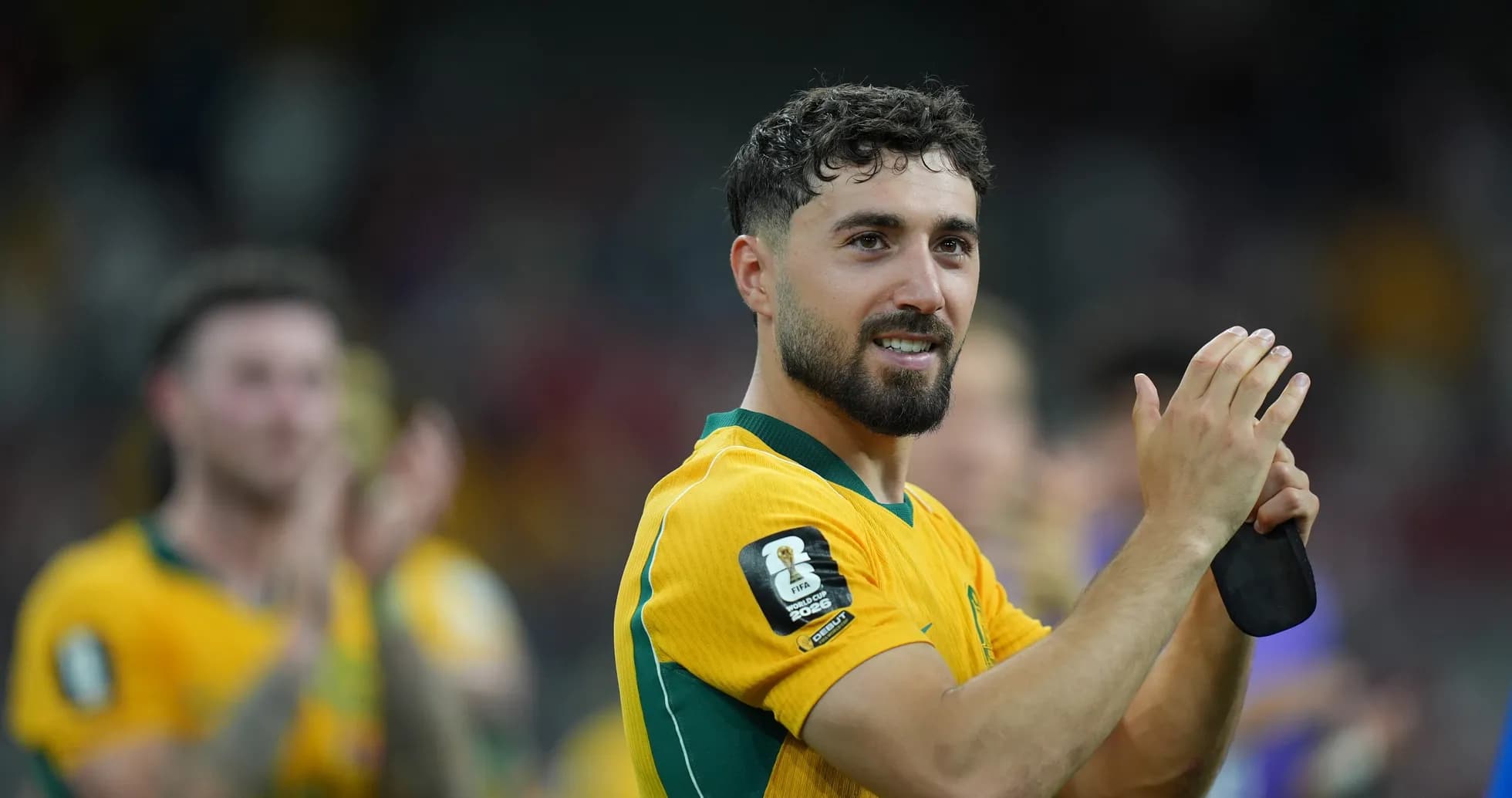
Alessandro Italiano, who had quietly become one of Tony Popovic’s most important players, is set to miss the crucial group clash with Paraguay through injury. Having already lost Mat Leckie, Popovic now heads into a do-or-die game without the right wing-back who has effectively owned that flank so far in the tournament.
Italiano stepped in for the injured Lewis Miller and never looked back. He helped shut out Turkiye on Matchday 1 with an industrious, disciplined performance, then went the full 90 against the USA in Seattle. Two starts, two lung-busting shifts. Now, suddenly, he’s gone.
That absence lands at a tense moment.
Against the USA, Australia retreated deep, invited pressure and paid the price – two first-half goals conceded and a game that looked lost before it had really begun. Only when Connor Metcalfe, Nestory Irankunda and Cristian Volpato were unleashed after the break did the match tilt. The energy flipped, the tempo changed, and the Americans were finally forced backwards.
Popovic is naturally cautious. That’s not a criticism; it’s his coaching DNA. But former Socceroo Craig Foster wants to see the handbrake loosened in this final group game.
“I hope so (that they attack), but they're a little bit more cautious under Tony Popovic, that’s the way that he coaches, that’s the reality,” Foster told 1170 SEN Breakfast, before immediately acknowledging the coach’s record. Automatic qualification, something Australia had been chasing for years, sits firmly in Popovic’s favour.
The warning, though, was clear. Against the USA, caution almost killed them.
“If you're a bit too cautious and you go behind, it's very difficult to get back into the game. So hopefully he's learned from that, and I'm sure he has,” Foster said.
He wants aggression. He wants speed. He wants the kids.
“I don't think he's going to go with full attack in the first half, but I certainly hope that he does put the young really quick guys on anyway,” Foster added. Volpato’s brief cameo, he argued, should be impossible to ignore.
“He showed enough in that short cameo… he was phenomenal. I mean, that has to make a statement to the coach. It has to. So, I'd be surprised if we didn't see him and Irankunda in the first half definitely.”
The formula is simple: get ahead of Paraguay, then trust the defensive structure that has already proved hard to break down – “like Ghana were this morning,” Foster noted. But to get ahead, you need chances. To take chances, you need your best attackers on the pitch.
Popovic now has a choice: double down on control, or lean into the chaos his young forwards can create.
Colombia climb, Congo cling on
Elsewhere, Group K has found its leader.
Right-back Daniel Muñoz delivered the decisive moment, thundering forward to score the only goal of the game in the 76th minute and send Colombia top of the group with six points. Efficient, composed, ruthless when it mattered.
Congo, by contrast, are surviving on hope. With just one point to their name, they are hanging on “by the skin of their teeth”, still alive only because a win over Uzbekistan on Sunday could yet drag them into the last 32 as one of the best third-placed sides.
Their margin for error has evaporated. One game, one result, or the plane home.
Bellingham, Queiroz and a flashpoint in Boston
Boston delivered a World Cup stalemate that felt like a missed opportunity and almost boiled over into something more.
A scrappy, frustrating 0-0 draw – sub-par by any measure – ended with Jude Bellingham and Carlos Queiroz locked in a heated exchange as the players left the pitch. The flashpoint came after Bellingham’s heavy challenge on Jerome Opoku right in front of the dugouts, a tackle that might easily have drawn a card.
Queiroz, never one to shy away from confrontation, was incensed by what he heard from the England star.
“He had a bad reaction with some bad names,” the coach explained afterwards. He insisted his first instinct had been to calm the situation, worried for his player’s condition after Bellingham went in with his foot. Then came the words, the swearing, and with it a spike in tension.
“In the middle of the emotional moment these things are normal,” Queiroz said. “It's football, it's nothing special. One word created a bit of fire but we cooled down. Football is not dancing in a saloon with tuxedos. It's not a show.”
Bellingham’s version was more self-critical than combative.
“It was just when I made a silly tackle, to be honest,” he admitted. He said he had tried to win the ball, followed through and caught his opponent, then spoke to him afterwards. The reaction from the opposing bench, he felt, was aimed at getting him booked.
Queiroz, though, was recognised instantly.
“He's obviously the one who used to be at Manchester United, so great respect, and nothing but a competitive edge for both of us,” Bellingham said.
The game itself left both sets of supporters short-changed, but the subplot told its own story: a young star on the edge, an old tactician unflinching, and a World Cup group still finely poised.
Ghana’s double-decker and England’s stutter
If England’s 4-2 win over Croatia had hinted at something expansive and fearless, the goalless grind against Ghana at Foxborough dragged them back into the mud.
For 95 minutes, Ghana parked the bus – and then parked another one behind it. Deep block, endless duels, relentless physicality. The referee team struggled to impose any rhythm, dishing out decisions that angered both sides and let the contest descend into a tangle of fouls and frustration.
England never solved it. No real chances of note, no incision through the middle, no sustained pressure that truly rattled Ghana’s wall. Declan Rice’s yellow card summed up the mood: a challenge born more of exasperation than tactical necessity.
The result leaves England and Ghana level on four points, with England top of Group L only on goal difference. It also leaves a nagging question about Gareth Southgate’s side: what happens when the opposition refuses to play?
Micah Richards didn’t sugar-coat it.
"The frustrating thing was that England weren't brave enough," he said. He pointed to the safe passing, the unwillingness to take risks against a low block. When a team sits deep, you either force the issue or you stagnate. England, on this night, did the latter.
Harry Kane, so influential against Croatia, found himself shackled.
"I was kind of man-marked there with (Thomas) Partey for a lot of the games," he told the BBC. The space he loves – dropping deep to link play, then arriving late in the box – simply never opened up. Ghana defended the area superbly, crowding the box and making crosses a lottery.
"We had plenty of crosses, but just couldn't quite get the first contact," Kane said. The middle of the pitch was “so compact” that threading passes through felt almost impossible. He sensed the game improved as England’s wide players started winning one-v-one duels, but the breakthrough never came.
Wayne Rooney, who knows Queiroz and his defensive structures better than most, called it a typical display from a side drilled by the veteran coach.
"These games are so difficult when the teams sit back," Rooney said. For him, the key lay in delivery from wide areas; that’s where England’s few real openings emerged. His message, though, was to hold the nerve: England still have a strong chance to top the group, and negativity, he argued, helps no one.
Croatia, meanwhile, have quietly dragged themselves back into contention. Their first win of the tournament has lifted them to third in Group L on three points, just one behind England and Ghana. Beat Ghana on June 28 and they’re through. Draw, and they’re still alive as a potential third-placed qualifier.
Panama, already eliminated, will play for pride against England on the same day. For Southgate’s side, that game suddenly carries a sharper edge.
Penalty shoot-outs get a new twist
Beyond the group-stage intrigue, FIFA is preparing to tweak one of football’s most nerve-shredding rituals.
Currently, penalty shoot-outs are preceded by two coin tosses: one to decide which end the kicks are taken into, and another to determine who shoots first. It’s a system that can leave one team feeling doubly disadvantaged – as Arsenal discovered in their Champions League final shoot-out against PSG, when they lost both tosses, kicked second and faced a wall of opposition fans.
FIFA wants to level that psychological playing field.
From the last 32 stage of this World Cup, there will be a single coin toss. The winner chooses either to kick first or to select the end. The other captain gets whatever decision is left.
The structure of the shoot-out itself remains untouched. If a knockout game is level after 90 minutes and 30 minutes of extra time, penalties will still decide it. But the balance of power at the toss now shifts, just a little, back towards fairness.
Ronaldo roars back as Portugal hit five
Cristiano Ronaldo arrived at this World Cup under a cloud.
A 1-1 draw with DR Congo in Portugal’s opener triggered familiar questions: at 41, should he still start? Was Roberto Martinez too loyal, too fearful of the backlash if he left out a legend?
Against Uzbekistan, Ronaldo answered with the one argument no one can ignore – goals.
His two strikes in a 5-0 demolition job not only silenced the doubters, they all but sealed Portugal’s passage to the knockout rounds. The performance came on the back of a remarkable run of individual brilliance across the tournament, with Lionel Messi, Kylian Mbappé and Erling Haaland all scoring braces the previous day.
Ronaldo framed his response as the product of stubborn belief.
“I knew it. God helps those who work hard,” he said. He spoke of a “difficult, dark week,” a feeling of being treated as if he were already retired, and of clinging on through faith in hard work over reputation. It was raw and revealing – a superstar still fighting the perception that time has passed him by.
Roy Keane never bought the idea that Ronaldo had gone.
“Cristiano Ronaldo was never gone. He is the man,” the former Manchester United captain insisted. He likened Ronaldo’s enduring greatness to Tom Brady’s, placing him among the elite across all sports. For Keane, the finishing remains the hardest part of the game, and Ronaldo still does it better than almost anyone.
“Again, he has joined the party,” Keane said. On this evidence, Portugal intend to stay at it deep into the night.
Grief in the France camp
Amid the noise and colour of the tournament, France have been struck by personal tragedy.
Didier Deschamps has left the national team camp after the death of his mother. The French Football Federation confirmed he will miss training sessions and will not be on the bench for Friday’s final Group I match against Norway.
“In agreement with Philippe Diallo, president of the French Football Federation, who is currently at the France team’s base camp, Deschamps has entrusted assistant coach Guy Stephan with responsibility for leading the squad until his return,” the FFF said.
France must now navigate the remainder of the group stage without the man who has shaped their modern era, all while their coach deals with loss far beyond football.
US ambition meets a brutal verdict
Across the Atlantic, the USA’s World Cup swagger has been hard to miss. Big talk, bold claims, a sense that this might finally be their moment on the global stage.
Tim Howard isn’t buying it.
The former national team goalkeeper cut through the noise on the Unfiltered Soccer Podcast, calling it “literally impossible” for the US to win this World Cup.
“The US cannot, unequivocally, win the World Cup,” he said, arguing that they would need to play the greatest game in their history four times in a row to navigate the round of 16, quarter-finals, semi-finals and final against a gauntlet of global heavyweights.
“They’re going to have to beat (four) world soccer powerhouses in a row… It is literally impossible for the US to win the World Cup… That’s just the reality.”
Harsh? Maybe. Honest? Definitely. And it lands just as the US team’s trash talk has started to grate on neutrals, especially after their bruising, bad-tempered clash with Australia.
Howard’s words strip the conversation back to something simple: talent, depth, experience, and the ruthless demands of tournament football. Belief alone won’t be enough.
The group stages are nearing their tipping point now. Coaches under pressure, stars answering or dodging the questions thrown at them, and nations like Australia, Croatia and Congo staring down the barrel of defining games.
World Cups don’t wait for anyone. Who bends, who breaks, and who finds another gear when the stakes spike again in the last 32?